Esprit Logo History: The Stencil Lettering

Esprit grew out of Plain Jane, a dress label that Susie Tompkins and Jane Tise sold from the back of a Volkswagen bus in San Francisco in the late 1960s. By the late 1980s the stencil-cut “ESPRIT” logo that designer John Casado drew for the company was printed across sweatshirts and bags worn by teenagers around the world. The company later moved its headquarters to Hong Kong and Germany, collapsed in a wave of insolvencies in 2024, and now survives mainly as a brand licensed out to other firms.
What does the Esprit logo mean?
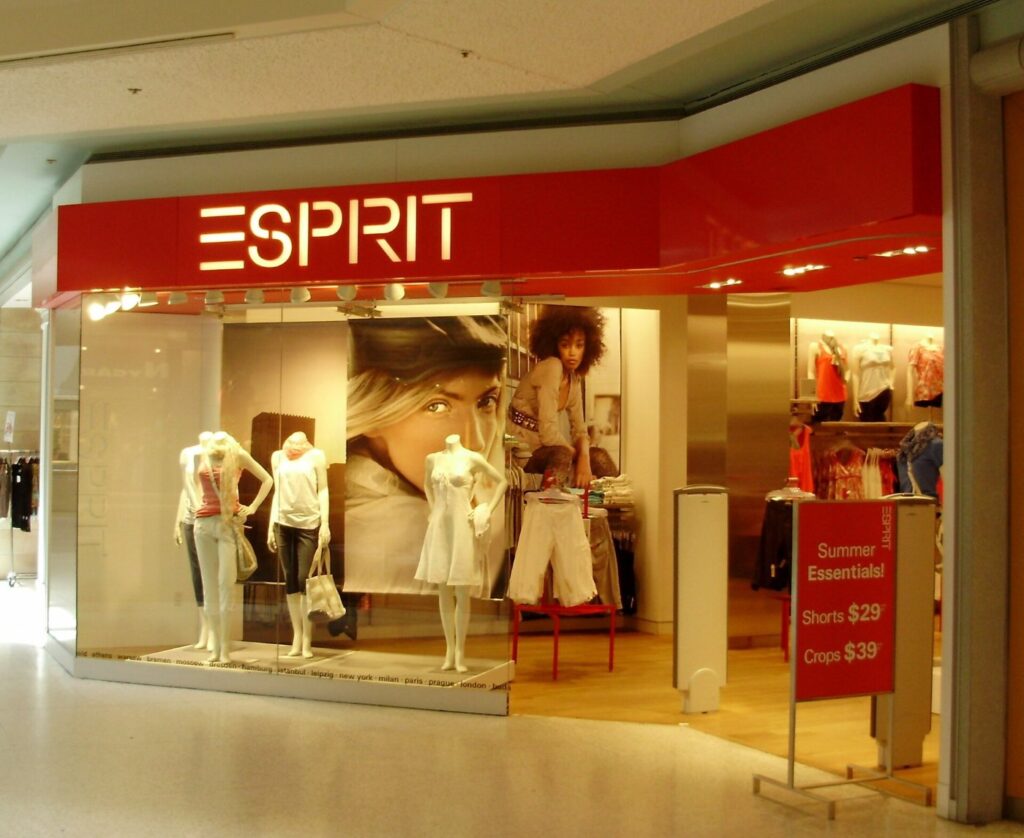
“Esprit” is French for spirit, wit or liveliness, and the company’s full original name, Esprit de Corp, was a pun on “esprit de corps,” the sense of team spirit inside a group. Casado started from Helvetica, the plain Swiss typeface, then cut gaps into the letters like a stencil, shortened the “R” and broke up the “E” so that it reads as three separate bars. The result looks like lettering sprayed through a template onto a crate or a wall.
Colour was part of the idea from the start. Early versions printed each of the six letters in a different colour, which matched the sunny, mix-and-match Californian clothes, and in 1987 an overlapping version gave the wordmark a sense of movement, with the letter colours changing every season to follow the collection’s palette. Casado also drew three weights of the logo and a matching display typeface, and simple shapes such as circles, triangles and squares were added to tags, T-shirts and shop signs.
Has the Esprit logo changed over time?
The Casado wordmark has stayed at the heart of the brand since the end of the 1970s (sources give 1978 or 1979), replacing an earlier wordmark tied to 1970s style. What changed was everything around it. In later years Esprit dropped the playful extras and printed the logo in a single colour, often red or black, and around 2012 it opened up the spacing between the letters.
In 2020 the brand worked with Natasha Jen of the design studio Pentagram on a new identity. She redrew the logo, extended Casado’s stencil typeface, which had been capitals only, with lowercase letters, and created Esprit’s first monogram. The new colour system used two or three seasonal base colours accented by their opposites on the colour wheel, an attempt to bring back some of the old cheerfulness inside a much simpler look.
Who founded Esprit?
Susie Tompkins (later Susie Tompkins Buell) started the business with her friend Jane Tise, and her husband Doug Tompkins, who had earlier been involved in founding the outdoor brand The North Face, joined to build it into Esprit de Corp. The company’s first office was the couple’s apartment. Esprit grew fast in the 1970s and 1980s with bright, casual clothes for young women, eye-catching catalogues and advertising campaigns by photographer Oliviero Toscani, and a large headquarters in San Francisco’s Dogpatch district. In a city that also produced Gap, Esprit was the louder, more colourful option.
The brand’s logo sweatshirts became a fixture of late-1980s and early-1990s youth fashion, and they have come back as vintage favourites since. In 2002 the San Francisco company sold its U.S. trademark rights to Esprit Holdings, which had long run the brand outside America. Esprit Holdings, listed in Hong Kong and with a large operating base in Ratingen, Germany, was now the centre of the business, selling through hundreds of stores in Europe and Asia and competing on the high street with chains such as Zara and H&M.
What happened to Esprit?
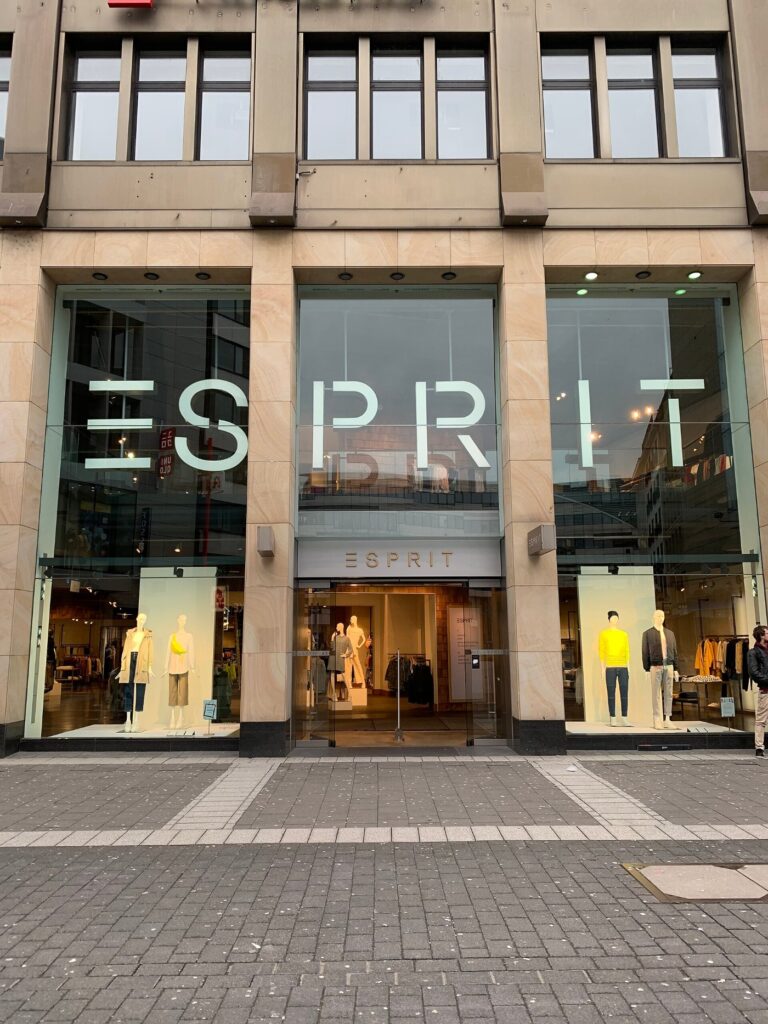
After years of falling sales, Esprit’s European operations collapsed in 2024. Franchises in Switzerland and Belgium filed for bankruptcy in the spring, Esprit Europe and several other companies entered insolvency in May, and the U.S. subsidiaries filed for Chapter 7 in October. In August 2024 the British investor Alteri, owner of the German fashion group CBR, bought the rights to the brand in Europe without taking over the stores, and all 56 Esprit shops in Germany closed by the end of the year.
Esprit Holdings now runs a licensing business. In the first half of 2025 it had about 38 staff, it signed a new licensing partner for China and one for North America, renewed its Latin American licence, and stopped operating in Canada. Shoes are coming back too: Deichmann took over the Esprit footwear licence in October 2024, and its Cologne-based unit Urbn Concepts is launching a new Esprit shoe range for autumn/winter 2026.
Quick facts
| Founded | 1968, San Francisco, United States |
| Founders | Susie Tompkins, Jane Tise and Doug Tompkins |
| Original names | Plain Jane, then Esprit de Corp |
| Logo designer | John Casado (late 1970s) |
| Logo update | Natasha Jen, Pentagram (2020) |
| Company | Esprit Holdings Limited, Hong Kong (SEHK: 330) |
| European brand rights | Alteri (since 2024) |