Escada Logo History: The Munich Fashion House

Escada took its name from an Irish racehorse that Margaretha and Wolfgang Ley liked to bet on, and the Munich label they launched in the late 1970s became the uniform of 1980s power dressing, with bright colors, bold knitwear and a monogram of two letters “E” joined back to back. That double “E” still sits beside the thin capital “ESCADA” wordmark today, after two insolvencies, three sets of owners and a string of attempts to bring the brand back.
What does the Escada logo mean?
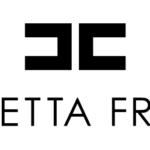
The logo has two parts. The emblem is a pair of bold serif capital “E”s, one reversed so that they face each other, with their top and bottom bars joined into one shape; the empty space between them forms a pattern of its own. Next to it, the word “ESCADA” is set in widely spaced, thin geometric capitals similar to Futura. On the brand’s website both parts appear in black, although Escada has also used the logo in gold for much of its history.
The double “E” is simply the first letter of the name doubled and mirrored, a classic way of making a monogram that looks the same from either side. It became a status mark in the 1980s and 1990s, and vintage Escada garments are still easy to spot by the “EE” on their labels and details. The light, airy wordmark balances the heavy monogram and gives the brand a cleaner, more modern face than its glitzy reputation might suggest.
Has the Escada logo changed over time?
Yes, though the core letters have stayed close to the original. For most of its history Escada used an uppercase sans-serif wordmark together with the mirrored “EE” monogram, often in gold and white. Around 2015 the brand dropped the monogram from its main logo and used only the lettering in a medium-weight black sans-serif. From about 2018, around the house’s 40th anniversary, the wordmark was redrawn in a lighter, thinner typeface, and the double “E” returned as a separate emblem that can sit beside, above or below the name.
Who founded Escada?
Margaretha Ley was a Swedish former model who had worked as a house mannequin for Jacques Fath and Christian Dior, trained with a royal court tailor in Stockholm and became head designer at the German label Mondi. Her husband Wolfgang Ley ran a knitwear factory in Munich, which she also managed. The couple began the business in 1976 and showed their first full women’s collection under the Escada name in 1978, the year the company now gives as its founding date.
Escada grew quickly on the strength of its colorful knitwear, tailoring and evening wear, went public in 1986 with the Ley family keeping a majority of the votes, and added the more casual Escada Sport line. Margaretha Ley died in 1992, and from 1994 the Scottish designer Brian Rennie led the creative side, giving the brand a younger look. At its height Escada competed for the same well-dressed customers as Carolina Herrera, while at home in Germany its peers were Hugo Boss, with its younger Boss Orange line, and the menswear label Baldessarini.
Who owns Escada today?
The company filed for insolvency in Munich in August 2009, and later that year it was bought by the family of steel magnate Lakshmi Mittal, reportedly for about 70 million euros, with his daughter-in-law Megha Mittal as chair. Under the Mittals, Escada returned to the runway in New York in September 2018 with a 40th-anniversary show by new design director Niall Sloan, and in 2019 the British designer Emma Cook took over creative direction.
In 2019 the Mittals sold Escada to Regent, a US private equity firm, and in September 2020, during the pandemic, the German operating company filed for insolvency again and scaled back its stores. The brand has continued under Regent’s ownership, selling its collections online, including a spring/summer 2026 line, while Escada fragrances continue to be sold under license.
Quick facts
| Founded | 1978 (business started 1976), Munich, Germany |
| Founders | Margaretha and Wolfgang Ley |
| Name | An Irish racehorse the founders bet on |
| Logo | Mirrored double “E” monogram and thin capital wordmark |
| Known for | Colorful 1980s and 1990s womenswear, knitwear, evening wear |
| Owners | Ley family and public shareholders, Mittal family (2009), Regent (2019) |