Emilio Pucci Logo History: The Florence Fashion House

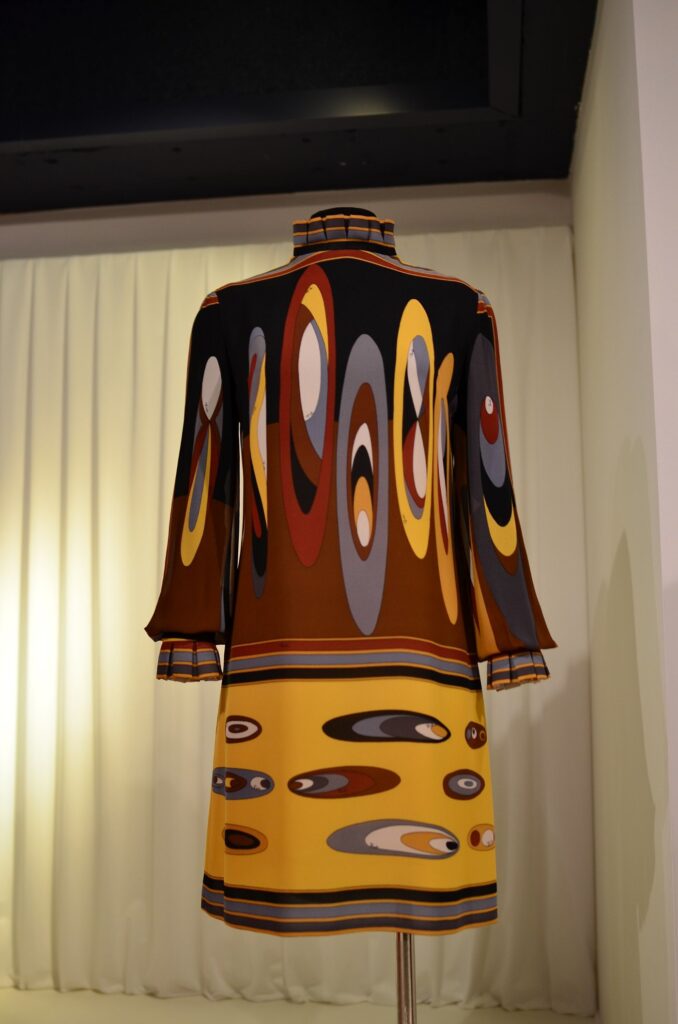
Emilio Pucci was a Florentine aristocrat and keen skier whose ski outfits, made for the Reed College team in Oregon and photographed for Harper’s Bazaar in the late 1940s, launched one of Italy’s most colorful fashion houses, famous for swirling, many-colored silk prints. Today the house belongs entirely to LVMH, has shortened its name to simply “Pucci,” and uses a crisp, high-contrast serif wordmark with no symbol at all.
What does the Pucci logo look like?
The current logo spells “PUCCI” in black capital letters in a classic, high-contrast serif, with very thin hairlines and heavy vertical strokes. Up close, the letters have small distinctive touches, such as triangular, wedge-shaped serifs, which give the type a slightly calligraphic, hand-cut feel. There is no emblem and no color, which is a deliberate contrast: the brand’s prints are loud, so the logo stays quiet.
Plenty of old European couture houses use a serif wordmark like this, so the logo fits in with its neighbors on a shopping street. Dropping “Emilio” made the name shorter and easier to fit on labels, bag hardware and phone screens, and the family surname is still the whole logo.
Has the Pucci logo changed over time?
Yes, mostly in the name and the extras rather than the lettering. From the early 1950s the house used “EMILIO PUCCI” in black serif capitals with long, sharp, thin serifs on a plain background. Around 2012 it added an ornate monogram: an “E” between two mirrored, back-to-back “P”s, with curving bars that looked a little like a butterfly, topped by a crown, fitting for a family of marquesses.
In 2021, the year LVMH took full ownership, the brand began presenting itself simply as Pucci. The monogram was removed from the main logo, leaving the single word “PUCCI” in a typeface close to the one used before. The result is cleaner and more modern, but still recognizably the same house.

Who was Emilio Pucci?
Emilio Pucci (1914 to 1992) was born in Naples and spent much of his life at the Pucci family palace in Florence. He studied at the University of Georgia, Reed College and the University of Florence, and flew bombers for the Italian Air Force during the Second World War. His skiwear caught the eye of Harper’s Bazaar in 1947 and 1948, and he is credited with one of the first one-piece ski suits. He went on to open a boutique on Capri and moved into swimwear, silk scarves, dresses and lingerie, with prints worn by Sophia Loren, Jackie Kennedy and, later, Madonna. Marilyn Monroe was buried in a Pucci dress.
His designs reached well beyond fashion: he created uniforms for Braniff Airways from 1965 to 1974 and special editions of the Lincoln Mark car from 1976 to 1983. He also had a political career, serving in the Italian Chamber of Deputies for the Liberal Party from 1963 to 1972.
Who owns Pucci today?
LVMH bought 67% of the company in 2000 and the remaining 33% from the Pucci family, including the founder’s daughter Laudomia Pucci, in June 2021. Creative directors since the takeover have included Christian Lacroix, Matthew Williamson, Peter Dundas and Massimo Giorgetti, and Camille Miceli has led the design side since 2021, staging her first Pucci show in Florence in May 2023. In October 2026 LVMH named Clara Boissonnas, a leather goods director at Louis Vuitton, as Pucci’s chief executive from 1 January 2027, succeeding Saar Debrouwere. Pucci now sits in the same group as Fendi, Loewe and Givenchy.
Quick facts
| Founder | Emilio Pucci (1914 to 1992) |
| Founded | Late 1940s, Florence (skiwear first shown in Harper’s Bazaar, 1947 to 1948) |
| Known for | Bold, many-colored geometric silk prints |
| Owner | LVMH (67% from 2000, 100% since June 2021) |
| Creative director | Camille Miceli (since 2021) |
| CEO | Clara Boissonnas (from January 2027) |
| Logo | “PUCCI” in high-contrast black serif capitals since 2021 |