Carolina Herrera Logo: The CH Monogram Explained

Carolina Herrera was still a Venezuelan socialite with no formal fashion training when she moved to New York in 1980 and, the following April, staged her debut collection inside Manhattan’s Metropolitan Club with supermodel Iman on the runway — the first fashion show the exclusive venue had ever allowed within its walls. Within months Women’s Wear Daily and Tatler were praising her tailoring, and a clientele that would eventually include Jacqueline Kennedy Onassis and multiple First Ladies began forming around a house that Spanish beauty conglomerate Puig would first license for fragrances in 1988 and then buy outright in 1995.
Meaning and History
Carolina Herrera (born María Carolina Josefina Pacanins y Niño in 1939) founded her namesake fashion house in New York in 1980, debuting her first collection at the Metropolitan Club in April 1981. Her design instincts traced back to a socialite upbringing in Caracas, where her grandmother had introduced her to haute couture through Balenciaga shows and Lanvin and Dior purchases. The label built its reputation on sharp, architectural sleeve construction and refined eveningwear, quickly attracting press acclaim and a clientele of First Ladies and Hollywood figures. Puig began licensing the Carolina Herrera name for perfumes in 1988 and acquired the full fashion business in 1995, growing the fragrance division to more than 25,000 retail points worldwide by 2016. Herrera’s own daughters joined the creative team starting in 2011, and after presenting her final collection in 2018, she handed creative direction to American designer Wes Gordon.
Logo Symbolism Analysis
Carolina Herrera’s branding has always rested on the designer’s own name rendered in a refined serif typeface, with the current emblem distilling that identity down to a two-letter monogram: a red “C” paired with a black “H.” That single splash of red against an otherwise monochrome mark was chosen specifically to signal passion and luxury, letting one color do the emotional work in an identity that is otherwise deliberately restrained.
Logo History Timeline
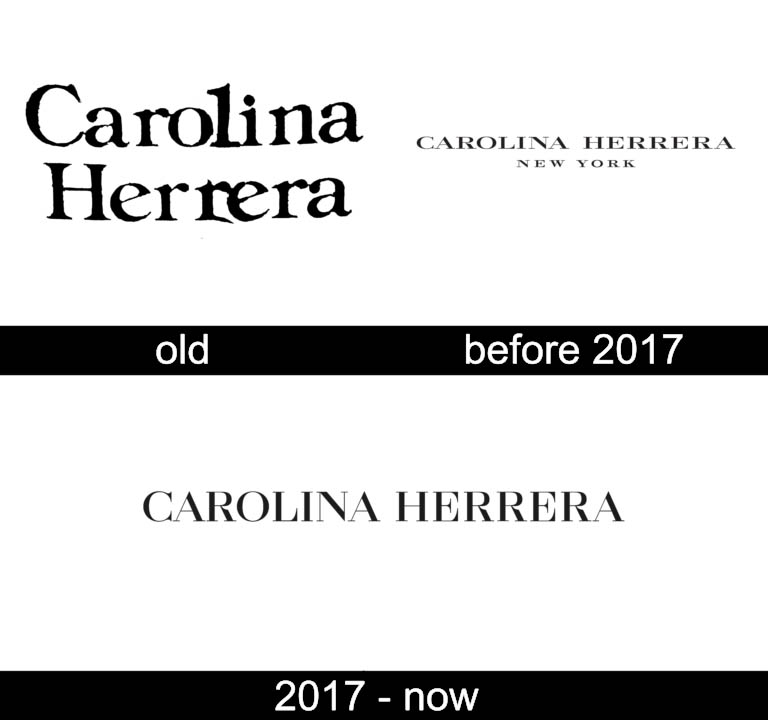
Original version: A bold, two-level inscription in a classic serif typeface, rendered entirely in black with no additional framing or symbol.
Version used until 2017: The brand name appeared in extended uppercase serif lettering on the top line, with “New York” set in smaller capitals beneath it, preserving the two-tier structure of the original.
Current version (2017–present): A redesigned wordmark set in Didot — the same elegant serif typeface used by Vogue — with “New York” again placed beneath it in matching type, now paired with a separate “CH” monogram emblem in red and black.
Typography and Visual Construction
The shift to Didot in 2017 aligned Carolina Herrera’s wordmark with one of fashion’s most recognizable typefaces, trading the house’s earlier extended serif lettering for something more closely associated with high-fashion publishing. Alongside the wordmark, the brand introduced a standalone “CH” monogram — a clean, serif-set initial mark that functions as a compact badge for packaging and smaller applications where the full “New York” wordmark would be impractical.
Colors
Carolina Herrera keeps its wordmark in black, reserving color for the “CH” monogram alone, where a red “C” sits beside a black “H.” That restraint mirrors the brand’s broader aesthetic of polished, eveningwear-driven elegance, where a single deliberate accent color carries more weight than a crowded palette would.
Heritage and Brand Positioning
From a single runway show inside a Manhattan club that had never before hosted one, Carolina Herrera grew into a house whose clothes have dressed First Ladies and whose fragrances now reach more than 25,000 retail points worldwide under Puig’s ownership. The 2017 move to a Didot wordmark and red-and-black monogram marked the brand’s transition from founder-led house to an institution built to continue past her, a shift formalized the following year when Herrera stepped back from the runway and passed creative direction to Wes Gordon.
Frequently Asked Questions
Who founded Carolina Herrera?
Carolina Herrera founded her namesake fashion house in New York in 1980, debuting her first collection in April 1981.
Who owns Carolina Herrera today?
The Spanish company Puig has owned Carolina Herrera’s fashion business since 1995, after first licensing the name for fragrances in 1988.
What does the Carolina Herrera “CH” logo mean?
The monogram pairs a red “C” with a black “H,” a single accent color chosen to convey passion and luxury.
Who is Carolina Herrera’s current creative director?
Wes Gordon has led creative direction since 2018, when Carolina Herrera presented her final collection for the house.