Boss Orange Logo: Hugo Boss’s Casual Line Explained
Hugo Boss launched a casual menswear line called Boss Sport in 1998, rebranded it Boss Orange, and grew it into a genuine business of its own — by 2009 it accounted for roughly 17% of the entire company’s sales — before winding the label down starting in 2016 and folding its remaining pieces back into the main Boss Collection by early 2018. The orange-accented wordmark that identified it for two decades didn’t disappear entirely; casual Boss pieces today are still marked with a simple orange line on the label, a quiet holdover from a sub-brand that once stood on its own.
Meaning and History
Boss Orange traces back to Hugo Boss AG, the German fashion house Hugo Ferdinand Boss founded in 1924 in Metzingen, Germany, after taking over his parents’ clothing retail business and registering it as a manufacturing company. In 1998, Hugo Boss introduced a casual wear line under the name Boss Sport, aimed at offering a more relaxed aesthetic than the formal tailoring of the main Boss Black line; the line was soon renamed Boss Orange. The brand expanded into womenswear in 2006 and grew into a meaningful part of Hugo Boss’s business, representing around 17% of total company sales by 2009. Under a strategic realignment led by new company leadership, Boss Orange began winding down in 2016 and was fully discontinued by early 2018, with its casual pieces absorbed into the main Boss Collection rather than kept as a standalone label.
Logo Symbolism Analysis
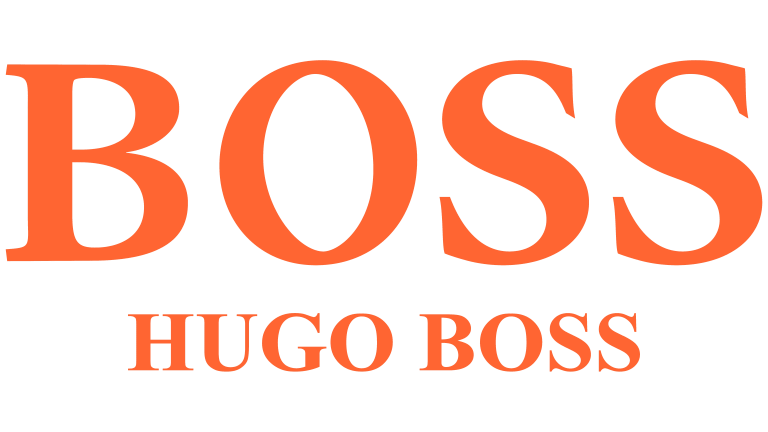
The Boss Orange identity leaned entirely on color and simplified typography rather than any elaborate emblem, using a straightforward sans-serif rendering of “Boss Orange” — sometimes paired with the “Hugo Boss” name — that was deliberately less ornate than the parent company’s primary logo treatment. In its later years, the wordmark incorporated a small pictogram inspired by the shape of an orange on its left side, a literal visual cue reinforcing the sub-brand’s name and its position as the more playful, casual counterpart to Hugo Boss’s formal tailoring.
Typography and Visual Construction
Boss Orange used a clean, straightforward sans-serif typeface, intentionally simpler than the more polished wordmark associated with the main Hugo Boss brand, reflecting the line’s relaxed positioning within the company’s broader portfolio. The addition of the orange-shaped pictogram alongside the text gave later versions of the logo a small illustrative anchor, distinguishing it at a glance from other Hugo Boss sub-labels like the sportier Boss Green line.
Colors
Orange was the defining color of the brand, chosen to match its name and to visually separate it from the black-and-white palette long associated with Hugo Boss’s core menswear line. That same orange survives today in a small way: casual Boss Collection pieces descended from the old Boss Orange line are still marked with a simple orange line on the label, much as former Boss Green pieces now carry a green one.
Heritage and Brand Positioning
Boss Orange occupied a specific niche within the Hugo Boss portfolio for two decades: a casual, more accessible counterpart to the formal tailoring the parent brand built its reputation on since 1924. Its growth to nearly a fifth of total company sales by 2009 shows how significant that casual positioning became before the company chose to consolidate its labels rather than keep expanding them. Rather than treating Boss Orange’s 2018 discontinuation as an ending, Hugo Boss folded its identity into the main Boss Collection, preserving the orange color coding as a subtle nod to the sub-brand’s legacy.
Frequently Asked Questions
When was Boss Orange founded?
Boss Orange launched in 1998 as Boss Sport, a casual line from Hugo Boss, and was later renamed Boss Orange.
Does Boss Orange still exist as a brand?
No. Hugo Boss discontinued Boss Orange by early 2018, folding its casual pieces into the main Boss Collection.
What did the Boss Orange logo look like?
It used a simple sans-serif “Boss Orange” wordmark, sometimes paired with “Hugo Boss” lettering, later joined by a small orange-shaped pictogram.
How is Boss Orange represented today?
Casual pieces in the current Boss Collection are marked with an orange line on the label, a holdover from the discontinued Boss Orange brand.