Scripps-Booth Logo: The Early American Carmaker
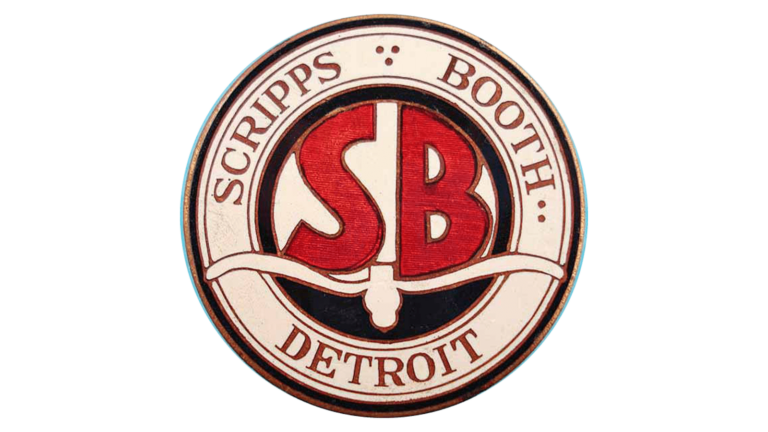
Scripps-Booth belongs to a fascinating, largely forgotten tier of American automotive history: the ambitious independent marques of the 1910s, founded on genuine design innovation, that General Motors absorbed and then quietly dissolved within a decade. Its story is less about a logo evolving over generations and more about a distinctive identity that flared briefly and then disappeared, a pattern common to many of the era’s smaller manufacturers.
Meaning and History
Founded in 1913 by James Scripps Booth, a member of the influential Scripps newspaper publishing family, the company set out to build small, stylish automobiles that stood apart from the heavier, more utilitarian vehicles common at the time. Its early “Cyclecar” model drew particular attention for distinctive design touches, including a round radiator grille that broke from the rectangular convention most manufacturers favored — a detail emblematic of the company’s broader design philosophy, prioritizing style and novelty within the compact, mid-range segment it occupied.
That independence was short-lived. Chevrolet acquired Scripps-Booth in 1916, and the company became a fully owned General Motors subsidiary the following year, in 1917. Despite the backing of a major manufacturer, Scripps-Booth struggled to hold its position in an increasingly competitive early automotive market, and General Motors discontinued the line entirely by 1922 — less than a decade after Booth had founded it.
Brand and Design Identity
Operating in the 1910s, Scripps-Booth’s visual identity reflected the design conventions of America’s earliest mass-market automotive era: a company name rendered prominently as the primary identifying mark, in keeping with how young manufacturers of the period typically built recognition — through the founder’s or family’s name itself, rather than through abstract emblems or illustrated symbols, which became more common industry-wide only in later decades. The round radiator grille that distinguished the Cyclecar model functioned almost as a brand signature in its own right, a physical design element as recognizable as any badge, at a time when a car’s silhouette and mechanical details often carried as much identifying weight as its formal logo.
Heritage and Brand Positioning
Scripps-Booth’s brief nine-year run — independent founding to GM discontinuation — makes it a representative case study in the fate of many early-1900s American automotive ventures: genuine design ambition and a distinctive point of view, absorbed into a larger conglomerate’s portfolio, and ultimately unable to justify its continued existence once that conglomerate needed to rationalize its lineup. The Scripps family’s publishing background lent the venture credibility and capital that many contemporaneous cyclecar makers lacked, but even that advantage wasn’t enough to secure the brand’s long-term survival within General Motors’ expanding structure.
Frequently Asked Questions
Who founded Scripps-Booth?
James Scripps Booth, a member of the Scripps publishing family, founded the company in 1913 in Detroit, Michigan.
When did Scripps-Booth become part of General Motors?
Chevrolet acquired the company in 1916, and it became a fully owned General Motors subsidiary in 1917, before being discontinued in 1922.
What made the Scripps-Booth Cyclecar distinctive?
Its round radiator grille broke from the rectangular convention typical of the era, becoming one of the model’s most recognizable design features.
Why did Scripps-Booth stop production?
Despite General Motors’ backing, the brand struggled to compete in the increasingly crowded early automotive market and was discontinued in 1922, less than a decade after its founding.