Dodge Demon Logo Explained
Some automotive emblems exist to represent a brand. The Dodge Demon logo exists to represent a single, specific machine — and it does so without a single letter of text. In an industry where most badges lean on wordmarks or stylized initials, Dodge chose to let a snarling demon’s head speak entirely for itself, a decision that says as much about the car’s positioning as anything written in a press release.
Meaning and History
The Demon nameplate is not new to Dodge. It first appeared in 1971 on the compact Dodge Dart Demon, a short-lived model that lasted only about a year before religious and consumer objections to the name pushed Dodge to retire it. When the badge resurfaced in 2017 for the 2018 model year, it was attached to something entirely different: a limited-run, drag-strip-focused variant of the Dodge Challenger, engineered specifically to dominate quarter-mile runs rather than to serve as everyday transportation.
Production was deliberately scarce — 3,300 units for the United States and 300 for Canada — which turned the Demon into an instant collector’s item. Dodge backed the car’s drag-racing identity with genuine hardware: launch control, a dedicated Drag Mode suspension calibration, trans-brake functionality, and an optional “Demon Crate” that shipped owners drag radials, a floor jack, and race-prep tools alongside the car itself. Widebody fenders, functional hood scoops, and an oversized rear spoiler completed a car built to look exactly as extreme as its numbers suggested.
Logo Symbolism Analysis
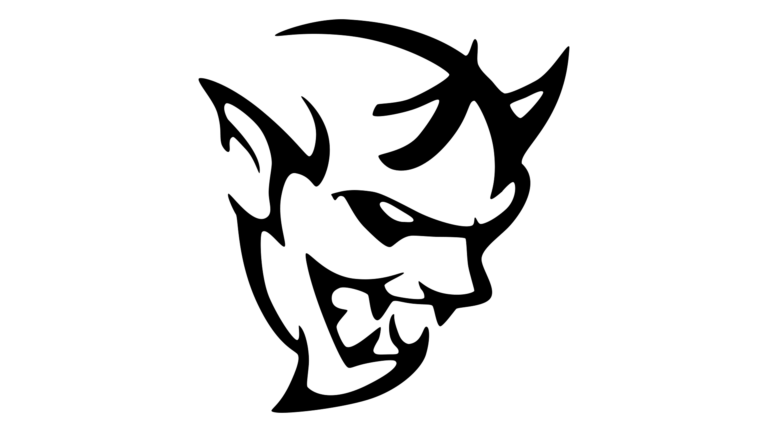
The demon’s head is drawn with thick, angular black linework — sharp horns, elongated ears, bared teeth, and a slightly tilted, rightward-facing pose that gives the whole mark a sense of coiled aggression rather than a static portrait. Nothing about the illustration is soft or rounded; every line reinforces intimidation.
That choice of subject matters as much as the execution. Where badges built around shields or crests borrow authority from heritage and tradition, a demon borrows something different: rebellion, danger, and a refusal to be tamed. It positions the car outside the more genteel language of performance branding and squarely inside the culture of drag strips and muscle-car defiance — a fitting emblem for a vehicle engineered to do one thing, as fast as physically possible.
Typography and Visual Construction
There is no wordmark at all — a deliberate omission. Black is the only color used for the illustration itself, set against a plain white field, a combination chosen for maximum contrast and legibility at the small scale of a fender badge. Black carries dual meaning here: it signals boldness and aggression on one hand, while also nodding to prestige and exclusivity on the other, appropriate for a car whose scarcity made ownership itself a status marker. Stripping away any text forces the demon’s head to do all the communicating, which is precisely the point — this is a badge meant to be recognized instantly, without a moment spent reading it.
Heritage and Brand Positioning
The Demon badge illustrates a different kind of automotive heritage than most marques claim — not decades of continuous production, but a name resurrected, repositioned, and paired with an entirely new visual identity to fit a new purpose. Rather than softening the original name’s provocative edge, Dodge leaned into it, using the demon imagery to make an unambiguous statement: this is not a car designed for broad appeal, but one built for a specific kind of enthusiast who wants the most extreme expression of muscle-car performance Dodge could legally sell. That positioning — niche, extreme, self-aware — has made the Demon one of the most recognizable limited-production badges in modern American car culture.
Frequently Asked Questions
What does the Dodge Demon logo represent?
The demon’s head symbolizes aggression, rebellion, and extreme performance, reflecting the Dodge Demon’s identity as a purpose-built drag-racing variant of the Challenger.
Why is there no text in the Dodge Demon logo?
Dodge relies entirely on the illustrated demon’s head to communicate the car’s character, letting the imagery — rather than a wordmark — carry the brand’s aggressive, drag-strip-focused identity.
Where does the Demon name come from?
The name dates back to the 1971 Dodge Dart Demon, a compact model that was later revived in 2017 for a very different kind of car: a limited-production, drag-racing-focused Challenger variant.
What colors are used in the Dodge Demon logo?
The emblem uses black linework on a white background, a high-contrast combination chosen for both legibility and its associations with boldness, power, and exclusivity.