Aegean Airlines Logo: The Bird Explained
Aegean Airlines is Greece’s largest airline by fleet size and passenger numbers, operating from its main base at Athens International Airport. Its logo has gone through three distinct eras since the carrier began scheduled passenger service in 1999, moving from a circular bird emblem with a tricolor divider to a stripped-down alliance-era mark and, since 2020, a horizon symbol built from two seagulls and an arc suggesting sea and sky.
Meaning and History: The Origin of the Aegean Airlines Identity
The company’s roots go back to 1987, when brothers Antonios and Nicolaos Simidglades set up Aegean Aviation shortly after Greece deregulated its aviation sector. Aegean Aviation was not a scheduled passenger carrier. It operated as a small private air-taxi and business-aviation outfit, flying charter and VIP trips on company-owned Learjets. In 1992 the Hellenic Civil Aviation Authority issued it an Independent Air Carrier Licence, the first such licence granted in Greece, which gave the operator standing as an independently run private airline at a time when Olympic Airways was still the state-owned national carrier.
The business built toward scheduled passenger flying through the 1990s, and the Aegean Airlines brand took off on 28 May 1999, when the airline began service from Athens with a pair of Avro RJ100 regional jets. The next major step came in 2001, when Aegean merged with Cronus Airlines, a Greek carrier founded in 1994 that had been flying Boeing 737s on routes to Germany and seasonal charter destinations. A code-share between the two companies started in spring 2001, aircraft were briefly repainted with a combined “Aegean Cronus” livery, and by October 2001 Aegean had fully absorbed Cronus, with Cronus’s owners taking a minority stake in the merged carrier. The deal gave Aegean a bigger fleet and route network and set up the airline that exists today.
Aegean’s biggest acquisition came more than a decade later, when it moved to buy Olympic Air, the successor to the original Olympic Airways. An earlier attempt to combine the two carriers was blocked by the European Commission in early 2011, which found the merger would have created a near-monopoly on routes to and from Athens and raised fares for an estimated four million passengers a year. Aegean and Olympic Air’s owner, Marfin Investment Group, tried again, and this time the European Commission approved the deal on 9 October 2013 for roughly 72 million euros, concluding that Olympic Air was unlikely to survive as an independent carrier regardless of the outcome. Aegean completed the takeover of Olympic’s non-subsidized routes on 1 February 2014, and the two brands ran in parallel for several more years before full integration.
Aegean also built up international partnerships during this period. The Star Alliance Chief Executive Board approved its membership on 26 May 2009, and Aegean formally joined the alliance on 30 June 2010, becoming the first Greek carrier in a global airline alliance. Other legacy European carriers such as Lufthansa, TAP Air Portugal, Alitalia, and Iberia have at various points been Star Alliance or codeshare partners or competitors on Greek and Mediterranean routes, though Aegean’s own network growth, rather than any single partnership, has been the main driver of its expansion.
Logo Meaning and Symbolism
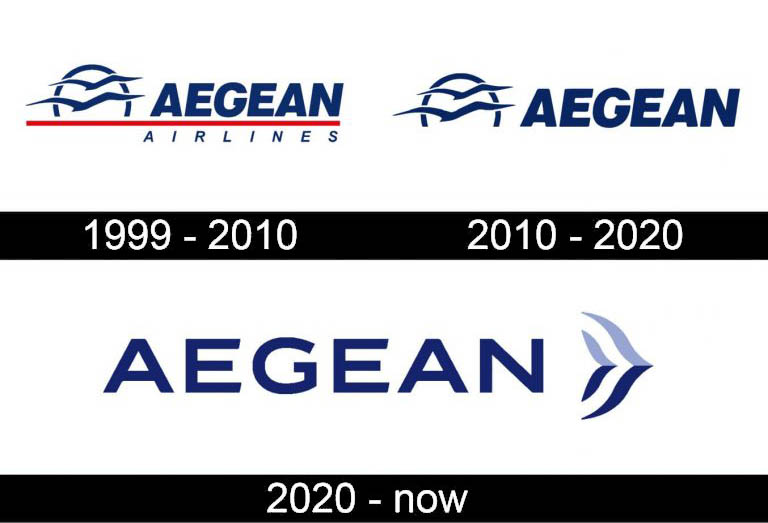
The first Aegean Airlines logo, used from 1999 to 2010, paired a circular emblem containing two stylized blue bird silhouettes with the word “Aegean” and a thick red bar cutting across the badge, echoing the blue and white of the Greek flag with a dash of red for contrast. The design worked as a self-contained crest that could sit on a tail fin or a boarding pass with equal clarity.
Between 2010 and 2020, as Aegean settled into its new status as a Star Alliance member with an international route map, the identity was simplified. The red divider and the word “Airlines” were dropped, leaving a plainer two-bird emblem next to an italic “Aegean” wordmark in blue. The result read more like the mark of a modern network carrier and less like a regional badge.
The current logo, introduced around 2020, replaces the circular emblem with two seagulls set against a wide arc that reads as both a rising sun and a line of sea horizon, a nod to the airline’s Greek, maritime, and Mediterranean identity. The wordmark sits below in a clean sans-serif, giving the brand a flatter, more contemporary mark than either of its predecessors.
Quick Facts
| Aegean Aviation founded | 1987, as a private air-taxi and business-aviation operator |
| Scheduled passenger service launched | 28 May 1999, under the Aegean Airlines brand |
| Cronus Airlines merger | Completed October 2001 |
| Olympic Air acquisition | Approved 9 October 2013 for about 72 million euros; takeover completed 1 February 2014, after an earlier merger attempt was blocked by the European Commission in 2011 |
| Star Alliance membership | Joined 30 June 2010 |
| Current logo era | 2020 to present, the “horizon” seagull symbol |
FAQ
When was Aegean Airlines founded?
The company’s history starts in 1987 with Aegean Aviation, a private air-taxi and business-aviation operator. Scheduled passenger service under the Aegean Airlines brand began on 28 May 1999.
What happened in the Cronus Airlines merger?
Aegean Airlines and Cronus Airlines, a separate Greek carrier founded in 1994, began a codeshare in spring 2001 and briefly flew under a combined livery before Aegean fully absorbed Cronus in October 2001, with Cronus’s owners taking a minority stake in the enlarged airline.
When did Aegean Airlines join Star Alliance?
Aegean’s membership was approved by the Star Alliance Chief Executive Board on 26 May 2009, and the airline formally joined the alliance on 30 June 2010, becoming the first Greek carrier in a global airline alliance.
When did Aegean Airlines acquire Olympic Air?
An initial attempt to merge the two airlines was blocked by the European Commission in early 2011 over competition concerns. A revised deal worth about 72 million euros was approved on 9 October 2013, and Aegean completed its takeover of Olympic Air’s non-subsidized routes on 1 February 2014.