NBA Logo History: Meaning, Symbolism & Brand Heritage

The NBA is more than a sports league — it’s a cultural force, a global entertainment phenomenon, and home to some of the most iconic athletes in history. Yet one of the most recognizable elements of the league isn’t a team, a trophy, or a player. It’s the NBA logo itself: the white silhouette of a dribbling athlete set against a red-and-blue backdrop.
Clean, dynamic, and unmistakably American, the NBA emblem has become a symbol of excellence, athleticism, and heritage. But the story behind it stretches back decades, through mergers, restructures, league expansions, and a defining era of basketball legends.
Below is a complete breakdown of the NBA logo history — how it began, how it evolved, who inspired it, and why it remains unchanged for over 50 years.
Meaning and Origins
Before the modern NBA was officially founded in 1949, American basketball was fragmented across several leagues. The sport’s popularity was still growing, and only by the late 1930s and 1940s did professional basketball start to become commercially viable.
The National Basketball League (NBL) and the Basketball Association of America (BAA) were the two dominant leagues of the time. The NBL had talent; the BAA had money, arenas, and visibility. Their rivalry eventually led to a logical conclusion: a merger.
On August 3, 1949, the two joined forces — giving birth to the National Basketball Association. The newly formed league started with 17 teams, eventually stabilizing at eight franchises that remain foundational to this day. As basketball’s popularity exploded throughout the 1950s and 1960s, the league needed a stronger visual identity.
That perfect identity would come in 1969.
Logo Evolution Through the Years
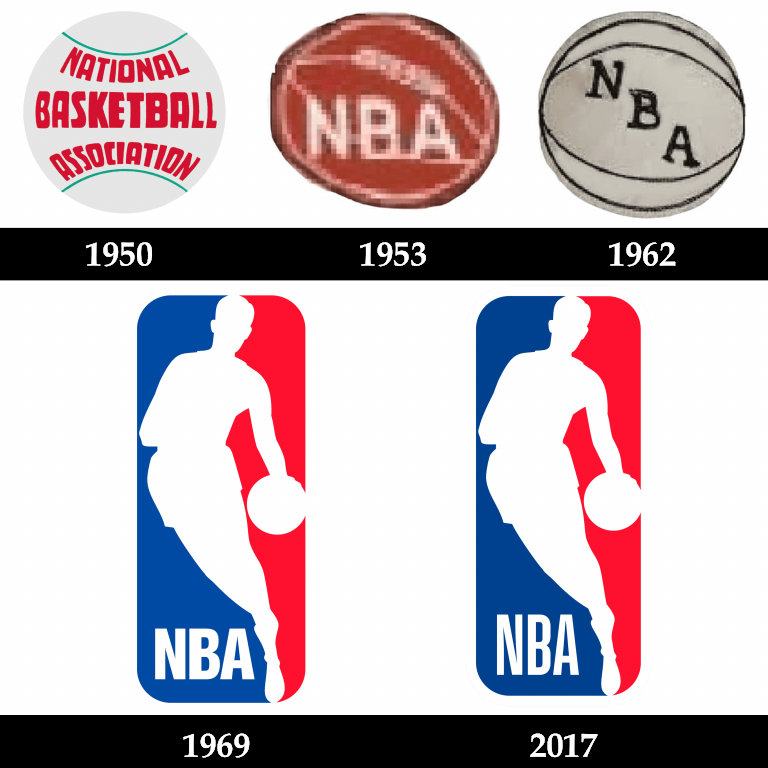
1950–1953 First Experimental Emblem
The first NBA logo was heavily inspired by the sport itself. A full basketball served as the backdrop, divided into segments where the league’s name was placed. It was traditional, direct, and unmistakably tied to the game.

1953–1962 A Cleaner Basketball Identity
A cleaner version appeared: a red basketball tilted diagonally with the bold white letters NBA across the bottom. This signaled a move toward simpler, more modern aesthetics.

1962–1969 Toward Modern Simplicity
The ball was redesigned again — now white with black stitching and a diagonal serif “NBA.” It was professional but still lacked a distinctive identity.

1969–2017 The Birth of the Iconic Silhouette
Everything changed in 1969 when branding expert Alan Siegel introduced the now-iconic silhouette logo. The emblem featured a player dribbling, set between blue and red panels. It echoed the spirit of American sports branding while giving the league a visual signature of its own.
This design remained untouched for nearly half a century.
2017–Today: Modern Refinement
The current version preserves Siegel’s design. Only the typography was refined — slimmer, more modern lines while maintaining the classic layout.
The result? One of the most enduring sports logos in history.
Who Is on the NBA Logo? The Jerry West Debate
Although the NBA publicly avoids confirming it, the silhouette was based on a photograph of Jerry West, the legendary Los Angeles Lakers guard. Siegel himself has repeatedly stated that West’s stance, grace, and movement captured “the essence of basketball.”
Jerry West has acknowledged this link but has expressed modest discomfort with being called “The Logo.”
Still, his image remains the quiet backbone of the league’s identity.
Symbolism Behind the Design
The logo’s symbolism is subtle but powerful:
-
White silhouette – purity of movement, athletic excellence, a universal figure representing all players
-
Red and blue panels – a nod to the American flag and the league’s national heritage
-
Dynamic stance – motion, energy, and the essence of basketball
-
Minimalist geometry – consistent with other major American sports logos (MLB in particular)
Its success lies in its ability to feel timeless. Unlike team logos that change with trends, the NBA emblem represents the league’s fundamental identity.
Cultural and Financial Impact
The NBA logo is considered one of the most commercially successful sports trademarks in the world. Siegel+Gale estimates its licensing value at over $3 billion per year, though exact figures are not public.
From jerseys to merchandise to global broadcasts, the emblem has become a cultural icon recognized everywhere from New York to Tokyo.
Icon and Typography
The NBA icon — the standalone vertical badge — is now the standard for digital platforms, apps, sponsors, and global marketing. Its silhouette remains inspired by West’s photo, maintaining a sense of tradition.
The typography uses a customized sans-serif type resembling Helvetica Pro Black Condensed, ensuring legibility and strength at small sizes.
Color Palette
Only one color scheme is truly acceptable:
Red, white, and blue — reflecting both American sports culture and the NBA’s global brand stability.
A monochrome version is allowed for printing or specific visual contexts, but the main palette remains sacred.
NBA Logos – National Basketball Association Logos
Discover all official NBA logos in one place, from legendary teams to today’s modern franchises. NBA team logos reflect basketball history, city culture, and decades of design evolution, from classic emblems to modern rebrands. This complete NBA logos collection offers a clear look at how visual identity has shaped the world’s most popular basketball league.


















FAQs
Who is the player on the NBA logo?
Jerry West — although the league has never officially credited him.
Why hasn’t the NBA changed its logo?
Because it’s globally recognized, visually timeless, and deeply tied to the league’s heritage.
Who designed the iconic logo?
Branding expert Alan Siegel in 1969.
What does the NBA logo symbolize?
Athleticism, motion, national pride, and the timeless spirit of basketball.
Has the NBA ever considered a redesign?
Discussions emerged in 2020 about potentially using Kobe Bryant’s silhouette, but no official change has been made.