TurboTax Logo History

The old version of this article framed TurboTax’s logo purely as a story about “trust,” “accuracy,” and a reassuring checkmark, and said nothing about why that framing is complicated. It left out Intuit’s 2021 withdrawal from the IRS Free File Program, the $141 million settlement Intuit paid to all 50 state attorneys general in 2022 over “free” filing ads, and the FTC’s 2024 ruling that those same ads were deceptive. A logo built around the idea of dependable, accurate tax help is worth reading alongside the real record of how that promise played out in advertising and in court.
Meaning and History: Where Did TurboTax Come From?
TurboTax was originally developed in the late 1980s by Michael Chipman, founder of a company called Chipsoft. Intuit acquired Chipsoft in 1993, and TurboTax became Intuit’s flagship consumer tax product. Over the following three decades it grew into one of the most widely used tax preparation platforms in the United States, filing tens of millions of returns each tax season.
Why did Intuit leave the IRS Free File Program in 2021?
For about two decades, Intuit was one of the lead participants in the IRS Free File Program, a public-private partnership in which major tax-software companies agreed to offer truly free federal filing to eligible lower-income taxpayers in exchange for the IRS agreeing not to build its own free filing portal. In July 2021, Intuit announced it would withdraw from the program, effective at the end of that year’s extended filing season. The company said it wanted to pursue product improvements that the program’s rules did not allow.
The exit followed years of reporting, including a widely cited 2019 ProPublica investigation, that found Intuit and other participants steered taxpayers who qualified for the free program toward paid products instead, including through separate “free” offers marketed outside the official Free File site. H&R Block had already left the program in 2020, and with Intuit’s departure the program’s two largest participants were both gone, raising questions about its future viability.
Why did Intuit pay $141 million over TurboTax’s free-filing ads?
In May 2022, Intuit agreed to pay $141 million to resolve a multistate investigation joined by the attorneys general of all 50 states, led by New York Attorney General Letitia James. The investigation concluded that TurboTax’s advertising deceptively lured taxpayers who were eligible for free filing under the IRS Free File Program into paying for products and services that should have been free to them.
Under the settlement, nearly 4.4 million consumers who had been steered into paying received direct restitution, with checks of roughly $30 for each year they had been deceived into paying. Intuit did not admit wrongdoing as part of the agreement but committed to changes in how it advertises free products going forward.
What did the FTC rule about “TurboTax Free” advertising?
Separately from the state settlement, the Federal Trade Commission brought its own administrative case against Intuit, filing a complaint in March 2022 that accused the company of advertising “TurboTax Free Edition” as free without adequately disclosing that most taxpayers did not actually qualify for it. On January 21, 2024, the Commission issued its final order, finding the “free” claims deceptive under the FTC Act and barring Intuit from advertising a product as free unless it is free for everyone or the company clearly discloses who actually qualifies.
Intuit disagreed with the ruling and, within days, petitioned the U.S. Court of Appeals for the Fifth Circuit for review, arguing separately that having the FTC’s own in-house administrative process decide the case in the first place was unconstitutional.
What happened to the FTC’s order on appeal?
On March 20, 2026, a panel of the Fifth Circuit ruled unanimously in Intuit’s favor and vacated the FTC’s January 2024 order. The court held that letting an FTC administrative law judge (rather than a federal court) decide deceptive-advertising claims against Intuit violated the constitutional separation of powers, relying on a 2024 Supreme Court decision that had limited the SEC’s use of a similar in-house adjudication process. The ruling set aside the specific order barring Intuit’s “free” advertising claims, though it did not address whether the underlying advertising was in fact deceptive.
As of the sources available for this article, it is not fully clear whether the FTC intends to pursue the matter further, for example by refiling in federal court or seeking further appellate review, so readers should treat the ultimate legal outcome on this specific FTC claim as unresolved. The 2022 multistate settlement with the state attorneys general is a separate, already-finalized matter and is not affected by the Fifth Circuit’s ruling on the FTC order.
Logo Symbolism: What Does the TurboTax Mark Represent?
Independent of the legal history, the design itself has a fairly consistent symbolic vocabulary across its versions. The checkmark at the center of the mark reads as a signal of confirmation or correctness, the kind of mark a person makes when a task is done right. The circular form around it suggests completeness, a return filed start to finish. The red tone throughout the identity carries a sense of urgency and attention, appropriate for a product tied to annual deadlines, while white sections read as clarity and simplicity, and the blue introduced in later versions (through the Intuit parent wordmark) signals institutional credibility.
TurboTax Logo History Timeline
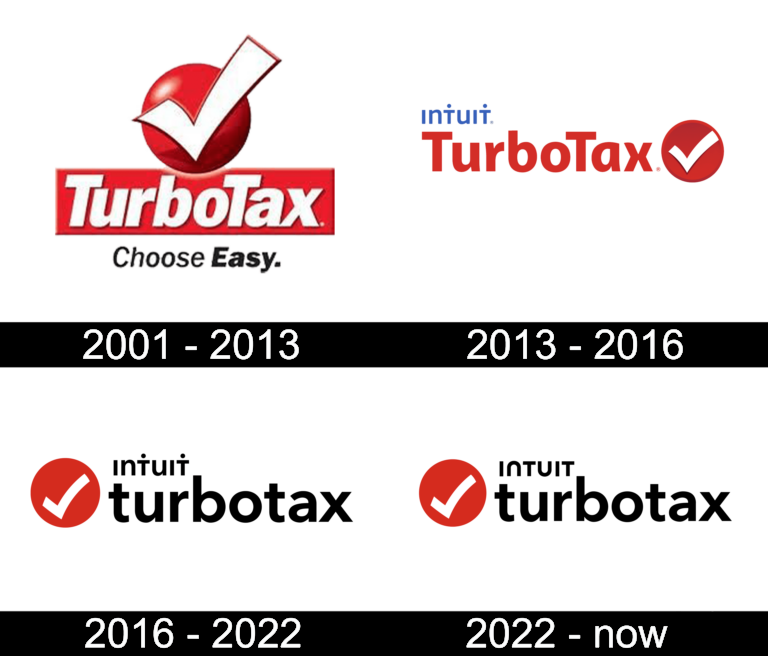
2001-2013: The Banner Identity
This version used a solid red rectangular banner behind a bold white wordmark, paired with a three-dimensional red dot containing a white checkmark positioned above the text. The design ran alongside the tagline “Choose Easy,” reinforcing a message of simplicity over complexity in tax preparation.

2013-2016: The Flat Design Era
Intuit’s company-wide shift to flat design brought a red, white, and blue palette and a modern sans-serif wordmark in title case. The red dot checkmark moved to sit beside the text rather than above it, and a small blue “Intuit” wordmark was added above the TurboTax name to make the parent company’s ownership visible for the first time.
2016-2022: The Icon-Centered Identity
This redesign introduced a lowercase wordmark in a bold, smooth sans-serif typeface. The red circular checkmark was separated out into a standalone icon that could be used on its own, a common move at the time toward app-style icons that work at small sizes on phone screens.

2022-Present: A Subtle Refinement
The most recent update is a minor one, part of Intuit’s broader brand refresh across its product family rather than a change specific to TurboTax. The Intuit wordmark accompanying the logo picked up a rounder typeface and dropped the dots that previously sat above the letter “T,” while the TurboTax checkmark and wordmark themselves were left largely unchanged.
Quick facts
| Date | Event |
|---|---|
| Late 1980s | TurboTax developed by Michael Chipman at Chipsoft |
| 1993 | Intuit acquires Chipsoft and TurboTax |
| 2001-2013 | Banner logo era with “Choose Easy” tagline |
| 2013-2016 | Flat red/white/blue redesign; Intuit wordmark added above logo |
| July 2021 | Intuit withdraws from the IRS Free File Program |
| 2016-2022 | Icon-centered redesign with standalone checkmark icon |
| March 2022 | FTC files administrative complaint over “TurboTax Free” ads |
| May 2022 | Intuit agrees to pay $141 million to settle a 50-state investigation led by New York’s attorney general; about 4.4 million consumers receive restitution checks of roughly $30 each |
| January 21, 2024 | FTC issues final order finding “TurboTax Free” ads deceptive |
| 2022-Present | Subtle refinement tied to Intuit’s broader brand refresh |
| March 20, 2026 | Fifth Circuit vacates the FTC’s order on separation-of-powers grounds; further proceedings are not fully resolved as of the sources available here |
Further reading
- FTC: Final order on Intuit and “TurboTax Free” advertising
- New York Attorney General: $141 million nationwide settlement with Intuit
- Nextgov: Intuit’s withdrawal from the IRS Free File Program
- Bloomberg Law: Fifth Circuit vacates FTC order on TurboTax ads
FAQ
Is TurboTax actually free?
A version of TurboTax is free for taxpayers with simple returns, but regulators found that past advertising did not make clear how few filers actually qualified. Separately, the IRS Free File Program offers genuinely free federal filing for eligible taxpayers through several participating companies, though Intuit itself left that program in 2021.
Did Intuit admit wrongdoing in the $141 million settlement?
No. Intuit agreed to pay $141 million and change some advertising practices without admitting it violated the law, as is common in this type of multistate settlement.
Did the FTC’s ruling against Intuit stick?
Not as of the sources used for this article. The FTC issued a final order in January 2024 finding “TurboTax Free” ads deceptive, but the Fifth Circuit Court of Appeals vacated that order in March 2026 on separation-of-powers grounds, without ruling on whether the ads were actually deceptive. Whether the FTC will pursue the case further is unclear.
Who originally created TurboTax?
TurboTax was developed in the late 1980s by Michael Chipman at Chipsoft, which Intuit acquired in 1993.
Has the TurboTax logo itself changed because of these controversies?
No. The documented controversies involve advertising claims and business practices, not the logo design itself. The logo’s design changes have followed Intuit’s broader brand updates in 2013, 2016, and 2022.