Etihad Airways Logo History: Meaning, Symbolism & Brand Heritage
In contemporary aviation logo history, Etihad Airways stands out as a brand whose visual identity was conceived fully formed, rather than evolving gradually over decades. Founded in the early 21st century, Etihad emerged at a moment when airline branding had already shifted toward minimalism, symbolism, and global legibility. As a result, its logo heritage reflects refinement and restraint rather than experimentation.
The Etihad Airways logo history aligns closely with the visual strategies explored in Qatar Airways logo and the state-driven identity logic seen in Emirates logo history. From its inception, Etihad’s visual language was designed to communicate sovereignty, luxury, and ambition, positioning Abu Dhabi as a global aviation hub through symbolism rather than overt national imagery.
Meaning and History: The Origin of the Etihad Airways Logo
Etihad Airways was established in 2003 by royal decree as the national airline of the United Arab Emirates, headquartered in Abu Dhabi. Unlike many airlines that undergo visual trial and error in their early years, Etihad launched with a clearly defined identity strategy. The brand name itself, “Etihad,” translates from Arabic as “union,” directly referencing the political and cultural foundation of the UAE.
From the beginning, the logo meaning of Etihad Airways centered on unity, prestige, and modern Arab identity. The visual identity avoided figurative symbols such as animals or aircraft silhouettes, instead relying on typography, bilingual presentation, and color symbolism to convey authority and elegance. This approach ensured immediate recognition while remaining culturally grounded.
Etihad Airways Logo History Timeline
2003–2014: Foundational Identity and Cultural Duality
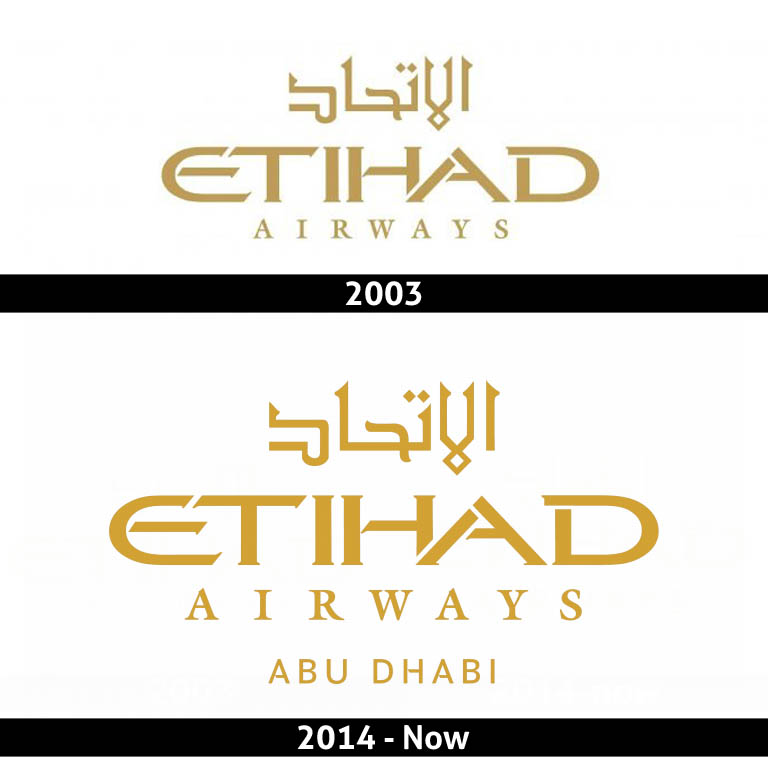
The original Etihad Airways logo introduced in 2003 established the framework that still defines the brand today. The composition was dominated by the word “Etihad,” rendered in a custom serif typeface with sharp, geometric details. Above it appeared the airline’s name in Arabic script, reinforcing cultural authenticity and bilingual communication.
Below the main wordmark, “Airways” was set in a more restrained serif typeface, acting as a functional descriptor rather than a focal element. In some applications, the logo included two flowing ribbons in gold and red, accompanied by a blue “Airways” inscription. These decorative elements added ceremonial richness, aligning the brand with luxury and national prestige.
This early logo description emphasized hierarchy and balance. The Arabic and Latin scripts coexisted without visual conflict, signaling Etihad’s role as both a national carrier and a global airline.
2014–Today: Refinement, Luxury, and Visual Clarity
The 2014 redesign refined the existing identity rather than replacing it. Decorative ribbons were removed, allowing the typography to take full visual precedence. The gold color was brightened and clarified, enhancing legibility and digital performance.
The “Airways” inscription grew larger and adopted a simpler type structure, creating better balance with the dominant “Etihad” wordmark. The bilingual layout was preserved, reinforcing cultural continuity. This update strengthened the logo’s versatility across aircraft liveries, airport environments, and digital platforms.
The result is a logo heritage defined by consistency and polish, where minor adjustments elevated clarity without disrupting recognition.
Logo Symbolism: Unity, Authority, and Modern Arab Identity
The symbolism of the Etihad Airways logo is primarily typographic. The name “Etihad,” meaning “union,” encapsulates the airline’s national role and philosophical foundation. Rather than illustrating this concept visually, the logo relies on structure, symmetry, and proportion to convey unity.
Gold is the defining color of the identity. Universally associated with excellence, quality, and prestige, it also holds cultural significance in the Gulf region. Set against white, the gold wordmark communicates calm authority rather than excess, aligning with Etihad’s positioning as a premium yet restrained airline.
The absence of pictorial symbols reinforces the brand’s confidence. Etihad does not need illustrative metaphors; its authority is expressed through clarity and refinement.
Typography and Color Philosophy
Typography is the core of Etihad’s visual identity. The custom serif wordmark combines sharp edges with elegant proportions, creating a balance between tradition and modernity. The Arabic script above mirrors this precision, ensuring visual harmony across languages.
The color palette is deliberately minimal. Gold dominates, supported by white negative space. This restraint enhances recognition and positions the brand alongside luxury institutions rather than mass-market airlines.
Etihad Airways Logo History and Contemporary Prestige
The Etihad Airways logo history demonstrates how a young airline can establish a powerful visual identity without constant reinvention. By launching with a clear symbolic framework and refining it carefully over time, Etihad built a logo heritage rooted in unity, authority, and cultural confidence.
Today, the Etihad logo stands as a benchmark for modern state-backed airline branding, proving that consistency, symbolism, and typographic discipline can create enduring global recognition.
FAQ: Etihad Airways Logo Meaning and History
What does the Etihad Airways logo represent?
The logo represents unity, national identity, and premium service through refined typography and gold coloring.
Why does Etihad Airways use gold in its logo?
Gold symbolizes luxury, quality, and authority, aligning with the airline’s premium positioning.
Has the Etihad Airways logo changed over time?
The core design has remained consistent since 2003, with refinements made in 2014 to improve clarity.
Why is Arabic included in the Etihad logo?
The Arabic script reinforces cultural authenticity and reflects Etihad’s role as a national carrier.