Prime Video Logo History
Prime Video began as a small side project inside Amazon’s retail business and grew into one of the handful of streaming services with the scale to outbid traditional broadcasters for live sports. The platform’s logo has changed shape seven times since 2006, tracking a path from a plain video-download add-on to a standalone media brand that now sits alongside Netflix as one of the most widely distributed streaming apps in the world.
Few logo histories map so closely to a company’s business strategy. Amazon kept its own wordmark attached to the service for nearly a decade before cutting it loose in 2017, a sequencing choice that shows up directly in the eight logos below. The pattern has echoes elsewhere in Netflix’s logo history, where a service built around rented physical media eventually had to design an identity for a business it hadn’t started as.
Quick Facts
| Service launched | September 7, 2006, as Amazon Unbox |
| Parent company | Amazon.com, Inc. |
| Prime Video name adopted | 2015, with worldwide expansion in December 2016 |
| Countries/territories reached in 2016 expansion | About 200 additional countries and territories |
| NFL Thursday Night Football deal | Exclusive US rights starting with the 2022 season, an 11-season agreement reported at roughly $1 billion per year |
| Ads added to standard tier | Late January 2024 (January 29 in the US, UK and Germany; other markets followed in the weeks after) |
| Primary logo colors | Amazon blue and the Amazon smile/arrow mark |
How did Prime Video get its name?
Prime Video traces back to Amazon Unbox, a digital video download service Amazon launched on September 7, 2006. Unbox let customers download movies and TV episodes to a PC or compatible device, a modest extension of the online retailer’s existing DVD business rather than a competitor to cable television.
In September 2008 Amazon renamed the service Amazon Video on Demand, reflecting a shift from pure downloads toward on-demand playback as broadband speeds improved. The bigger change came on February 22, 2011, when Amazon folded video streaming into the Amazon Prime membership for the first time, giving Prime subscribers unlimited, commercial-free access to several thousand movies and TV shows at no added cost. That benefit was marketed as Amazon Instant Video and, within about a year, commonly as Prime Instant Video, tying the service’s identity to the paid membership program for the first time.
Amazon dropped “Instant” from the US name in September 2015, simplifying it to Amazon Video before settling on Prime Video as the service name used in branding and marketing. The service briefly operated as a standalone subscription outside Prime in the US starting April 2016, priced separately from the full Prime membership, before the name and positioning stabilized under the global Prime Video rollout that followed. On December 14, 2016, Amazon expanded Prime Video into roughly 200 additional countries and territories, making it available nearly everywhere Amazon did business except a short list of markets including mainland China, Cuba, Iran, North Korea, Sudan and Syria.
Prime Video Logo History Timeline
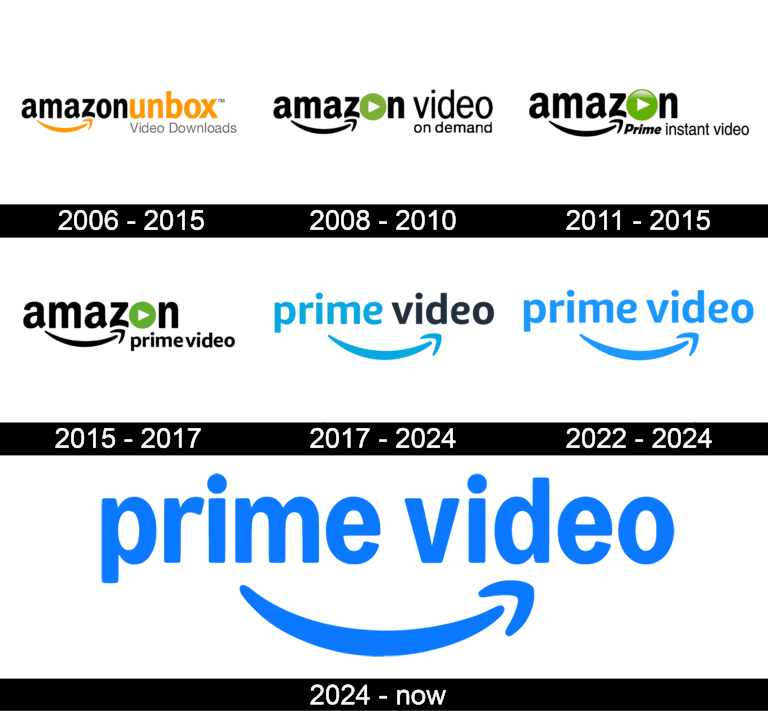
2006 to 2008: Amazon Unbox
The first logo tied to today’s Prime Video appeared with the September 2006 Amazon Unbox launch. It paired Amazon’s lowercase black wordmark and orange smile-arrow with an orange “Unbox” lettering and a small “Video Downloads” tagline underneath, making clear the service was a feature of Amazon.com rather than its own product.
2008 to 2011: Amazon Video on Demand
The September 2008 rename to Amazon Video on Demand introduced a green circular play button in place of the lowercase “o” in Amazon, the first time the logo used a symbol tied directly to video playback rather than retail.

2011 to 2015: Amazon Instant Video and Prime Instant Video
Following the February 2011 announcement that bundled streaming into Prime membership, the logo gave the play button more visual weight and leaned on the word “Prime” to connect the service to the subscription customers were already paying for.
2015 to 2017: Prime Video under the Amazon name
When Amazon dropped “Instant” from the name in 2015 and moved toward the Prime Video label used today, the logo simplified to a plain “Prime Video” wordmark set beneath the Amazon brand, still visually dependent on its parent.
2017 to 2022: A standalone identity
The version that accompanied Prime Video’s global availability dropped the Amazon wordmark entirely. “prime video” stood on its own in lowercase letters, with Amazon’s blue smile-arrow running underneath as an underline rather than a logo element borrowed wholesale from the parent company’s mark.
2022 to 2024: A heavier “Prime”
A later refinement gave the word “prime” noticeably more typographic weight than “video,” a small change that nonetheless shifted emphasis toward the membership brand at a moment when Amazon was investing heavily in exclusive content, including the NFL rights deal that took effect that same year.
Current logo
The logo in use today narrows the letterforms slightly and uses a more saturated blue for the smile-arrow underline, continuing the 2017 layout of a standalone lowercase “prime video” wordmark without any visible Amazon branding.
What does the Prime Video logo symbolize?
The smile-arrow underneath “prime video” is the same mark Amazon has used since 2000, originally designed to suggest both a smile and an arrow running from A to Z, implying the retailer stocked everything a customer could want. Carried over to Prime Video, the same curve reads less as a retail promise and more as a simple underline, tying the service back to its parent without needing the Amazon name spelled out. The shift from green, used in the 2008 to 2011 era logos, to the blue used since 2017 moved the service’s color away from the “play button” convention common across media-player icons and toward Amazon’s own corporate blue, reinforcing that Prime Video is a facet of the broader Amazon and Prime ecosystem rather than an independent media company competing purely on content.
What font does Prime Video use?
Prime Video’s wordmark is set in a custom sans-serif based on Amazon’s corporate typeface family, the same lineage used across Amazon’s retail site and other Prime-branded products. The letters are lowercase and tightly spaced, a choice that keeps “prime video” legible at small sizes on app icons and connected TV interfaces, where the logo often has to work at a fraction of the size it appears in marketing.
How did Prime Video become a major sports and entertainment platform?
Two business decisions did more to define Prime Video’s current identity than any single redesign. In March 2021, Amazon and the NFL announced that Prime Video would become the exclusive home of Thursday Night Football starting with the 2022 season, an 11-season agreement running through 2032 and reported at approximately $1 billion per year, ending the previous arrangement that had split the package between Fox, NFL Network and Amazon. It was the first time a full NFL game package moved exclusively to a streaming service rather than broadcast or cable television.
Then, in January 2024, Amazon began showing limited advertising to Prime Video subscribers on its standard plan, starting January 29 in the United States, United Kingdom and Germany, with Canada and other markets following within days. Customers who wanted to keep watching without ads could pay an additional monthly fee on top of their existing Prime or Prime Video subscription. The change marked the first time advertising appeared by default in a service that had been pitched for more than a decade as an ad-free perk of Prime membership.
FAQ
When did Prime Video launch?
Prime Video’s roots go back to September 7, 2006, when Amazon launched Amazon Unbox, a video download service. The service was renamed several times before becoming Prime Video in 2015, with global availability following in December 2016.
Why was the Amazon name removed from the Prime Video logo?
Amazon dropped its own wordmark from the Prime Video logo starting with the version introduced around the 2017 global rollout, letting “prime video” stand on its own with the blue smile-arrow mark as the only visual tie back to the parent company.
What does the arrow under the Prime Video logo mean?
The curved mark under “prime video” is the same smile-arrow Amazon has used in its own logo since 2000. In Prime Video’s logo it functions mainly as an underline connecting the service to Amazon, carrying over the shape rather than its original A-to-Z retail meaning.
When did Prime Video add Thursday Night Football?
Amazon became the exclusive home of NFL Thursday Night Football starting with the 2022 season, under an 11-season deal announced in March 2021 and reported at roughly $1 billion per year.
When did ads come to Prime Video?
Amazon introduced limited advertising into the standard Prime Video subscription starting January 29, 2024, in the US, UK and Germany, with other countries including Canada following shortly after. Subscribers could pay an extra monthly fee to remove ads.
Further Reading
- Amazon.com Launches Amazon Unbox, A Digital Video Download Service With DVD-Quality Picture, Amazon Press Center
- Amazon Prime Members Now Get Unlimited, Commercial-Free, Instant Streaming of More Than 5,000 Movies and TV Shows at No Additional Cost, Amazon Press Center
- Amazon Spins Out Prime Video and Launches It Globally, Engadget
- Amazon’s NFL Deal for Thursday Night Football on Prime Video Will Begin a Year Early and Run 11 Seasons, GeekWire
- Prime Video Confirms Ads Are Coming in January 2024, TV Insider