ConocoPhillips Logo History
ConocoPhillips is an American energy company formed in August 2002 through the merger of Conoco Inc. and Phillips Petroleum Company. The company traces its roots back more than a century through two separate corporate lines: Conoco, which began in 1875, and Phillips Petroleum, founded in 1917. Today ConocoPhillips is one of the world’s largest independent exploration and production companies, focused on finding and producing oil and natural gas rather than refining or retail fuel sales.
Meaning and History
The Conoco side of the business began on November 25, 1875, when Isaac E. Blake founded the Continental Oil and Transportation Company in Ogden, Utah. The company distributed kerosene and other refined petroleum products across the western United States, supplying lamp oil to a region not yet served by the major eastern refiners. Standard Oil acquired the business in 1884, and it operated for decades as part of the Standard Oil network before becoming independent again after the 1911 breakup of Standard Oil under antitrust law.
The modern Conoco name and logo trace to 1929. Marland Oil Company, founded in 1921 by oilman E.W. Marland, merged with Continental Oil and Transportation Co. on June 26, 1929. The combined company took the Continental Oil Company name and moved its headquarters to Ponca City, Oklahoma, where Marland Oil had been based. Although Continental’s name survived, the merged company adopted Marland Oil’s existing red triangle and bar emblem as its new corporate mark. That logo stayed in use until 1970.
The other half of the company, Phillips Petroleum, was incorporated on June 13, 1917, in Bartlesville, Oklahoma, by brothers Frank Phillips and L.E. Phillips. The company grew out of earlier banking and oil exploration ventures the brothers had run in the area and quickly became a major natural gas and crude oil producer in the region. In 1930, Phillips Petroleum introduced its Phillips 66 brand for retail gasoline. According to company accounts, the name came from a test drive of the new fuel on U.S. Route 66 near Tulsa, where the car was said to be running at about 66 miles per hour. The Phillips 66 brand, with its distinctive shield, became far better known to ordinary drivers than the Phillips Petroleum corporate name itself and remained the company’s consumer-facing identity for decades.
Conoco introduced a new corporate look in 1970, replacing the red triangle with a bold red “capsule” mark, an elongated rounded rectangle containing the word Conoco in a heavy sans-serif typeface. A notable detail of the wordmark was its lowercase “n,” drawn so that it echoed the shape of a rotated “c,” giving the logotype a subtle internal rhythm. This capsule identity carried Conoco through its years as part of DuPont, which acquired the company in 1981, and remained in place as Conoco was spun off again as an independent public company in 1998.
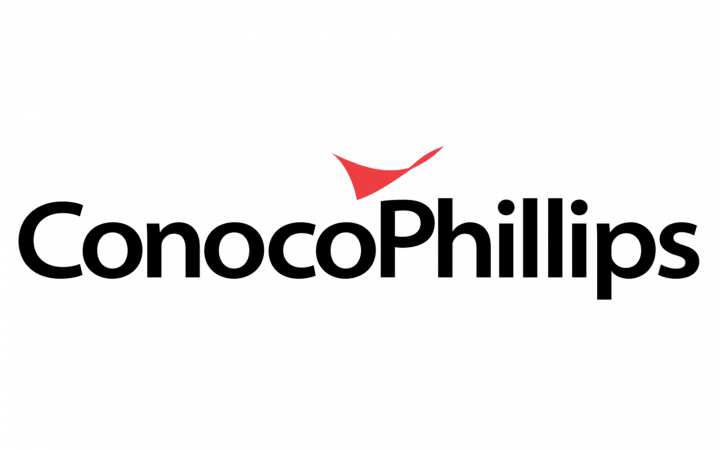
Conoco and Phillips Petroleum announced their merger of equals in November 2001. Under the terms of the deal, Phillips shareholders received one share of the new ConocoPhillips for each Phillips share they held, while Conoco shareholders received 0.4677 ConocoPhillips shares for each Conoco share. Phillips shareholders ended up owning about 56.6 percent of the combined company and Conoco shareholders about 43.4 percent, even though the new company took its headquarters in Houston, where Conoco had been based, rather than in Phillips’ longtime home of Bartlesville. The stock swap was valued at roughly 15.4 billion dollars, creating a combined company with a market value of about 35 billion dollars at the time, then the third largest oil company in the United States. The merger closed in August 2002, and the companies introduced a new ConocoPhillips logo built around a restrained sans-serif wordmark with capitalized “C” and “P,” topped by a red geometric accent drawn from the angular shapes of the earlier Conoco marks.
A decade later, ConocoPhillips reorganized itself again. On May 1, 2012, the company completed the spinoff of Phillips 66 as an independent, separately traded public company, moving its refining, chemicals, and retail marketing operations, the “downstream” side of the business, into the new entity. The move left ConocoPhillips as a pure upstream company focused solely on oil and natural gas exploration and production, while Phillips 66 carried on the refining and retail fuel brand that dated back to the 1930 highway test. The ConocoPhillips wordmark and red accent introduced in 2002 continued unchanged through the spinoff and remains the company’s logo today.
Logo Symbolism
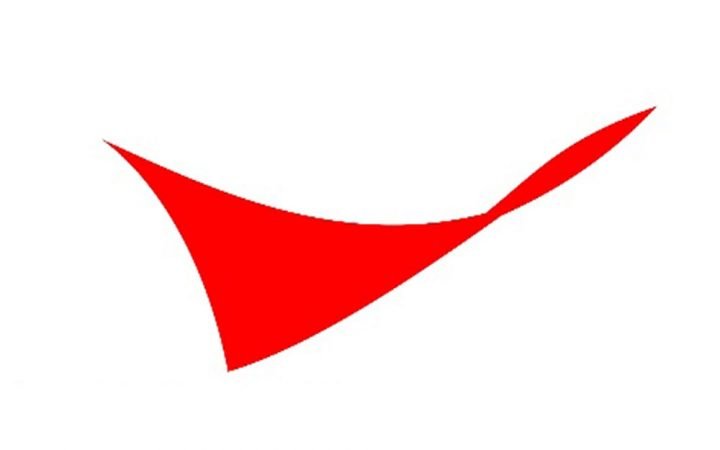
The current ConocoPhillips logo favors plain, confident typography over illustration. The wordmark sets the merged company’s name in a heavy, modern sans-serif, with the capital “C” and capital “P” sized and weighted to anchor the two halves of the combined name. Above the wordmark sits a red geometric accent, an angular shape that nods to the red triangle Marland Oil brought into the business in 1929 without directly copying it. Red has carried through nearly every version of the Conoco side’s branding since that 1929 merger, giving the current mark a visual link to the company’s nearly 150-year history even as the typography itself has been simplified and modernized.
Font and Color
The ConocoPhillips wordmark uses a bold, geometric sans-serif typeface with even letterforms and no serifs or decorative flourishes, in keeping with the plain, businesslike tone the company has used since the 2002 merger. The only color used in the current logo is a strong red for the geometric accent above the wordmark, paired with black or dark gray for the company name itself. That red traces back to the Marland Oil triangle of 1929 and has remained the one constant color across every redesign the company has gone through since.
Logo History Timeline
1930: Following the 1929 merger of Marland Oil Company and Continental Oil and Transportation Co., the enlarged Continental Oil Company adopted Marland’s existing red bar-and-triangle emblem as its corporate logo. The mark stayed in use from 1930 to 1970.
1970: Conoco replaced the triangle mark with a red capsule logo, an elongated rounded shape containing the Conoco name in a heavy sans-serif typeface, with a lowercase “n” drawn to echo a rotated “c.”
2002: After the August 2002 merger of Conoco and Phillips Petroleum, the new ConocoPhillips introduced its current logo, a plain sans-serif wordmark with capitalized “C” and “P” and a red geometric accent above it. The mark remained unchanged through the 2012 spinoff of Phillips 66 and is still in use today.
Quick Facts
| Fact | Detail |
|---|---|
| Conoco origin | Founded 1875 as Continental Oil and Transportation Company by Isaac E. Blake |
| Phillips Petroleum origin | Founded 1917 in Bartlesville, Oklahoma, by Frank and L.E. Phillips |
| ConocoPhillips merger | Conoco and Phillips Petroleum merged as equals, closing August 2002 |
| Phillips 66 spinoff | Downstream refining, chemicals, and retail business spun off as independent Phillips 66 on May 1, 2012 |
| Current headquarters | Houston, Texas |
FAQ
When was ConocoPhillips formed?
ConocoPhillips was formed in August 2002 through the merger of Conoco Inc. and Phillips Petroleum Company, a deal announced as a merger of equals in November 2001.
How old is the Conoco side of the company?
The Conoco name traces back to 1875, when Isaac E. Blake founded the Continental Oil and Transportation Company in Ogden, Utah, to distribute kerosene in the western United States.
What is the connection between Phillips Petroleum and Phillips 66?
Phillips Petroleum was founded in 1917 by brothers Frank and L.E. Phillips in Bartlesville, Oklahoma. In 1930 the company launched the Phillips 66 retail gasoline brand, which became far more widely recognized by consumers than the Phillips Petroleum corporate name.
Why isn’t Phillips 66 part of ConocoPhillips today?
ConocoPhillips spun off its refining, chemicals, and retail marketing operations as the independent public company Phillips 66 on May 1, 2012. That left ConocoPhillips focused solely on upstream oil and natural gas exploration and production.