
Carhartt Logo History: Meaning, Symbolism & Brand Heritage

Few American brands illustrate the transformation from industrial necessity to cultural icon as convincingly as Carhartt. Founded in the late nineteenth century to serve railroad workers and manual laborers, the company built its reputation on durability, utility, and uncompromising quality. Over time, this workwear DNA evolved into a visual identity that now resonates just as strongly with streetwear communities as it does with professionals who rely on rugged apparel. Much like the long-term consistency explored in the Levi’s logo history or the utilitarian clarity seen in the Dickies logo heritage, Carhartt’s identity demonstrates how authenticity and restraint can create lasting recognition. Within the wider landscape of American workwear logo history, Carhartt stands as a rare example of a brand whose logo meaning has remained aligned with its origin despite shifting cultural contexts.
The Carhartt logo is not merely a decorative mark. It is a visual bridge between industrial heritage and modern fashion relevance, reflecting more than a century of adaptation without abandoning its foundational values.
Meaning and History: The Origin of the Carhartt Identity
Carhartt was founded in 1889 by Hamilton Carhartt in Detroit, Michigan. The company emerged during a period of rapid industrial expansion in the United States, when durable clothing was essential for railroad workers, factory laborers, and craftsmen. From its earliest days, Carhartt positioned itself as a manufacturer of reliable garments designed to withstand harsh working conditions.
The logo meaning has always been closely tied to this mission. Early Carhartt branding emphasized trust, union craftsmanship, and industrial pride, reflecting both the values of the workforce and the realities of American manufacturing at the turn of the twentieth century. As the company expanded beyond work pants and overalls into jackets, accessories, and eventually lifestyle apparel, its visual identity adapted accordingly, becoming simpler and more symbolic while retaining references to strength and continuity.
The launch of the Work In Progress line in the 1990s marked a turning point, introducing Carhartt to fashion-conscious audiences without erasing its workwear origin. This balance between heritage and reinvention is central to understanding the brand’s logo history.
Carhartt Logo History Timeline
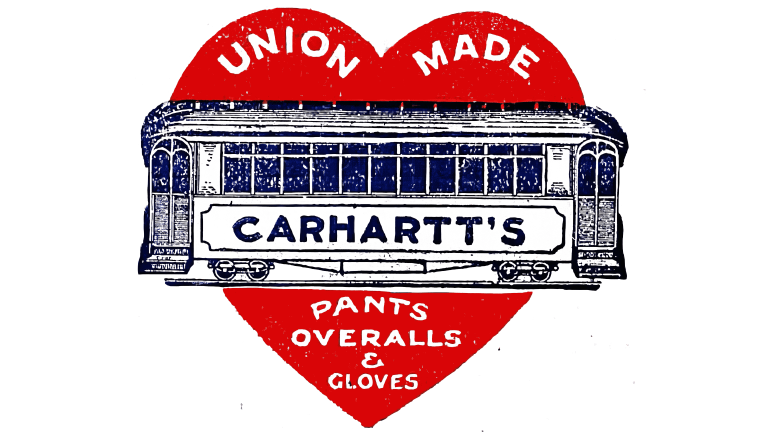
1920–1940: Industrial Symbolism and Union Identity
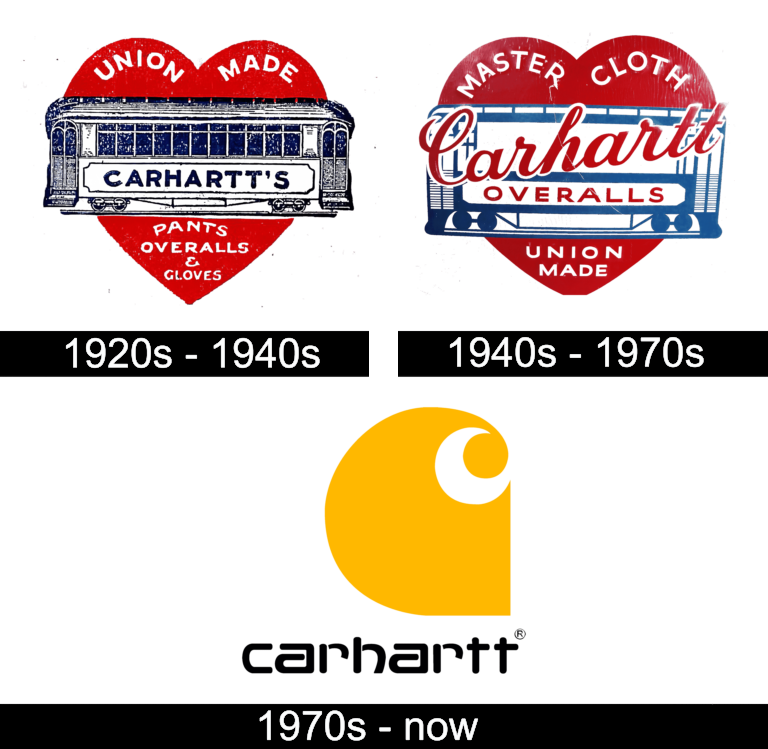
The earliest widely recognized Carhartt logo emerged in the 1920s. It featured a large red heart-shaped emblem, a direct visual play on the brand’s name. Integrated into this heart were phrases emphasizing union-made production, along with references to pants, overalls, and gloves. At the center sat a stylized tram car bearing the company name, an emblematic rather than literal reference that reinforced industrial associations and movement. This design reflected the era’s branding priorities, where logos functioned as detailed seals of credibility and craftsmanship.
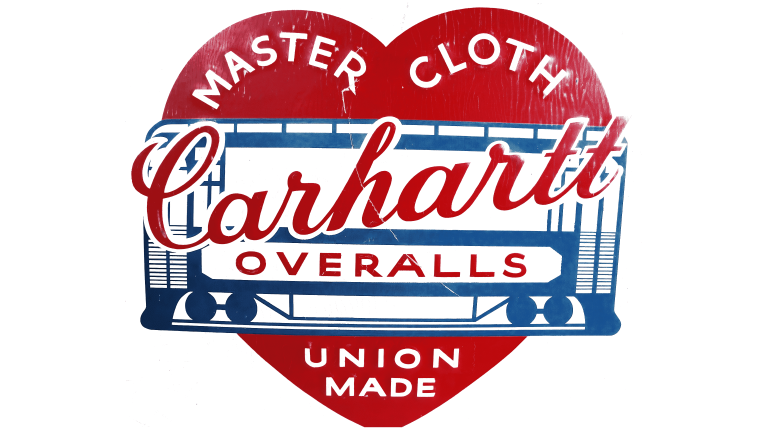
1940–1970: Refinement and Manufacturing Pride
During the 1940s, the logo underwent noticeable refinement. The heart shape became softer and more rounded, while the internal elements were simplified. The text shifted to emphasize “master cloth” and union manufacturing, reinforcing Carhartt’s reputation for quality materials. The tram motif was streamlined, adopting brighter blue tones and fewer details. Typography became more expressive, with cursive lettering introduced to convey confidence and maturity. This version aligned with mid-century branding trends while maintaining strong ties to industrial identity.
1970–Today: The Modern Workwear Icon
Around 1970, Carhartt introduced the logo that defines the brand today. The complex emblematic designs of earlier decades were replaced by a cleaner system composed of a distinctive wordmark and a standalone symbol. The lowercase wordmark uses a custom geometric typeface characterized by squared proportions and subtle separations within the letterforms, suggesting industrial precision and engineered strength.
Accompanying the wordmark is the now-iconic emblem: a rounded, abstract yellow shape resembling a wave or folded fabric form. This symbol communicates motion, growth, and adaptability, reflecting the brand’s evolution beyond traditional workwear. Its simplicity allows for versatile application across garments, labels, and global markets, making it a cornerstone of Carhartt’s contemporary visual identity.
Logo Symbolism: Durability, Motion, and Authenticity
The Carhartt logo symbolism operates on multiple levels. The sturdy, grounded typography reflects the brand’s workwear origin, evoking machinery, construction, and reliability. In contrast, the emblem introduces a sense of movement and progress, signaling that Carhartt is not confined to its past but continues to evolve.
Unlike logos that rely on literal imagery, Carhartt’s symbol remains abstract, allowing it to adapt across contexts without losing meaning. This abstraction has been key to its acceptance within both industrial environments and fashion-forward spaces, reinforcing the brand’s dual identity.
Typography and Color Palette
Typography plays a central role in the Carhartt logo meaning. The custom sans-serif wordmark balances sharp angles with subtle curves, creating a visual rhythm that feels both mechanical and human. The separation of vertical and horizontal strokes within certain letters adds a distinctive industrial character, enhancing recognition without sacrificing legibility.
Color further reinforces the logo heritage. The warm yellow of the emblem stands out against neutral backgrounds, symbolizing energy, optimism, and visibility. Paired with dark, muted tones often used in the wordmark and applications, this palette mirrors the contrast between rugged work environments and modern urban settings.
Carhartt Logo Heritage and Cultural Impact
The Carhartt logo heritage exemplifies how authenticity can drive cultural relevance. By maintaining a consistent visual core while simplifying its design language, the brand has successfully crossed from functional workwear into global street culture. The logo now appears as frequently in music, skateboarding, and fashion editorials as it does on job sites, yet its meaning remains rooted in durability and purpose.
This continuity has allowed Carhartt to build long-term trust while appealing to new generations. Within broader studies of logo history and brand evolution, Carhartt serves as a compelling case of how origin and innovation can coexist without dilution.
Carhartt Logo History and Enduring Identity
The Carhartt logo history reveals a brand that has evolved visually without abandoning its foundation. From detailed industrial emblems to a refined modern symbol, each stage reflects broader changes in manufacturing, culture, and consumer perception. Its lasting success lies in the careful balance between heritage and adaptability, proving that a strong logo origin can support relevance across centuries.
FAQ: Carhartt Logo Meaning and History
What does the Carhartt logo represent?
The logo represents durability, craftsmanship, and progress, combining industrial-inspired typography with a dynamic abstract emblem.
When was the Carhartt logo first introduced?
Early emblematic versions appeared in the 1920s, with the modern logo system established around 1970.
What is the meaning of the yellow Carhartt symbol?
The yellow emblem symbolizes movement, growth, and adaptability, reflecting the brand’s evolution beyond traditional workwear.
Has the Carhartt logo changed over time?
Yes. The logo has evolved from complex industrial emblems to a simplified modern identity, while preserving its core values.