
Utah Jazz Logo History: Meaning, Symbolism & Brand Heritage

Few NBA franchises demonstrate the long-term power of visual consistency as clearly as the Utah Jazz. In an era defined by frequent rebrands and aggressive identity shifts, the Jazz stand out for a logo history that ultimately came full circle. After experimenting with modernized emblems and regional symbolism, the franchise made a deliberate decision to return to its roots—refining rather than reinventing its original visual language.
This return was not driven by nostalgia alone. It reflected a broader understanding of logo heritage, where emotional recognition, historical continuity, and symbolic clarity often outweigh short-term design trends. Much like the enduring appeal explored across bold NBA logo history case studies, the Utah Jazz logo story illustrates how restraint can be just as powerful as innovation.
Meaning and History: The Origins of the Utah Jazz Identity
The Utah Jazz franchise was established in 1974 in New Orleans, a city universally associated with music, rhythm, and improvisation. The team’s name was inseparable from its place of origin, referencing jazz as both a musical genre and a cultural movement. From the beginning, the logo meaning was built around this connection, translating sound and motion into visual form.
When the team relocated to Salt Lake City in 1979, the name remained unchanged despite the geographic disconnect. Rather than abandon its identity, the franchise chose continuity, allowing the logo heritage established in New Orleans to carry forward. This decision shaped every subsequent redesign, anchoring the brand to its typographic core even as colors, details, and symbols evolved.
Throughout its history, the Jazz visual identity prioritized recognizability over novelty. The logo functioned not merely as a sports mark, but as a long-term brand signature capable of surviving relocation, generational change, and shifting design standards.
Utah Jazz Logo History Timeline
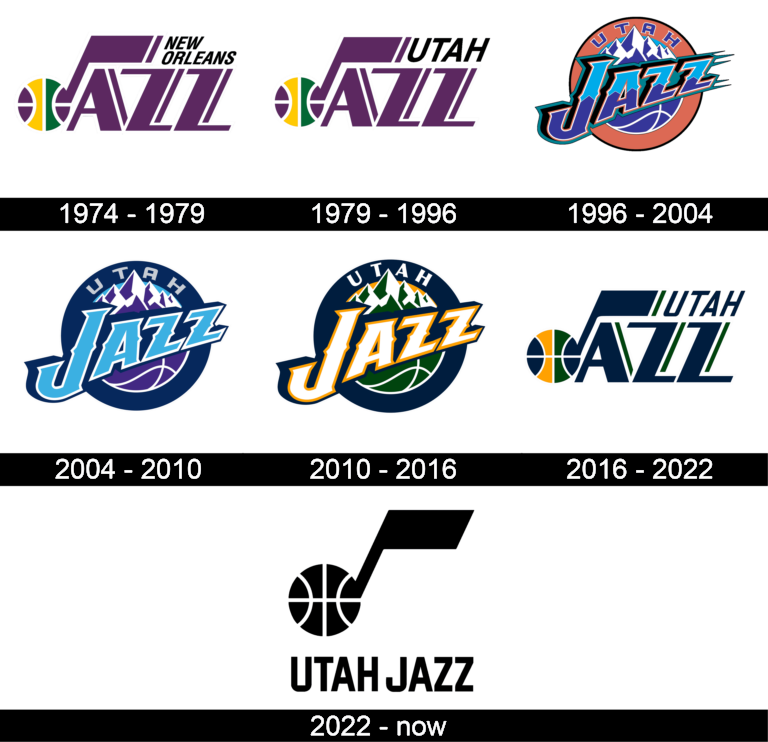
1974 – 1979: New Orleans Jazz Origins
The original Jazz logo debuted in 1974 and immediately set the foundation for everything that followed. The design centered on a stylized wordmark, with the letter “J” forming the silhouette of a musical note. Its rounded head doubled as a basketball, visually merging sport and music into a single symbol.
Rendered in purple, green, and gold, the logo balanced vibrancy with elegance. The “New Orleans” inscription appeared above the wordmark, anchoring the identity geographically while reinforcing its cultural roots. This logo established one of the most conceptually intelligent wordmarks in NBA history.
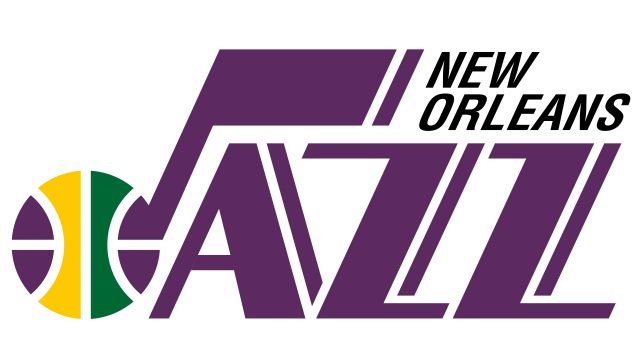
1979 – 1996: Transition to Utah
Following the franchise’s relocation, the logo remained virtually unchanged. The only modification involved replacing “New Orleans” with “Utah,” a subtle adjustment that preserved visual continuity. Over the next seventeen years, this version became deeply embedded in NBA culture.
By resisting unnecessary redesign, the Jazz strengthened brand recognition nationwide. The logo symbolism—music transformed into motion—continued to resonate even as the team adapted to a new home.
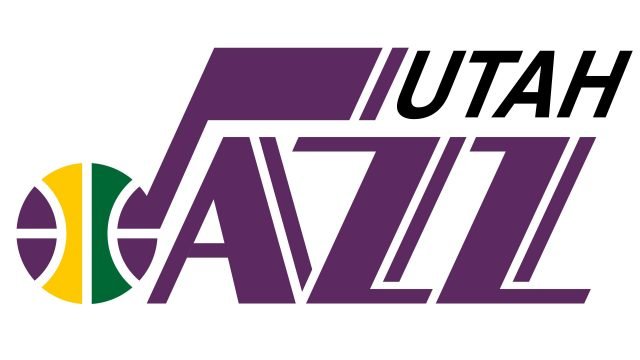
1996 – 2004: Mountain Identity Era
In 1996, the Jazz introduced a more complex emblem reflecting Utah’s landscape. A circular badge featuring stylized mountains replaced the minimalist wordmark focus. The “Jazz” lettering was reinterpreted in angular forms, layered diagonally across the badge.
While visually distinctive, this design marked a departure from the franchise’s original logo meaning. Music took a secondary role, replaced by regional symbolism. Though popular during its era, the logo felt more like a snapshot of 1990s sports design than a timeless identity.
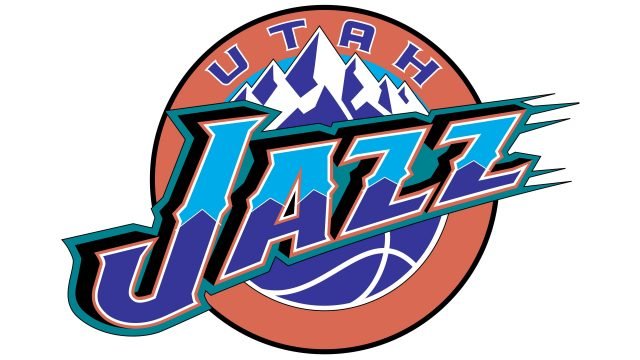
2004 – 2010: Refined Modernization
The 2004 update strengthened outlines and deepened colors, giving the mountain badge more visual weight. Darker blues and purples improved contrast, while refined contours enhanced legibility.
Despite these improvements, the logo remained conceptually distant from the Jazz’s original visual DNA. The emphasis stayed on geography rather than musical heritage.

2010 – 2016: Color Evolution Phase
In 2010, the Jazz adjusted the palette once again, introducing brighter blues, greens, and subtle yellow accents. The shapes were cleaned and simplified, aligning with modern digital display needs.
Although technically polished, this era highlighted a growing desire among fans for a stronger connection to the team’s original logo heritage.

2016 – 2022: Return to the Wordmark
Responding to that sentiment, the Jazz reintroduced their classic wordmark in 2016. The musical-note “J” returned, now rendered in updated colors suited for contemporary branding. The typography was slightly tightened, and the “Utah” inscription adopted a sleeker sans-serif form.
This redesign marked a philosophical shift: refinement over reinvention. The franchise acknowledged that its strongest identity had always been rooted in typography and symbolism rather than illustration.

2022 – Today: Minimalist Core Identity
The current logo embraces simplicity with confidence. A black basketball paired with a stylized “J” forms the central emblem, stripped of excess detail. The accompanying “UTAH JAZZ” wordmark grounds the design with clarity and authority.
This version functions exceptionally well across digital platforms, merchandise, and broadcast graphics. More importantly, it reconnects the franchise with the core elements that defined its original logo meaning.
Logo Symbolism: Music, Motion, and Discipline
The Utah Jazz logo is a masterclass in symbolic economy. The musical-note “J” communicates rhythm and improvisation, while the basketball integrates the sport seamlessly into the composition. Together, they convey movement, timing, and precision—qualities shared by both jazz music and professional basketball.
The absence of character imagery ensures longevity. Unlike logos tied to mascots or trends, the Jazz wordmark remains adaptable, timeless, and instantly recognizable.
Color choices further reinforce symbolism. Blues and greens evoke stability and balance, while gold accents introduce energy and highlight key elements without overwhelming the design.
Utah Jazz Logo Heritage and Cultural Identity
The Jazz logo heritage reflects a rare willingness to listen to history. Rather than pursuing constant reinvention, the franchise learned from its past, identifying which elements truly resonated with fans.
This approach mirrors successful patterns seen throughout classic NBA logo history, where brands endure not because they change often, but because they change thoughtfully. The Utah Jazz logo stands today as both a contemporary sports mark and a tribute to its original creative vision.
Utah Jazz Logo History: From New Orleans Roots to Modern Revival
The Utah Jazz logo history proves that strong design does not need constant disruption to remain relevant. By returning to its roots and refining what already worked, the franchise reaffirmed the power of logo heritage, symbolism, and restraint.
In a league where visual identities frequently chase trends, the Jazz chose clarity, continuity, and meaning. The result is a logo that honors its origin while remaining firmly positioned in the modern NBA landscape.
FAQ: Utah Jazz Logo Meaning and History
What does the Utah Jazz logo represent?
The logo represents the fusion of music and basketball, symbolized through a musical-note “J” that doubles as a basketball element.
Why did the Utah Jazz return to their original logo style?
The franchise recognized that its original wordmark carried stronger emotional recognition and long-term brand value.
Has the Utah Jazz logo changed often?
While there have been several redesigns, the core concept introduced in 1974 has remained central to the team’s identity.
What colors define the Utah Jazz logo today?
The modern palette focuses on dark blue, green, gold, and black, emphasizing clarity and versatility.