Orlando Magic Logo History
The old version of this article named no owner, treated the Shaquille O’Neal era as if it simply continued past 1996, and described both Orlando Magic NBA Finals runs without saying the team lost either series. It also claimed a “2025 emblem-first redesign” that removed the wordmark entirely and placed the basketball inside a solid black badge, a description that does not match what the Magic actually unveiled. This rewrite adds the DeVos family ownership history, Shaquille O’Neal’s 1996 departure to the Lakers, the results of the 1995 and 2009 NBA Finals, the Dwight Howard trade saga that ended in August 2012, and a corrected account of the real 2025 rebrand, based on multiple reputable sources.
Among the NBA’s modern-era franchises, the Orlando Magic occupy a unique place. Founded in 1989, the Magic are young by league standards, yet their history already includes defining moments, generational stars, and a logo that has stayed focused on a single theme for more than three decades. The franchise has reached the NBA Finals twice, in 1995 and 2009, and lost both series, while also capturing multiple division titles and establishing itself as a consistent presence in the Eastern Conference.
From the beginning, Orlando’s brand was built around imagination rather than intimidation. The name itself suggested wonder, motion, and possibility, a deliberate contrast to the more aggressive identities common in professional sports. Within the broader context of NBA logo history and basketball brand heritage, the Orlando Magic logo tells the story of a franchise that built its identity by committing to one clear concept and refining it over time rather than reinventing itself every few years.
Who Owns the Orlando Magic?
The Magic entered the NBA in 1989 as an expansion franchise. The original ownership bid was led by Jim Hewitt and Pat Williams, with investors including William duPont, Don Dizney, and Jim and Steve Caruso; the expansion fee was reported at $32.5 million. That original ownership group did not last long. On September 19, 1991, Rich DeVos, the co-founder of Amway, bought the franchise for a reported $85 million. The team has operated under the DeVos family and its holding company, RDV Sports, ever since. Rich DeVos began transferring day-to-day ownership responsibilities to his children in the mid-2000s, and after his death in September 2018, the family’s ownership structure continued through his children, with Dan DeVos listed as chairman of RDV Sports. The old version of this article never named an owner at all; the DeVos family’s more than three decades of ownership is one of the more stable arrangements in the NBA.
Meaning and History: A Franchise Built on Wonder
In NBA terms, Orlando is a young city. When the Magic entered the league in 1989, the franchise was planted in a market better known for theme parks than professional basketball. Early skepticism was inevitable, but the team’s identity was never meant to mirror traditional powerhouses. Instead, it leaned into the city’s sense of spectacle, optimism, and creativity.
That philosophy carried onto the court, though not always to a championship. Shaquille O’Neal, the top pick in the 1992 draft, and Penny Hardaway turned the Magic into one of the league’s most-watched young teams, reaching the 1995 NBA Finals. Houston, the defending champion led by Hakeem Olajuwon, swept Orlando 4-0 in a series played from June 7 to June 14, 1995. The loss stung, and it was followed by an even bigger blow: in July 1996, O’Neal left Orlando as a free agent and signed with the Los Angeles Lakers, a departure that reshaped the franchise and remains one of the most-discussed moments in Magic history. Reporting from the time, including later retrospectives from outlets such as CBS Sports, describes the Magic’s front office being outmaneuvered in the final negotiations, though accounts of exactly what went wrong differ.
More than a decade later, Dwight Howard led a second Finals run. Orlando beat Cleveland in the 2009 Eastern Conference Finals before facing the Lakers, who had since added Pau Gasol around Kobe Bryant. Los Angeles won the series 4-1, clinching the title in Game 5 on June 14, 2009, with Bryant named Finals MVP. Howard’s time in Orlando ended less cleanly than Shaq’s. Starting in 2011 he requested trades to several teams, rescinded the request, signed a short-term deal in March 2012, then suffered a herniated disk that required back surgery and ended his season. The saga, widely nicknamed “Dwightmare” by the national media, resumed that June when Howard again demanded a trade. On August 10, 2012, Orlando completed a four-team trade sending Howard to the Lakers, closing out an era the old version of this article never acknowledged ending at all.
Through every competitive cycle, the Magic’s logo tone remained consistent even as rosters changed. Stars, motion lines, and a cosmic basketball became the foundation of a brand that emphasized imagination and aspiration over brute force.
Orlando Magic Logo History Timeline
1989-2000: The Birth of the Magic
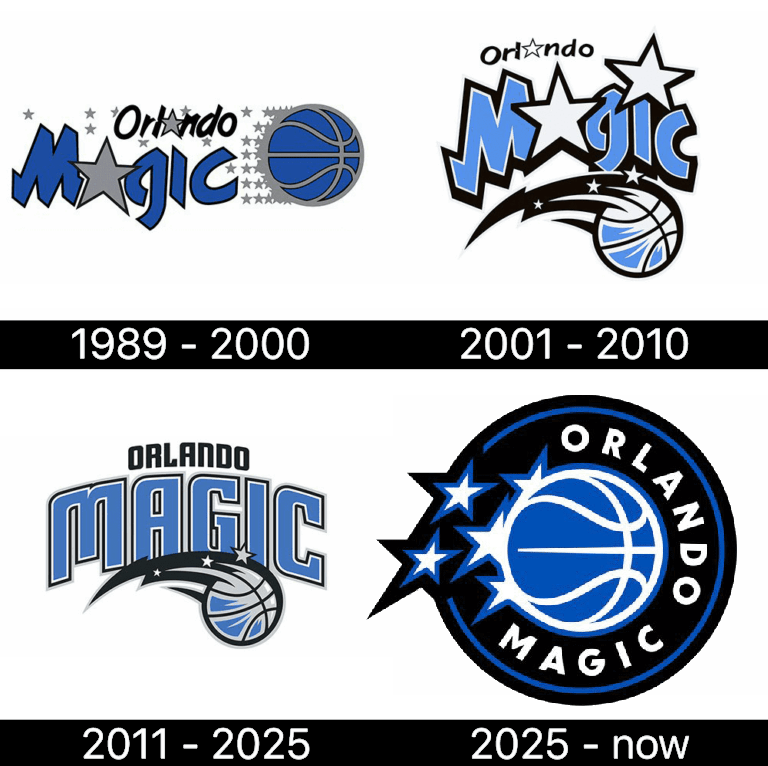
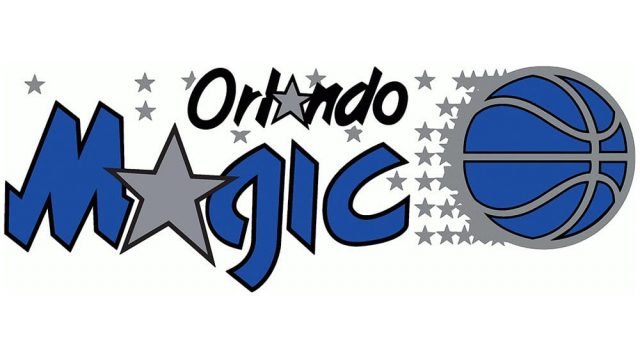
The original Orlando Magic logo, introduced in 1989, established nearly all of the franchise’s long-term visual DNA. A blue basketball, outlined in gray, streaked diagonally across the emblem, suggesting speed and lift. To the left, a custom two-line wordmark appeared in a playful handwritten style.
Two five-pointed stars replaced both “A” letters in “Magic,” subtly reinforcing the theme of fantasy and celestial motion. Rendered in blue, black, and gray, the logo balanced whimsy with professionalism, a rare combination for a brand-new expansion franchise.
2000-2010: Motion and Expansion
In 2000, the Magic refined their original concept rather than replacing it. The wordmark was repositioned above the basketball, while additional stars were introduced along the motion trail, emphasizing speed and continuity. A larger star was placed above the “I” in “Magic,” further anchoring the brand’s cosmic identity.
The color palette was brightened, with electric blues becoming more prominent. Black accents were retained to maintain contrast and visual discipline. This era coincided with the franchise’s transition from early novelty to established playoff contender, and it is this version of the streaking ball-and-stars mark that the 2025 rebrand would later revive.

2011-2025: Modernization and Control
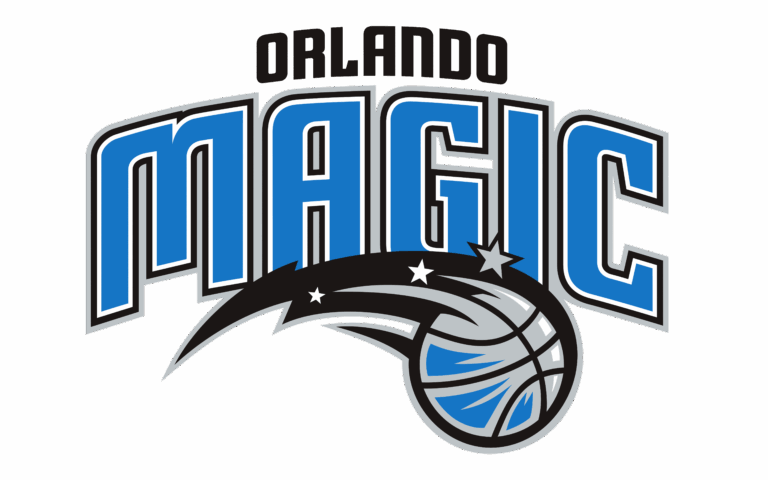
A major wordmark redesign arrived in 2011. While the basketball-and-stars emblem remained intact, the typography shifted dramatically. “Magic” was rendered in bold, uppercase sans-serif lettering, executed in light blue and outlined in black and white. The “Orlando” designation appeared above the emblem in solid black, providing hierarchy and clarity.
This version reflected a more mature franchise. Playfulness gave way to structure and legibility, aligning the Magic with the cleaner lettering style common across the NBA in the early 2010s while preserving the team’s core symbolism. This mark served as the Magic’s primary identity for roughly a decade and a half, longer than any previous version.
2025-Today: A Return to the Original Look
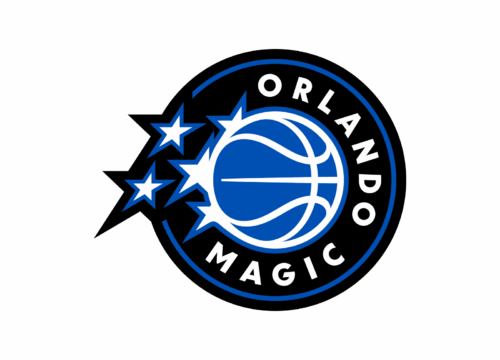
The old version of this article claimed that a 2025 redesign removed the wordmark entirely and placed a redrawn basketball inside a solid black circular badge. That description does not match what the Magic actually introduced. On June 3, 2025, at a reveal event at the Kia Center in Orlando, the team unveiled its first major logo and uniform update since the 2008-09 season, and the change moved toward the franchise’s past rather than toward a minimal, emblem-only mark.
According to reporting from CBS Sports, sports-logo trade outlet SportsLogos.net, and Orlando Fox affiliate coverage of the reveal event, the new identity revives the cascading star trail from the 1989-2000 “streaking ball” design and replaces the letter “A” with a star in both “Orlando” and “Magic” on the wordmark. The uniform set returned to a pinstriped look modeled on the team’s 1989-98 and 1991-97 warm-up gear, with three jerseys: a white Association uniform, a blue Icon uniform, and a black Statement uniform made by Jordan Brand. The team’s City uniform was also recolored to match the restored blue-and-silver scheme. In short, the 2025 update is best described as a nostalgia-driven refresh of the franchise’s earliest logo, not an emblem-first, wordmark-free redesign.
Logo Symbolism: Stars, Space, and Motion
Every version of the Orlando Magic logo has kept the same three symbolic elements: stars, motion, and a basketball treated as something closer to a comet than a piece of sporting equipment. The stars reference the team’s name and the sense of wonder the franchise wanted to project from its first season, rather than any specific constellation or local landmark. The streaking trail behind the basketball suggests speed and flight, reinforcing the idea of the ball as a magical object rather than a static shape. Even as the typography and color saturation changed across four decades, the Magic never abandoned this basic visual story, which is why the 2025 rebrand could return to the 1989-2000 version and still feel like the same brand rather than a nostalgia gimmick.
Typography and Color Identity
Blue has anchored the Orlando Magic’s color identity since 1989, moving from a muted, grayish blue in the original mark to a brighter, more saturated blue by 2000, and settling into the current blue-and-silver scheme introduced in 2025. Black has served as a supporting contrast color in every era, used for outlines and lettering rather than as a dominant field color. The wordmark has changed the most dramatically over time: a handwritten, informal script in 1989 gave way to cleaner but still rounded lettering in 2000, then a bold, structured uppercase sans-serif in 2011. The 2025 version keeps a bold uppercase treatment but reintroduces the star-as-letter device from the original 1989 wordmark, making it the first redesign in the franchise’s history to deliberately echo an earlier logo rather than move away from it.
Uniforms as Brand Continuity
Orlando’s uniforms have tracked closely with its logo history rather than following separate design cycles, which is unusual among NBA franchises. The pinstriped look and star-marked shorts from the team’s earliest seasons were retired for a cleaner, more generic look in the 2000s and 2010s, then restored almost exactly for the 2025-26 season. The reintroduction of a Jordan Brand Statement uniform modeled on the 1991-97 road warm-up gear is a direct, acknowledged callback rather than a new direction, which fits the broader pattern of the Magic treating their late-1980s and 1990s identity as the franchise’s definitive visual era.
Conclusion
The Orlando Magic’s logo history is short by NBA standards but unusually coherent. A single concept, stars and motion wrapped around a basketball, has carried the franchise through an expansion launch, two Finals losses, the departure of two franchise-defining stars under very different circumstances, and a 2025 rebrand that chose to look backward rather than forward. The DeVos family’s ownership since 1991 has provided a stability that few other NBA franchises can claim, even through the on-court turbulence of the Shaq and Dwight Howard eras. Understanding that full history, rather than a vague outline of “defining moments,” is what separates an accurate account of the Orlando Magic logo heritage from a generic one.
Quick Facts
| Date/Fact | Event/Detail |
|---|---|
| 1989 | Orlando Magic founded as an NBA expansion team; original logo debuts with a streaking blue basketball and star-shaped “A” letters |
| September 19, 1991 | Rich DeVos, co-founder of Amway, buys the Magic for a reported $85 million; the team is operated under RDV Sports |
| 1992 | Shaquille O’Neal drafted No. 1 overall by Orlando |
| June 7-14, 1995 | Magic reach their first NBA Finals and are swept 4-0 by the Houston Rockets |
| July 1996 | Shaquille O’Neal leaves Orlando as a free agent and signs with the Los Angeles Lakers |
| 2000 | Second-era logo introduced; wordmark moves above the basketball and the star trail expands |
| June 4-14, 2009 | Magic reach their second NBA Finals and lose 4-1 to the Los Angeles Lakers |
| 2011 | Third wordmark redesign: bold uppercase lettering in light blue, outlined in black and white |
| August 10, 2012 | Dwight Howard traded to the Lakers in a four-team deal after the prolonged “Dwightmare” trade saga |
| June 3, 2025 | Magic unveil a 1990s-inspired rebrand: the cascading star trail returns, a star replaces the “A” in the wordmark, and pinstriped uniforms are restored |
Further Reading
- Orlando Magic franchise history on Wikipedia
- 1995 NBA Finals: Houston Rockets sweep Orlando Magic
- 2009 NBA Finals: Los Angeles Lakers defeat Orlando Magic
- CBS Sports: Magic unveil new logo and uniforms in 1990s-inspired rebrand
FAQ
What do the stars on the Orlando Magic logo mean?
They represent the sense of wonder and fantasy behind the team’s name rather than any specific place or event. Stars have replaced the letter “A” in the wordmark since the original 1989 logo, and the 2025 rebrand brought that device back after it was dropped in 2011.
Has the Orlando Magic logo changed since 1989?
Yes, several times. The emblem was adjusted in 2000, the wordmark was substantially redesigned in 2011, and in June 2025 the team unveiled a rebrand that restored the original 1989-2000 star-and-motion design rather than replacing it with something new.
Did the Orlando Magic actually remove their wordmark in a 2025 “emblem-first” redesign?
No. That description is not accurate. The 2025 update, unveiled June 3, 2025, kept and modified the wordmark, reintroducing a star in place of the letter “A,” and paired it with pinstriped uniforms inspired by the team’s 1989-98 look.
Who owns the Orlando Magic?
The DeVos family has owned the Magic since September 19, 1991, when Rich DeVos, the co-founder of Amway, bought the franchise for a reported $85 million. The team continues to operate under the family’s RDV Sports ownership group.
Did the Orlando Magic ever win an NBA championship?
No. The Magic have reached the NBA Finals twice, in 1995 and 2009, and lost both series, to the Houston Rockets and the Los Angeles Lakers respectively.