Minolta Logo History: The Autofocus Win That Cost $127 Million

Minolta spent decades building a reputation as one of the sharpest camera makers in Japan, and its 1985 autofocus SLR system became so central to that reputation that it also became the company’s biggest legal liability: a 1992 jury found Minolta had built that system on technology it didn’t own, ordering it to pay Honeywell more than $127 million. Eleven years later, Minolta merged with Konica, and three years after that, the camera business itself was sold off to Sony.
How did Minolta actually start, and what happened to the autofocus technology it was famous for?
Kazuo Tashima founded the company in Osaka in November 1928 as Nichi-Doku Shashinki Shoten, meaning “Japanese-German Photography Shop,” reflecting early technical cooperation with German optical engineers. The company released its first camera, the Nifcarette, in 1929, and later adopted the name Minolta, commonly explained as standing for “Mechanism, Instruments, Optics, and Lenses by Tashima.”
Minolta’s best-known achievement came in 1985 with the Maxxum 7000 (sold as the Alpha 7000 in Japan and the Dynax 7000 in Europe), the first SLR camera with a fully integrated autofocus system built into the camera body rather than the lens. The launch was a commercial triumph, but it led directly to the single biggest event in the company’s history that the old version of this article never mentioned: Honeywell sued Minolta, arguing the autofocus system infringed its own patents, and in February 1992 a Minneapolis jury ordered Minolta to pay Honeywell $96.4 million in damages. The case settled shortly after for roughly $127.5 million once pre-judgment interest was added, one of the largest patent-infringement verdicts of its era, and Honeywell went on to extract similar settlements from other camera makers using the same Minolta-derived precedent.
Minolta merged with Konica in 2003, forming Konica Minolta Holdings, and continued making cameras under the Minolta name for a few more years. On 19 January 2006, Konica Minolta announced it was withdrawing from the camera and photo business entirely, transferring its digital camera assets and some photographic patents to Sony, and ceased camera operations on 31 March 2006. Sony’s Alpha-mount digital SLR line, launched later that year, was built directly on Minolta’s lens mount and sensor-autofocus technology, meaning Minolta’s optical engineering lives on inside Sony cameras rather than inside Konica Minolta, which continued on as a business-technology and printing company.
Logo evolution
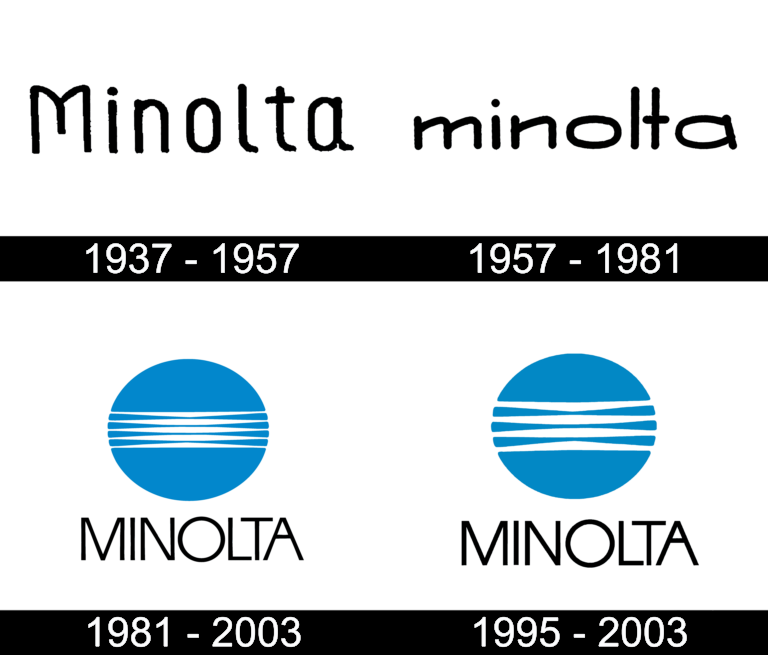
1937-1957: a handwritten wordmark
The first recognizable Minolta logo, introduced in 1937, paired a capitalized “M” with lowercase lettering in a blocky, semi-handwritten style, giving the young manufacturer a more established look.

1957-1981: a cleaner, lowercase wordmark
The 1957 update replaced the handwritten feel with a uniform, lowercase wordmark and squared-off letterforms, matching the company’s growing reputation as a serious engineering manufacturer in the post-war years.

1981-2003: the blue globe
Minolta introduced its blue circular emblem above the wordmark in 1981, later formalized as a globe crossed by five white lines representing beams of light, a conceptual nod to imaging and optics rather than a literal product or mascot. This version stayed in use through the autofocus era and the 2003 Konica merger.

2003: the final Minolta mark
The version used until the Konica merger kept the blue globe but rendered the wordmark in a custom sans-serif typeface. The blue used in the emblem was later carried forward as “Konica Minolta Blue” in the merged company’s branding.
Typography and color
Minolta’s final wordmark used a clean, medium-weight sans-serif with no ornamentation. Blue in the globe emblem signaled precision and technology, white represented light and clarity, and black in the wordmark added contrast and authority.
Quick facts
| Founded | November 1928, Osaka, by Kazuo Tashima, as Nichi-Doku Shashinki Shoten |
| First camera | The Nifcarette, released 1929 |
| First integrated-autofocus SLR | Maxxum/Alpha/Dynax 7000, 1985 |
| Honeywell patent verdict | $96.4 million jury verdict, February 1992; settled around $127.5 million |
| Merger with Konica | 2003, forming Konica Minolta Holdings |
| Camera business sold to Sony | Announced 19 January 2006; operations ceased 31 March 2006 |
Related reading
Further reading
FAQ
How did Minolta actually start?
Kazuo Tashima founded it in Osaka in November 1928 as Nichi-Doku Shashinki Shoten, a camera shop built on early cooperation with German optical engineers, releasing its first camera, the Nifcarette, in 1929.
Did Minolta get sued over its autofocus technology?
Yes. Honeywell sued Minolta over the autofocus system in its 1985 Maxxum 7000, and a jury ordered Minolta to pay $96.4 million in February 1992, a case that settled around $127.5 million.
What happened to Minolta’s camera business?
Minolta merged with Konica in 2003. In January 2006, Konica Minolta announced it was exiting the camera business and sold its digital camera assets to Sony, ending camera production that March.
Does Minolta’s technology still exist in any current cameras?
Yes. Sony’s Alpha-mount digital SLR cameras, launched later in 2006, were built on the lens mount and sensor-autofocus technology Konica Minolta transferred to Sony.