Credit Suisse Logo History Since 1856

Credit Suisse stopped existing as an independent bank after a 2023 crisis forced an emergency takeover. On 19 March 2023, UBS announced it would acquire Credit Suisse for CHF 3 billion ($3.25 billion) in an all-stock deal brokered by Swiss authorities, with the Swiss National Bank providing a CHF 50 billion liquidity loan to stabilize the bank during the crisis. The deal closed in June 2023, and Credit Suisse’s roughly $17 billion in AT1 bonds were written down to zero on regulators’ orders, a decision that drew criticism from European regulators and later legal challenges; by July 2024, Credit Suisse’s Swiss entity had been fully absorbed into UBS and the brand retired, none of which the old article clearly stated, despite vaguely alluding to “a new context shaped by structural and strategic changes” in its final section.
What actually happened to Credit Suisse in 2023?
Credit Suisse was founded in Switzerland in 1856 and built its reputation over more than 160 years as one of Europe’s most prominent banks. That history ended abruptly in March 2023. Following a crisis of confidence driven by years of scandals, losses, and client withdrawals, UBS announced on 19 March 2023 that it would acquire Credit Suisse for CHF 3 billion ($3.25 billion) in an all-stock transaction, negotiated over a single weekend with the Swiss government, the Swiss Financial Market Supervisory Authority (FINMA), and the Swiss National Bank, which provided a CHF 50 billion liquidity assistance loan to keep the bank afloat during the crisis.
The single biggest gap in the old version is that it never names this collapse directly. As part of the deal, Swiss regulators ordered that Credit Suisse’s roughly $17 billion in Additional Tier 1 (AT1) bonds be written down to zero, a move that left bondholders with losses while shareholders retained some value, drawing criticism from European regulators over the unusual order of losses and prompting bondholder lawsuits; an October 2025 ruling found that FINMA had lacked a legal basis for the write-down. The acquisition closed in June 2023, and by July 2024, Credit Suisse (Schweiz) AG had been fully integrated into UBS Switzerland, ending the Credit Suisse brand’s run as an independent identity.
Credit Suisse Logo Evolution Timeline
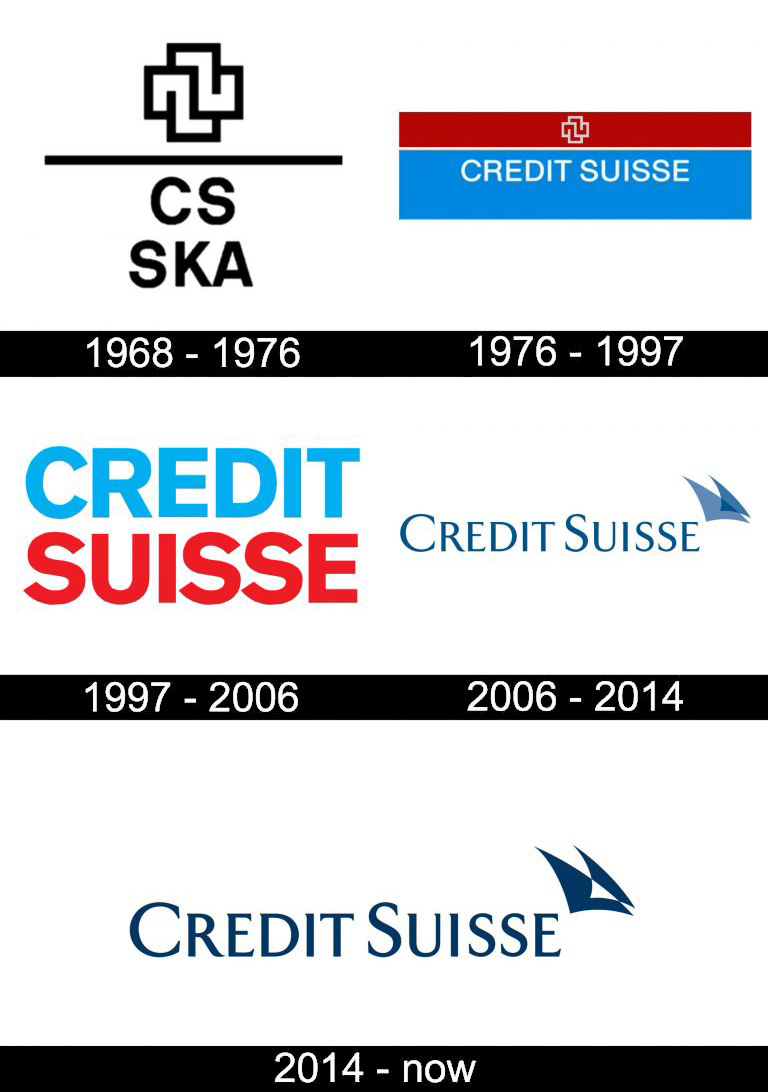
1968: a corporate abbreviation
The 1968 logo displayed the letters “CS” above “SKA” in an all-caps sans-serif typeface, topped by a geometric icon of rectangular shapes, presenting the bank as a modern, structured institution.

1976: Swiss flag influence
The 1976 redesign echoed the Swiss flag’s structure, with a red upper field containing the emblem and a blue lower field spelling out “Credit Suisse” in white uppercase letters.

1997: name and color simplification
The 1997 version dropped the earlier graphic elements for the name alone, set on two lines with “Credit” in blue and “Suisse” in red, a subtle reference to the Swiss flag without an explicit symbol.

2006: the twin sails
In 2006, as Credit Suisse unified several divisions under one brand, it introduced a serif wordmark alongside an emblem of two abstract sail shapes in different blue tones, a nautical reference to forward progress, paired with a royal blue and white palette.

2014: refined contrast
A 2014 update darkened the blue tones slightly for better legibility across digital and print applications, without altering the logo’s underlying structure.

2022-2023: the final chapter
The logo used from 2022 carried into 2023, when UBS’s emergency takeover brought Credit Suisse’s run as an independent brand to an end; by mid-2024 the Credit Suisse name had been fully retired and absorbed into UBS.
Logo symbolism
The twin sails introduced in 2006 were generally read as representing progress and navigation, a metaphor for steering through global financial markets. Earlier versions leaned on Swiss national colors and geometric order to project stability, a theme that ran through every redesign until the bank’s 2023 collapse ended its independent identity entirely.
Typography and color
Credit Suisse moved from sans-serif abbreviations in its earliest logo to a refined serif wordmark resembling TF Arrow from 2006 onward. Blue and white formed the core palette from the 1990s on, after red and blue Swiss flag references defined the brand’s earlier decades.
Quick facts
| Founded | 1856, Switzerland |
| UBS acquisition announced | 19 March 2023, CHF 3 billion ($3.25 billion) |
| Swiss National Bank support | CHF 50 billion liquidity loan |
| AT1 bonds written down | About $17 billion, to zero |
| Deal closed | June 2023 |
| Brand fully retired | By July 2024, absorbed into UBS Switzerland |
Related reading
Further reading
FAQ
Does Credit Suisse still exist?
No. UBS acquired Credit Suisse in an emergency deal announced 19 March 2023 and closed that June, and by July 2024 Credit Suisse’s Swiss entity had been fully absorbed into UBS, retiring the brand.
How much did UBS pay for Credit Suisse?
UBS agreed to pay CHF 3 billion ($3.25 billion) in an all-stock deal, with the Swiss National Bank separately providing a CHF 50 billion liquidity loan to stabilize Credit Suisse during the crisis.
What happened to Credit Suisse’s AT1 bondholders?
Swiss regulators ordered about $17 billion in Credit Suisse AT1 bonds written down to zero as part of the deal, a decision later challenged in court, with an October 2025 ruling finding the regulator lacked a legal basis for it.
What did the twin sails in the Credit Suisse logo represent?
Introduced in 2006, the twin sails were generally read as a nautical metaphor for progress and navigating global financial markets.