SoFi Logo Explained
SoFi‘s founding CEO, Mike Cagney, resigned on 11 September 2017 amid allegations of sexual harassment and of skirting the company’s own risk and compliance controls. SoFi went public four years later through a SPAC merger backed by Chamath Palihapitiya, raising up to $2.4 billion at a $9 billion valuation and beginning trading on the Nasdaq as SOFI on 1 June 2021; in January 2022, the Office of the Comptroller of the Currency approved SoFi’s national bank charter, making it the first full-service fintech startup to receive a US banking license. SoFi also paid about $30 million a year for 20 years to put its name on the Los Angeles Rams’ and Chargers’ stadium, a deal announced in September 2019 and described at the time as a record for sports venue naming rights, none of which the old article mentioned at all.
Who founded SoFi, and why did its first CEO leave?
Mike Cagney, Dan Macklin, James Finnigan, and Ian Brady, all Stanford Graduate School of Business students, founded Social Finance, known as SoFi, in August 2011 as a student-loan refinancing platform. Cagney led the company as CEO until 11 September 2017, when he announced his departure by year’s end following allegations of sexual harassment and circumventing the company’s own risk and compliance controls. Anthony Noto has served as CEO since 2018.
The single biggest gap in the old version is what happened to SoFi after its founding. In September 2019, SoFi agreed to a 20-year stadium naming rights deal with the Los Angeles Rams and Los Angeles Chargers worth about $30 million annually, a record for sports venue naming rights at the time; SoFi Stadium opened in Inglewood, California in 2020. SoFi went public on 1 June 2021 through a SPAC merger backed by investor Chamath Palihapitiya, raising up to $2.4 billion at a $9 billion valuation and beginning trading on the Nasdaq under the ticker SOFI. In January 2022, the Office of the Comptroller of the Currency approved SoFi’s application for a national bank charter, making it the first full-service financial-technology startup to receive a US banking license.
SoFi Logo Evolution Timeline
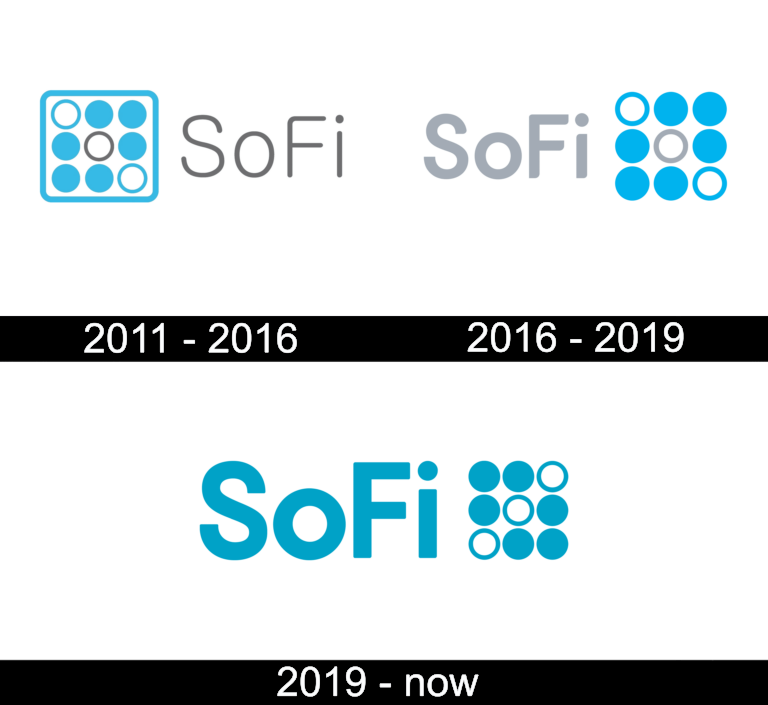
2011: the founding mark
SoFi’s first logo, introduced alongside its 2011 launch as a student-loan refinancing platform, featured a geometric symbol of multiple circles of varying sizes arranged within a square, rendered in blue, paired with a clean sans-serif “SoFi” wordmark with a detached dot above the “i.”

2016: refinement and balance
As SoFi expanded beyond student loans into other financial products, the 2016 update paired a soft grey wordmark with a vivid blue circular symbol, with a single grey circle disrupting the pattern for a more dynamic look.

2019-today: a unified cyan identity
The current logo, introduced in 2019, the same year as the stadium naming deal, adopted a single vibrant cyan color across both the wordmark and symbol, simplifying the palette for better consistency across apps, websites, and marketing.
Logo symbolism
The recurring circles in SoFi’s logo are generally read as representing connection and community, consistent with the company’s origins as a peer-funded student-loan platform before it expanded into banking, investing, and insurance. The shift to a single cyan color in 2019 moved the brand away from the more conservative blue tones typical of traditional financial institutions.
Typography and color
SoFi uses a clean sans-serif wordmark mixing uppercase and lowercase letters. The brand used blue for its first two logo eras before switching entirely to a bright cyan in 2019, a palette shift timed to SoFi’s growth into a broader financial platform.
Quick facts
| Founded | August 2011, by Mike Cagney, Dan Macklin, James Finnigan, and Ian Brady |
| Cagney’s resignation | 11 September 2017, amid harassment and compliance allegations |
| Stadium naming deal | September 2019, 20 years, about $30 million a year |
| SPAC merger / IPO | 1 June 2021, Nasdaq: SOFI, $9 billion valuation |
| National bank charter | Approved January 2022 by the OCC |
| Current CEO | Anthony Noto, since 2018 |
Related reading
Further reading
FAQ
Who founded SoFi?
Mike Cagney, Dan Macklin, James Finnigan, and Ian Brady, four Stanford Graduate School of Business students, founded SoFi in August 2011.
Why did SoFi’s first CEO resign?
Mike Cagney announced his departure on 11 September 2017 following allegations of sexual harassment and circumventing the company’s own risk and compliance controls.
How did SoFi go public?
SoFi went public on 1 June 2021 through a SPAC merger backed by investor Chamath Palihapitiya, beginning trading on the Nasdaq under the ticker SOFI at a $9 billion valuation.
Does SoFi have a banking license?
Yes. The Office of the Comptroller of the Currency approved SoFi’s national bank charter in January 2022, making it the first full-service fintech startup to receive one.