New Balance Logo Since 1906
New Balance‘s defining ownership moment lines up almost exactly with its defining design moment: Jim Davis bought the then-struggling arch-support company in 1972 at age 28, the same year designer Terry Heckler created the “N” logo with speed lines that the brand still uses today. Davis remains chairman and the company stayed privately held, reporting $6.5 billion in revenue for 2023 with about 8,000 employees as of 2024. The brand also weathered a 2011 class-action lawsuit over false advertising claims for its “toning” shoes, settled for $2.3 million in August 2012, and a 2016 political controversy after a company spokesperson’s remarks about the Trans-Pacific Partnership were widely read as a Trump endorsement, triggering a social media boycott, none of which the old article mentioned at all.
Who owns New Balance, and has the company faced any controversy?
William J. Riley founded the business in Boston in 1906 as the New Balance Arch Support Company, building orthopedic insoles rather than athletic shoes. The company stayed a small, specialized operation for decades until Jim Davis bought it in 1972 at age 28. New Balance has remained privately held under the Davis family ever since, with Jim Davis still serving as chairman and Joe Preston as CEO since December 2018. The company reported $6.5 billion in revenue for 2023 and employed roughly 8,000 people as of 2024, and it continues to manufacture shoes domestically in the United States as well as at a UK facility in Flimby, which produces about 28,000 pairs a week, around 5% of the brand’s European sales.
The single biggest gap in the old version is that New Balance’s history includes real controversy alongside its design story. In 2011, the company faced a class-action lawsuit alleging false advertising over the fitness claims made for its “toning” shoes, which it settled for $2.3 million in August 2012. In April 2016, the company’s vice president of public affairs, Matt LeBretton, commented that Donald Trump’s stance on trade agreements was closer to the company’s own opposition to the Trans-Pacific Partnership, remarks that were widely interpreted as a political endorsement; that September, chairman Jim Davis donated close to $400,000 to the Trump Victory Committee, and the combination sparked a social media boycott campaign. New Balance has opposed the Trans-Pacific Partnership on the grounds that it would hurt its US manufacturing, a position that set it apart from competitors such as Nike, which manufacture overseas and supported the agreement.
New Balance Logo History and Evolution Timeline
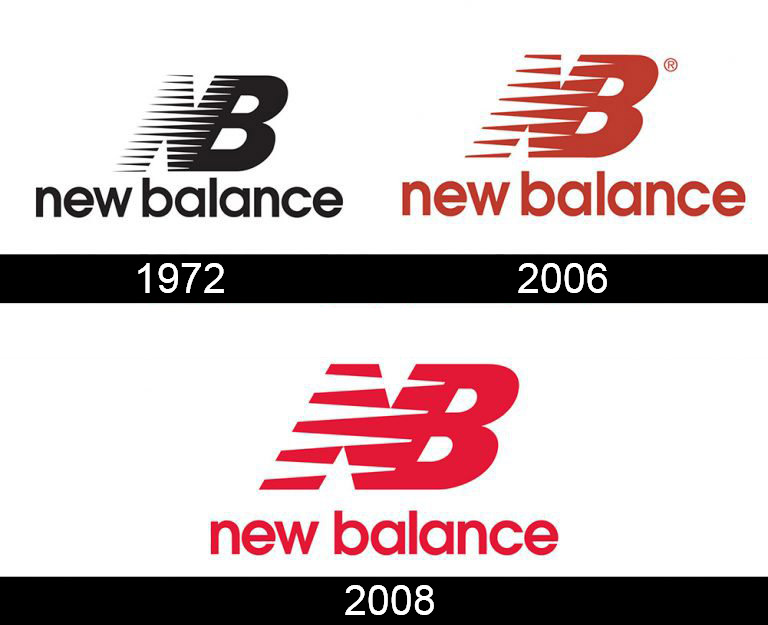
1972-2006: the original Terry Heckler design
New Balance introduced its first distinctive logo in 1972, the same year Jim Davis bought the company. Designer Terry Heckler combined the letters “N” and “B” into a single mark cut through by twelve horizontal speed lines, paired with a full “New Balance” wordmark beneath it. The design stayed largely unchanged for more than three decades.
2006-2008: fewer lines and added color
The 2006 update reduced the speed lines from twelve to seven and introduced a red “NB” mark paired with a black wordmark, giving the logo more contrast for retail displays and marketing.
2008-today: five lines and a standalone “NB” mark
A further 2008 revision cut the speed lines to five, the version still in use. The simplified mark reads clearly at small sizes, and New Balance now frequently uses the standalone “NB” emblem on its own, without the full wordmark, across footwear and apparel.
Logo symbolism
The speed lines cutting through the “N” are generally read as a reference to forward motion and running performance, while the solid block letterforms suggest stability, consistent with the company’s roots in orthopedic arch supports. New Balance has kept the core 1972 structure through every refinement, changing only the number of lines and the color treatment rather than the underlying concept.
Typography and color
The “New Balance” wordmark uses a typeface close to ITC Avant Garde Gothic Demi Bold, a geometric sans-serif originally designed by Herb Lubalin. New Balance has used red, black, and white across every version of the logo since color was introduced in 2006, a restrained palette compared to many competing athletic brands.
Quick facts
| Founded | 1906, Boston, by William J. Riley |
| Jim Davis acquisition | 1972, at age 28; still chairman today |
| Logo designer | Terry Heckler, 1972 (also designed the original Starbucks logo) |
| 2023 revenue | $6.5 billion |
| Employees (2024) | About 8,000 |
| Toning-shoe lawsuit settlement | $2.3 million, August 2012 |
Related reading
Further reading
FAQ
Who designed the New Balance logo?
Terry Heckler designed the original “N” logo in 1972, the same designer behind the original Starbucks, Cinnabon, and Panera Bread logos.
Who owns New Balance?
New Balance is privately held by the Davis family. Jim Davis bought the company in 1972 and remains chairman; it is not owned by Adidas, Nike, or any other sportswear corporation.
Has New Balance faced any controversies?
Yes. It settled a $2.3 million class-action lawsuit over toning-shoe advertising claims in 2012, and in 2016 remarks from a company spokesperson about the Trans-Pacific Partnership, combined with a large donation from chairman Jim Davis to the Trump Victory Committee, led to a social media boycott.
How many speed lines does the current logo have?
The current logo, in use since 2008, has five speed lines, down from twelve in the original 1972 design and seven in the 2006 update.