
20th Century Fox Logo History: Meaning, Symbolism & Brand Heritage

Few studio logos in cinematic history are as instantly recognizable as 20th Century Fox. Rising monumentally from an Art Deco pedestal and illuminated by sweeping searchlights, the emblem became more than a studio identifier—it became a ritual that announced the beginning of a film event. Its longevity and restrained evolution place it among the strongest examples of logo heritage in global entertainment.
Although the company’s roots stretch back to 1915, the visual identity that defined 20th Century Fox was born in the 1930s and endured for nearly a century. Even after the brand’s transformation into 20th Century Studios, the essence of the logo remains intact, proving the lasting power of a well-conceived cinematic symbol.
Meaning and History: The Origin of the 20th Century Fox Logo
The studio that would become 20th Century Fox was formed in 1935 through the merger of Fox Film Corporation and Twentieth Century Pictures. From the outset, the company sought a logo that conveyed scale, authority, and modernity—qualities aligned with Hollywood’s Golden Age ambitions.
The task of visualizing this identity fell to Emil Kosa Jr., a legendary matte painter whose background in architectural realism shaped the logo’s monumental character. Rather than a flat mark or simple wordplate, Kosa conceived a three-dimensional structure inspired by Art Deco architecture, then at its peak in the United States.
The result was a logo that looked less like branding and more like a physical landmark—something that could plausibly exist within the cinematic world it introduced.
20th Century Fox Logo History Timeline
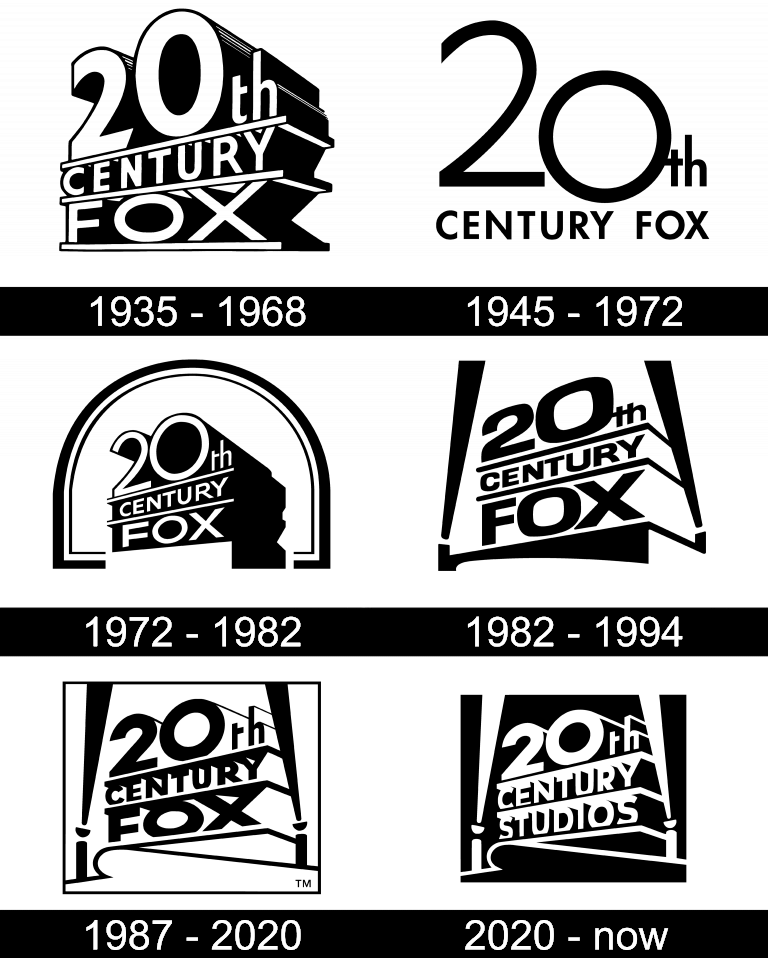
1935–1968: The Art Deco Monument
The original 1935 logo established the foundational composition that would define the brand for decades. It featured a three-tier structure divided by bold horizontal lines. The top tier displayed an oversized “20th,” followed by “Century” in the middle and “Fox” at the base.
The letters were rendered in white with dark outlines and shadows, creating a strong three-dimensional effect. The perspective was set at a three-quarter angle, enhancing the illusion of depth and architectural mass. This version immediately communicated grandeur, permanence, and cinematic prestige.

1945–1972: A Flat Modernist Interlude
In 1945, 20th Century Fox departed from its iconic structure in favor of a flatter, more restrained emblem. The “20th” remained dominant, positioned above “Century Fox,” but the design abandoned depth and ornamentation.
The typography shifted to a clean, modern sans-serif, reflecting post-war design sensibilities and a broader industry move toward simplicity. While functional and contemporary, this version lacked the mythic quality of the original and remained in use for 27 years without achieving the same cultural impact.

1972–1982: Return to Monumentality
The early 1970s marked a return to form. In 1972, the three-story structure reappeared, now enclosed within a double frame with an arched top. The lettering was updated with a more contemporary sans-serif typeface, improving clarity while restoring architectural presence.
This version bridged past and present, reestablishing the logo as a cinematic landmark rather than a corporate wordmark.

1982–1994: The Searchlight Era Begins
In 1982, the logo underwent its most influential redesign, led by Landor Associates. The emblem was placed against a dark sky, flanked by moving searchlights—an addition that transformed the logo from static image into cinematic spectacle.
This version laid the groundwork for the animated logo sequences that would become synonymous with the studio’s films. The searchlights introduced motion, drama, and anticipation, reinforcing the idea that a 20th Century Fox film was an event.

1987–2020: Refinement and Iconic Status
A further refinement arrived in 1987. The typography became bolder and more muscular, with clearer contours and restored shadows. The three-dimensional volume was emphasized, making the structure appear heavier and more imposing.
This version remained largely unchanged for over three decades, accompanying hundreds of major releases. It is this iteration that most audiences associate with the brand, solidifying its place in popular culture.

2020–Today: Transition to 20th Century Studios
Following the acquisition of 21st Century Fox by The Walt Disney Company, the studio was rebranded as 20th Century Studios in 2020. The redesign, executed by Picturemill, preserved the iconic structure while replacing the “Fox” name with “Studios.”
The letterforms were subtly cleaned and modernized, but the monument, lighting, and overall composition remained intact. This careful approach ensured continuity while acknowledging a new corporate era.
Logo Symbolism: Architecture, Light, and Authority
The symbolism of the 20th Century Fox logo is deeply architectural. The tiered structure resembles a monumental building or pedestal, suggesting permanence, stability, and cultural importance. Its Art Deco styling connects it to optimism, progress, and modernity—core values of early Hollywood.
The searchlights symbolize discovery, spectacle, and attention. They frame the logo as a beacon, drawing the viewer’s eye and signaling the start of a cinematic experience. Unlike logos that rely on mascots or abstract shapes, 20th Century Fox built its identity around scale and ceremony.
Color and Visual Language
Gold dominates the logo’s palette, a color traditionally associated with prestige, success, and excellence. This is complemented by deep blues and purples of the sky, creating contrast and depth. Over the decades, while lighting and tones evolved with technology, the fundamental golden identity remained consistent.
This controlled palette ensured timelessness, allowing the logo to adapt to new animation techniques without losing recognition.
20th Century Fox Logo Meaning and Evolution: Conclusion on Cinematic Logo Heritage
The 20th Century Fox logo history is a masterclass in visual restraint and cultural impact. Its meaning—cinema as monument, film as event—was established early and preserved through careful evolution rather than constant reinvention.
Even after the Fox name was retired, the logo’s core survived, underscoring its strength as a symbol independent of corporate ownership. Few logos have achieved such mythic status, making the 20th Century Fox emblem one of the most enduring examples of logo heritage in entertainment history.
FAQ: 20th Century Fox Logo Meaning, Symbolism, and History
Who designed the original 20th Century Fox logo?
It was designed in 1935 by Emil Kosa Jr.
Why is the logo three-dimensional?
The structure was meant to resemble monumental architecture, conveying authority and grandeur.
When were the searchlights added to the logo?
The searchlights were introduced in the 1982 redesign.
Does 20th Century Fox still exist?
No. The studio was renamed 20th Century Studios in 2020.
Why did the logo change in 2020?
The change followed the acquisition by The Walt Disney Company and reflected the new studio name.