
Zotye Logo History: Meaning, Symbolism & Brand Heritage
The rise and fall of Zotye mirrors one of the most controversial chapters in modern Chinese automotive history. Emerging during a period of explosive industrial growth, the brand positioned itself as an aggressive challenger in the domestic car market by offering visually familiar vehicles at accessible prices. While its business strategy sparked debate, Zotye’s visual identity followed a much more conventional path, aligning with global automotive branding trends rather than attempting radical differentiation.
Much like the identity evolution documented in the Geely logo history or the export-focused branding strategies seen in the Chery logo history, Zotye relied on clean geometry, metallic finishes, and assertive typography to establish credibility. Within the broader context of Chinese automotive logo heritage, Zotye represents a short-lived but telling example of how visual branding attempted to project legitimacy and modernity in a rapidly developing industry.
Meaning and History: The Origin of the Zotye Identity
Zotye traces its roots back to 2003, when the company initially operated as an assembler and distributor of automotive parts. This early focus on components rather than complete vehicles shaped its technical independence and manufacturing approach. In January 2005, Zotye Auto was officially established as a car manufacturer, marking its entry into China’s increasingly competitive automotive market.
The brand’s first production model, the RX6400 SUV, later renamed Zotye Nomad, set the tone for Zotye’s controversial reputation. Visually resembling the Daihatsu Terios, the model exemplified the company’s strategy of producing close replicas of established European, Japanese, and even Chinese vehicles. Despite this, Zotye deliberately avoided licensing foreign platforms, relying instead on internally developed engineering solutions.
Zotye Holding Group controlled multiple trademarks, including Zotye and Jiangnan, and diversified its production across passenger cars, commercial vehicles, trucks, motorcycles, and consumer goods. However, passenger cars remained the brand’s primary focus. Financial instability and mounting pressure within the Chinese auto sector ultimately led to Zotye ceasing operations in 2021, closing a brief but notable chapter in automotive history.
Logo Meaning: Modernity Without Narrative
The Zotye logo meaning was never deeply narrative-driven. Unlike heritage brands that embed mythology or national symbolism into their emblems, Zotye adopted a corporate-first approach. Its logo functioned primarily as a marker of modern manufacturing capability rather than as a storytelling device.
At the center of the identity stood the letter “Z,” a direct reference to the brand name. This choice emphasized recognition and simplicity, positioning Zotye alongside many contemporary automakers that favored initials and abstract letterforms. The absence of symbolic imagery allowed the logo to remain adaptable across a wide range of vehicle types and markets.
Logo Symbolism: Geometry, Strength, and Credibility
In terms of logo symbolism, Zotye leaned heavily on geometric balance and metallic finishes. The enclosed “Z” suggested containment, structure, and control, while the surrounding frame added a sense of completeness and stability. These elements were intended to communicate reliability and engineering discipline, qualities essential for consumer trust in a relatively young automotive brand.
The use of three-dimensional effects and gradient finishes, particularly in the earlier logo, aligned Zotye with global automotive design trends of the mid-2000s, where chrome and silver finishes were widely associated with technological sophistication.
Zotye Logo History Timeline
2005–2018: The Metallic Z Emblem Era
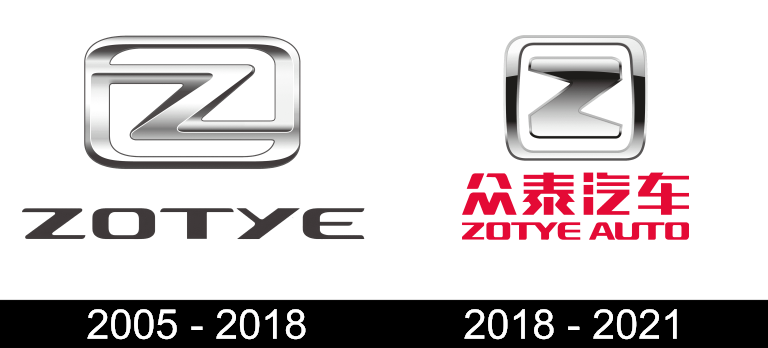
The original Zotye logo, introduced in 2005, remained in use for more than a decade. It featured a three-dimensional silver emblem positioned above an uppercase wordmark. The emblem consisted of a bold “Z” with elongated horizontal bars, integrated into a horizontally stretched rectangular frame with softly rounded corners.
This design balanced sharp contours with smooth edges, combining industrial precision with contemporary softness. The metallic gradient gave the logo a premium appearance, aligning Zotye visually with established global automakers despite its newcomer status.

2018–2021: The Simplified Red Identity
In 2018, Zotye introduced a comprehensive redesign that retained the core concept of a framed “Z” while modernizing its execution. The new emblem featured a shorter, thicker, and more rounded “Z” set within a square frame with softened corners. Unlike the previous version, the letter no longer touched the frame, creating a sense of openness and visual breathing room.
The accompanying wordmark was restructured into two lines, with the Chinese brand name placed above the English “ZOTYE.” Rendered entirely in red, the new identity emphasized confidence, ambition, and corporate seriousness. This redesign represented Zotye’s final attempt to reposition itself as a mature and credible automotive manufacturer before its operations ceased in 2021.
Typography and Color Palette
Typography played a central role in Zotye’s logo description. The heavy uppercase lettering used in the brand’s later years was based on a custom sans-serif typeface with slightly extended proportions. Fonts resembling Magnox Display Rounded or Avionic Wide Black served as stylistic references, though the final letterforms were significantly modified to achieve a more assertive presence.
The color palette combined metallic silver and deep red. Silver conveyed modernity, engineering precision, and alignment with automotive industry norms, while red introduced energy, passion, and ambition. Together, these colors reinforced Zotye’s attempt to project strength and relevance within a crowded market.
Logo Heritage and Industry Context
Zotye’s logo heritage reflects the broader challenges faced by emerging automakers during China’s rapid industrial expansion. While the visual identity evolved in line with global design standards, branding alone proved insufficient to overcome structural and financial pressures.
Within analyses of automotive logo history in emerging markets, Zotye illustrates how a contemporary and polished emblem can create initial credibility, but long-term brand equity ultimately depends on sustainable strategy and product differentiation.
Conclusion: Zotye Logo as a Snapshot of a Transitional Era
The Zotye logo stands as a visual artifact of a transformative period in the Chinese automotive industry. Its clean geometry, metallic finishes, and assertive typography were designed to signal legitimacy and modernity in a highly competitive environment. Although the brand itself ceased operations in 2021, its logo remains a concise representation of ambition, imitation-driven strategy, and the limits of visual identity in shaping lasting automotive heritage.
FAQ: Zotye Logo Meaning and History
What does the Zotye logo represent?
The Zotye logo represents modernity, structure, and manufacturing confidence, centered around a stylized “Z” emblem.
When was the Zotye logo first introduced?
The original Zotye logo was introduced in 2005, when the company began vehicle production.
Did Zotye change its logo before shutting down?
Yes, the logo was redesigned in 2018 with a simplified emblem and red wordmark, remaining in use until 2021.
Why did Zotye use metallic silver and red colors?
Silver conveyed technological precision and automotive tradition, while red symbolized ambition, energy, and confidence.