
Zoom Logo History: Meaning, Symbolism & Brand Heritage

In the modern era of remote work and digital communication, few platforms have become as universally recognizable as Zoom. Built around clarity, speed, and accessibility, Zoom’s visual identity reflects the same principles that define its product experience. Unlike many technology brands that frequently redesign their logos, Zoom followed a restrained and deliberate path, allowing its logo heritage to mature gradually alongside the platform itself.
When viewed in the broader landscape of famous company software logo history, Zoom’s evolution mirrors the functional clarity seen in Slack logo history and the interface-first approach explored in Microsoft logo heritage. Its logo meaning has always been rooted in usability rather than visual spectacle, making Zoom a compelling case study in modern digital branding.
Meaning and History: The Origin of the Zoom Identity
Zoom Video Communications, Inc. was founded in 2011 in California, although the Zoom software itself was officially introduced in 2013. From the beginning, the platform positioned itself as a cloud-based solution for video conferencing, webinars, and real-time collaboration, offering both free and paid plans tailored to different organizational needs.
For nearly a decade, Zoom maintained remarkable consistency in its visual identity. This stability reflected the company’s focus on reliability and trust, qualities essential for enterprise and educational users alike. The explosive global adoption of Zoom during the COVID-19 pandemic in 2020 further cemented the logo as a familiar digital symbol, seen daily by millions of users worldwide.
Throughout its evolution, Zoom’s logo history demonstrates a preference for refinement over reinvention, ensuring that each update preserved continuity while improving clarity and scalability.
Logo Symbolism: Simplicity, Function, and Accessibility
The Zoom logo symbolism is direct and transparent. The camera icon used in earlier versions clearly communicated the platform’s primary function: video communication. Unlike abstract tech logos that require interpretation, Zoom’s emblem embraced immediate recognition, reinforcing user confidence and ease of use.
The consistent use of blue plays a critical role in the logo meaning. Blue has long been associated with trust, clarity, and stability, making it a natural choice for communication software. Zoom’s particular shade, often described as sky blue, adds approachability and openness, distancing the brand from colder corporate tones.
Typography further reinforces accessibility. The custom lowercase wordmark appears friendly and neutral, avoiding sharp aggression while maintaining excellent legibility across devices, interfaces, and scales.
Zoom Logo History Timeline
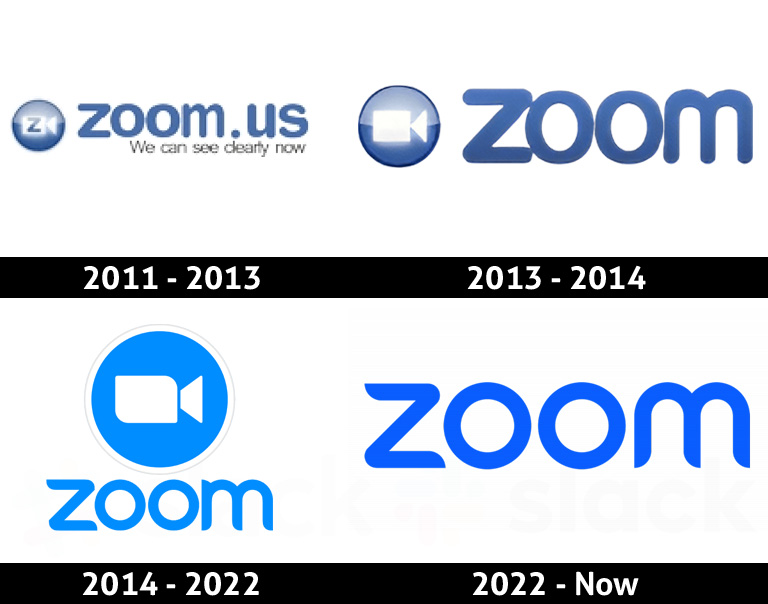
2011–2013: Camera Emblem and Early Identity
The first Zoom logo, introduced in 2011, featured a circular emblem containing a stylized side-view camera. Inside the camera shape, a blue letter “Z” reinforced brand recognition. The emblem was paired with a lowercase wordmark in a muted blue-gray tone.
This design balanced calm professionalism with modern simplicity, establishing a foundation that would remain recognizable for years.

2013–2014: Simplification and Brand Refinement
In 2013, the logo was subtly refined. The “.us” portion of the original inscription was removed, and the letter “Z” disappeared from the camera emblem. The blue shade became darker and more confident, while the wordmark’s typeface was slightly refined to appear bolder and clearer.
These changes reflected Zoom’s transition from a startup identity to a more mature software brand.
2014–2022: Wordmark-Centered System
From 2014 onward, Zoom adopted a flexible logo system. The primary logo became the wordmark alone, while the camera emblem evolved into a standalone icon used for apps and interfaces. When combined, the wordmark and emblem formed a full logo variant, allowing adaptability across digital environments.
This period solidified Zoom’s logo heritage, emphasizing consistency and scalability rather than visual experimentation.

2022–Present: Pure Typography and Modern Focus
In 2022, Zoom simplified its visual identity further by removing the emblem from the primary logo entirely. The wordmark became the sole focus, retaining its custom typeface while adopting a brighter, more vivid blue.
This update aligned the brand with modern minimalist trends while reinforcing confidence, clarity, and forward momentum.
Zoom Logo Heritage and Digital Trust
The Zoom logo history illustrates how restraint and clarity can outperform constant reinvention. By evolving gradually and prioritizing function, Zoom built a logo heritage grounded in trust, familiarity, and usability. Its logo meaning remains inseparable from its purpose, serving as a visual promise of reliable connection in an increasingly remote world.
In the context of technology branding, Zoom stands as an example of how simplicity, when executed with precision, can become a lasting global symbol.
FAQ: Zoom Logo Meaning and History
What does the Zoom logo represent?
The logo represents video communication and accessibility, reinforced by clean typography and a camera-based visual language.
Why did Zoom remove the camera icon in 2022?
The change emphasized simplicity and scalability, making the wordmark the primary brand identifier across platforms.
What does the blue color in the Zoom logo symbolize?
Blue symbolizes trust, clarity, and reliability, aligning with Zoom’s role as a communication platform.
Has the Zoom logo changed frequently?
No. Zoom maintained a stable visual identity for nearly a decade, introducing only gradual refinements.