Zilli Logo History: Meaning, Symbolism & Brand Heritage
In the uppermost tier of European menswear, Zilli represents a distinct interpretation of luxury—one rooted not in trends, but in materials, craftsmanship, and restraint. Founded in France during the second half of the twentieth century, the house built its reputation on exceptional leatherwork and refined tailoring. Its visual identity follows the same philosophy, favoring permanence over novelty and precision over spectacle.
Within broader discussions of logo history, logo meaning, and luxury brand heritage, Zilli stands alongside maisons such as Brioni logo heritage, Ermenegildo Zegna brand identity, and Hermès logo symbolism. Each of these brands uses visual identity not as a marketing tool, but as a quiet confirmation of status, tradition, and confidence.
Meaning and History: A House Built on Craft
Zilli was founded in 1965 in Lyon, France, by Alain Schimel. From the beginning, the brand specialized in high-end men’s fashion, with a particular focus on leather jackets and accessories crafted from rare and luxurious materials such as alligator, vicuña, silk, and fine cashmere.
Unlike fashion houses that rely on seasonal reinvention, Zilli built its identity on continuity. Its clientele—business leaders, athletes, collectors, and public figures—valued discretion as much as quality. This positioning shaped not only the brand’s products, but also its logo meaning. The visual identity was designed to communicate authority, exclusivity, and permanence without excess.
As Zilli expanded internationally, opening boutiques in major luxury markets across Europe, the Middle East, Russia, and Latin America, the logo remained unchanged. This consistency reinforced the idea that Zilli’s value lay in what it perfected long ago.
Zilli Logo History Timeline
1965–Today: A Singular Luxury Identity
Since its establishment, Zilli has relied on a single, enduring logo concept. The absence of frequent redesigns is not accidental; it reflects a deliberate commitment to timelessness.
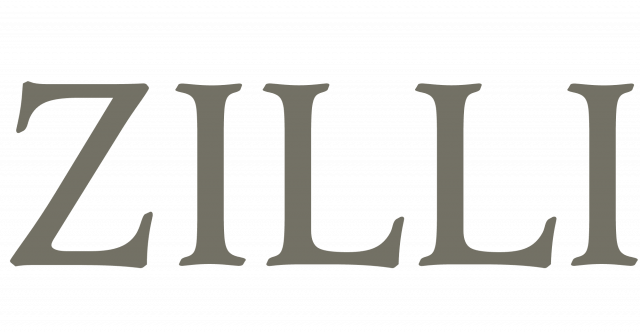
The Zilli logo is centered on a refined wordmark rendered in all-capital letters. The typography is a classic serif, defined by straight strokes, sharp angles, and clearly articulated serifs. Despite the thinness of the letterforms, the inscription feels strong and authoritative, balancing elegance with solidity.
In many applications, the wordmark appears alone. In others, it is enclosed within a distinctive emblem resembling a rectangular keychain or plaque. This emblem is typically rendered in gold with a metallic, three-dimensional finish, evoking precious objects rather than graphic symbols.
The logo has never required simplification or modernization. Its design language already aligns with the codes of high luxury.
Logo Symbolism: Metal, Precision, and Permanence
The symbolism of the Zilli logo is inseparable from material culture. Unlike logos that rely on abstract shapes or metaphorical imagery, Zilli’s identity communicates through texture and form.
The gold plaque emblem functions as a symbol of value and authenticity. It recalls engraved metal nameplates, luxury luggage tags, or jewelry hallmarks, objects traditionally associated with ownership, craftsmanship, and legacy. This reinforces the idea that Zilli garments are not disposable fashion items, but possessions meant to endure.
The serif typography further supports this message. Serif typefaces historically convey tradition, credibility, and refinement. In the context of Zilli, they align with the brand’s emphasis on heritage tailoring and artisanal production.
Typography and Visual Language
Zilli’s typographic choices are intentionally conservative. The letterforms are balanced and restrained, avoiding decorative flourishes. This allows the logo to function across a wide range of materials, from fabric labels and leather embossing to storefront signage and digital platforms.
The consistent use of uppercase lettering adds authority and clarity, while the measured spacing between characters enhances legibility. The wordmark does not seek attention; it assumes it.
This approach places Zilli within a lineage of luxury brands that prioritize typographic discipline, similar to Tom Ford, Brioni, and Zegna.
Color Strategy and Luxury Codes
The Zilli logo primarily appears in monochrome black and white, a palette chosen for versatility and restraint. This neutrality allows the logo to integrate seamlessly with various textures and colors used in the brand’s collections.
Gold is reserved for specific contexts, particularly advertising, packaging, and digital presentations. When used, it signals exclusivity and refinement rather than ornamentation. The contrast between black and gold reinforces the brand’s positioning at the highest end of the menswear market.
Importantly, color is never used to modernize the logo. It is applied to elevate it.
Zilli Logo Heritage in Luxury Fashion
What distinguishes Zilli in discussions of luxury logo heritage is its refusal to follow visual trends. While many high-end brands have simplified or flattened their identities in recent years, Zilli has remained steadfast.
This consistency aligns the brand with traditional European luxury values, where credibility is built through repetition and mastery rather than reinvention. In this sense, Zilli’s logo functions less as a brand marker and more as a signature.
A Logo That Speaks Softly—and Endures
The Zilli logo heritage is a study in restraint. By committing to a single, carefully crafted visual identity, the brand has allowed meaning to accumulate naturally over decades.
Within the broader landscape of logo history, brand heritage, and luxury fashion identity, Zilli exemplifies how timeless design can outlast trends. Like Hermès, Brioni, and Zegna, Zilli proves that the strongest logos are those that do not need to evolve to remain relevant. They simply continue to exist, unchanged, and unquestioned.
FAQ: Zilli Logo Meaning and History
What does the Zilli logo represent?
The logo represents luxury, craftsmanship, and permanence through refined typography and metallic symbolism.
When was the Zilli brand founded?
Zilli was founded in 1965 in Lyon, France.
Has the Zilli logo changed over time?
No. The logo has remained consistent, reflecting the brand’s commitment to timeless luxury.
Why does Zilli use gold in its logo?
Gold symbolizes exclusivity, value, and the use of premium materials.