Washington Commanders Logo History: Meaning, Symbolism & Brand Heritage

Few franchises in American professional sports have experienced a visual and cultural journey as complex as the Washington Commanders. For decades, the club’s identity stood at the intersection of tradition, controversy, and competitive legacy. The brief existence of the Washington Football Team during the 2020–2021 season marked only one chapter in a much longer logo history defined by repeated reinvention and eventual realignment with contemporary values.
Within NFL logo history, Washington occupies a unique position. Unlike teams such as Green Bay Packers logo heritage, whose identity evolved through refinement, or Seattle Seahawks logo history, which maintained a stable cultural core, Washington’s branding reflects social change as much as sporting ambition. As part of the broader American sports logo heritage archive, the Commanders represent how visual identity can become inseparable from cultural context, public discourse, and institutional transformation.
Meaning and History: The Origin of the Washington Football Team Identity
The franchise was founded in 1932, initially under the name Boston Braves, before becoming the Boston Redskins in 1933 and relocating to Washington in 1937. For most of the twentieth century, the club’s visual identity centered on Native American imagery, combined with a consistent burgundy and gold color palette that remained unchanged through every rebrand.
The Washington Football Team name, introduced for the 2020–2021 season, was conceived as a transitional solution rather than a permanent identity. Its logo meaning was intentionally minimal, focusing on typography and color instead of symbolism. This stripped-down approach allowed the franchise to maintain continuity while distancing itself from earlier imagery, preparing the ground for a more comprehensive rebrand.
By 2022, the transformation was finalized with the adoption of the Washington Commanders name, signaling a decisive shift toward a modern, abstract visual system rooted in geometry rather than illustration.
Washington Commanders Logo History Timeline
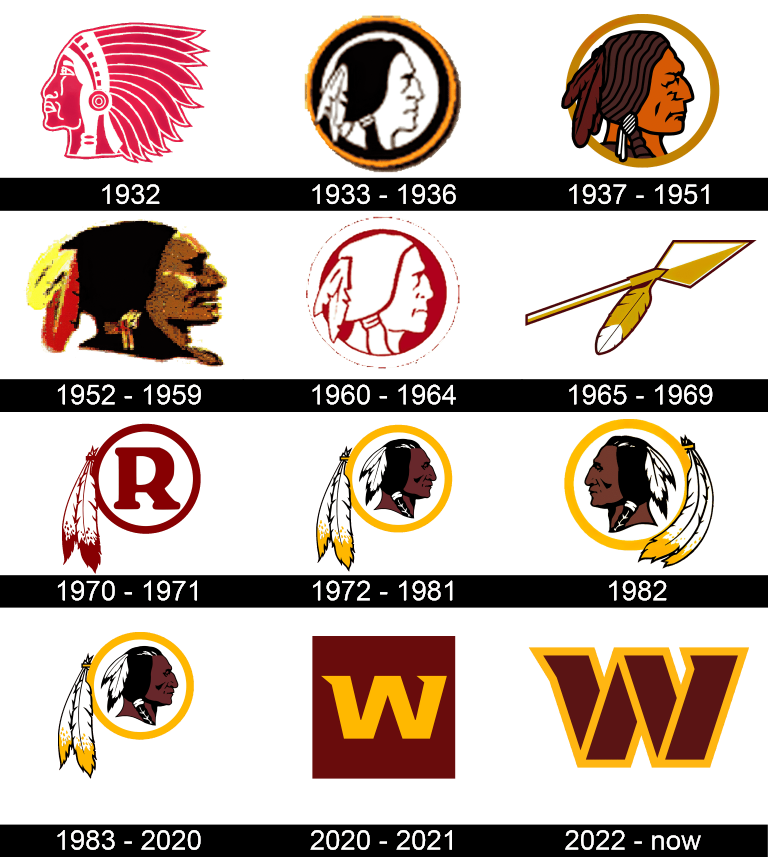
1932: The First Native American Portrait
The earliest badge introduced in 1932 featured a detailed profile of a Native American man facing right. Executed in red and white, the image emphasized realism and ceremonial elements, particularly an ornate feathered headdress that dominated the composition. This emblem remained in use for only a short period.
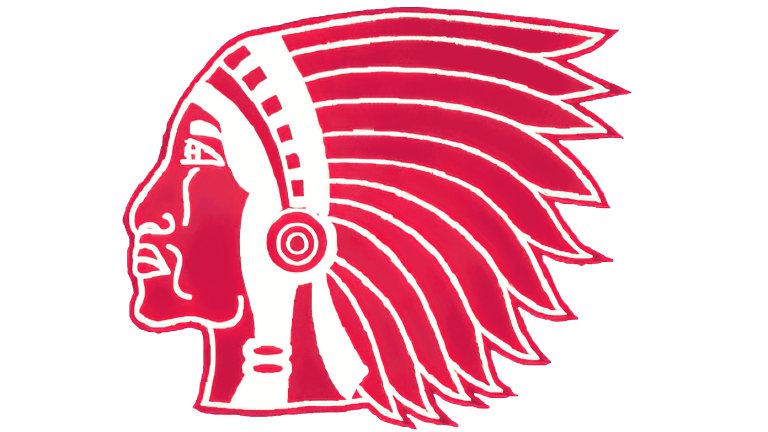
1933–1936: Simplification and Directional Change
The redesign that followed reversed the profile’s direction and significantly simplified both color palette and detailing. The headdress became smaller and more restrained, while the overall image adopted a calmer, less decorative appearance. This version lasted just three seasons.

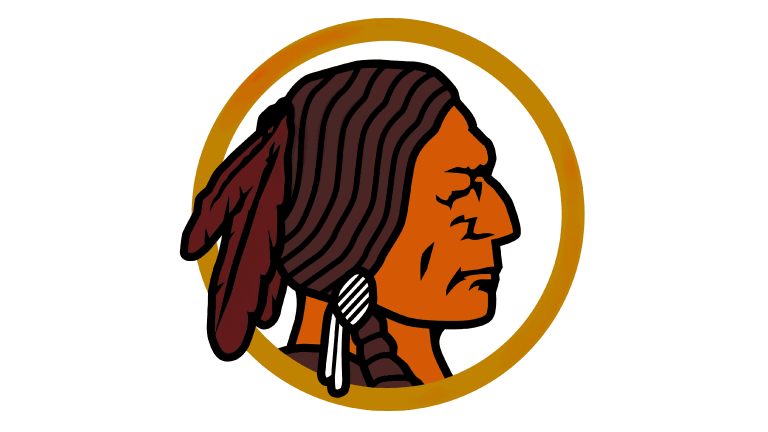
1937–1951: Refined Medallion and Stronger Contrast
In 1937, the logo evolved into a more structured medallion. The portrait gained darker tones, refined contours, and increased prominence within a circular frame. The outline was reduced to a single gold ring, emphasizing clarity and balance.
1952–1959: Increased Realism and Color Depth
The 1952 redesign removed the medallion outline and introduced subtle gradients, giving the face a more dimensional and realistic appearance. Feathers were recolored in yellow and red, reinforcing the club’s long-standing palette.
1960–1964: Minimalist Silhouette Interpretation
At the start of the 1960s, the logo shifted dramatically toward minimalism. A white silhouette of the profile was placed against a solid red circular background, framed by a wide white border. This design emphasized contrast and abstraction over detail.

1965–1969: Symbolic Arrow Emblem
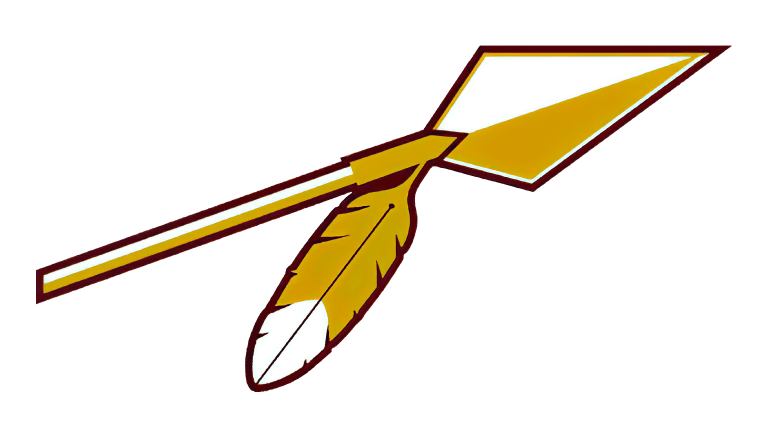
In 1965, the club abandoned portrait imagery entirely. The new emblem featured a gold and white arrow with a triangular arrowhead and feather detail, outlined in black for versatility. This marked the first fully symbolic logo in the franchise’s history.
1970–1971: Monogram Experimentation
The return to a circular badge came with a bold burgundy letter “R” on a white background. Two feathers decorated the left side of the frame, reconnecting the design with earlier themes while emphasizing typography.

1972–1981, 1983–2020: Return of the Portrait Identity
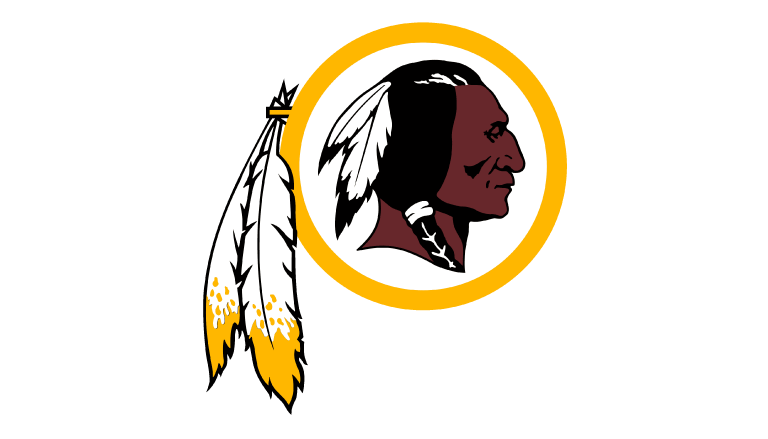
In 1972, the Native American profile returned, now centered within a white medallion with a gold frame. Enlarged feathers adorned the frame’s left side, while additional feathers appeared in the subject’s hair. This logo remained in use until 1981, returned in 1983, and stayed until the 2020 rebrand.
1982: One-Year Refinement
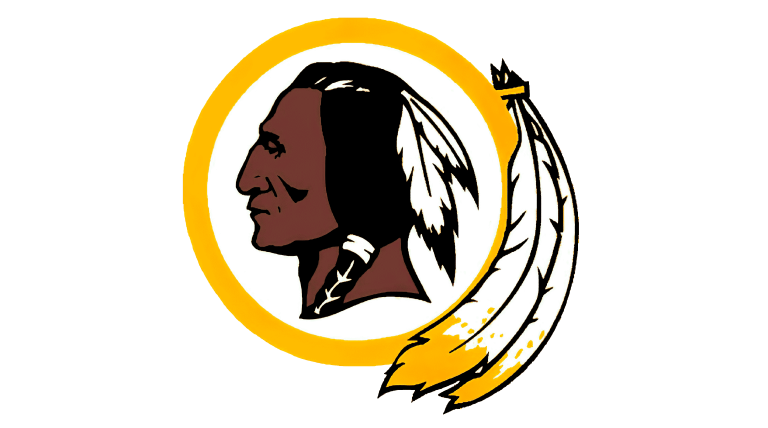
For a single season in 1982, the portrait was turned left, enlarged, and refined. The feathers were repositioned and curved to follow the medallion’s contour, creating a more dynamic composition.
2020–2021: Washington Football Team Transitional Identity
The Washington Football Team logo introduced a typographic-only concept. Set on a burgundy background, the emblem featured “Washington” in bold uppercase lettering, accompanied by “Football Team, Est 1932.” A standalone “W” icon was also developed for digital and merchandise use.

2022–Now: The Washington Commanders Emblem
The current logo centers on a bold burgundy “W” outlined in gold. Constructed from four trapezoidal elements, the letter features sharp triangular serifs pointing left. The design eliminates additional wording, establishing a clean, modern emblem grounded in geometry and color.
Logo Symbolism: From Representation to Abstraction
The symbolism of Washington’s logos has shifted dramatically over time. Early emblems relied on representational imagery, while later designs embraced abstraction. The current Commanders logo symbolism is rooted in strength, authority, and unity, conveyed through angular geometry and the enduring burgundy and gold palette.
The letter “W” functions as both an initial and a symbolic anchor, allowing the brand to move forward without visual dependence on past representations.
Washington Commanders Logo Heritage and Cultural Impact
The Washington Commanders logo heritage reflects broader societal evolution within American sports. Few franchises illustrate as clearly how branding decisions intersect with cultural awareness and public responsibility. Compared with franchises discussed in Chicago Bears logo history or Detroit Lions logo heritage, Washington’s identity journey is defined less by aesthetic refinement and more by historical reckoning.
Today, the Commanders emblem represents a conscious departure from the past while preserving continuity through color and legacy. Within NFL logo heritage, it stands as one of the most significant rebrandings of the modern era.
Washington Commanders Logo Heritage and the Power of Reinvention
The Washington Commanders logo history tells a story of transformation shaped by time, context, and cultural change. From early representational imagery to a modern abstract identity, the franchise’s visual evolution reflects a broader shift within professional sports branding. When viewed alongside NFL logo history and other landmark rebrands across American sports logo heritage, the Commanders stand as a defining example of how identity can be reimagined without abandoning origin.
FAQ: Washington Commanders Logo Meaning and History
What was the Washington Football Team?
It was the transitional name used by the franchise during the 2020–2021 NFL season.
When did the Washington Commanders logo debut?
The current logo was introduced in 2022 following the official renaming of the team.
What does the “W” in the Commanders logo represent?
It represents Washington while symbolizing strength and unity through geometric construction.
Have the team colors always been the same?
Yes. Burgundy and gold have remained the official colors throughout every rebrand.