Volvo Logo History: Meaning, Symbolism & Brand Heritage
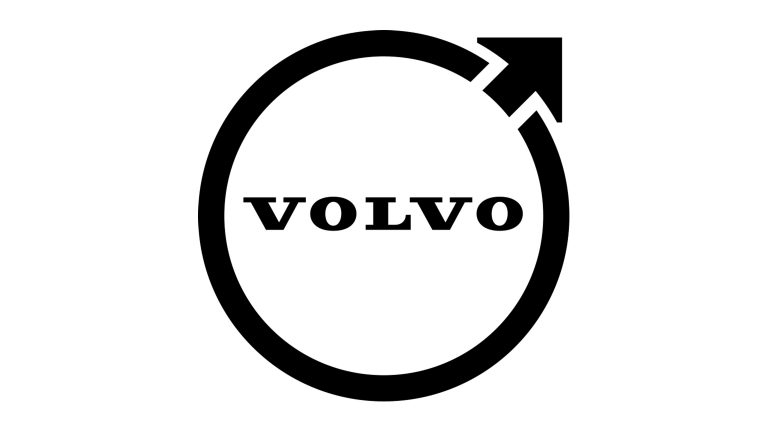
Few automotive emblems blend heritage, engineering, national pride, and symbolism as seamlessly as the Volvo logo. Founded in 1927 under the SKF Financial Group, Volvo emerged from the industrial backbone of Sweden and quickly distinguished itself through engineering integrity, safety innovation, and a design philosophy rooted in Scandinavian clarity.
The name chosen for the brand — Volvo, Latin for “I roll” — was originally registered by SKF for ball bearings. It became the perfect metaphor when the company shifted into automobiles: movement, momentum, continuity and mechanical purity.
While many automakers have completely reinvented their emblems over time, Volvo has remained remarkably faithful to a single symbol — the ancient circle-and-arrow, known as the Iron Mark. A design that predates the automobile by thousands of years, the Iron Mark represents durability, strength, craftsmanship and technological progress. In Swedish culture, it also evokes the country’s metallurgical heritage, particularly the high-quality iron and steel for which Sweden has been known since antiquity.
Across nearly a century, Volvo’s logo has evolved with changing eras of design, but the essence has remained untouched: a perfect circle, a rising diagonal arrow, and a wordmark defined by Nordic precision.
Volvo Logo Evolution: A Complete Timeline
1927–1930: The First Identity
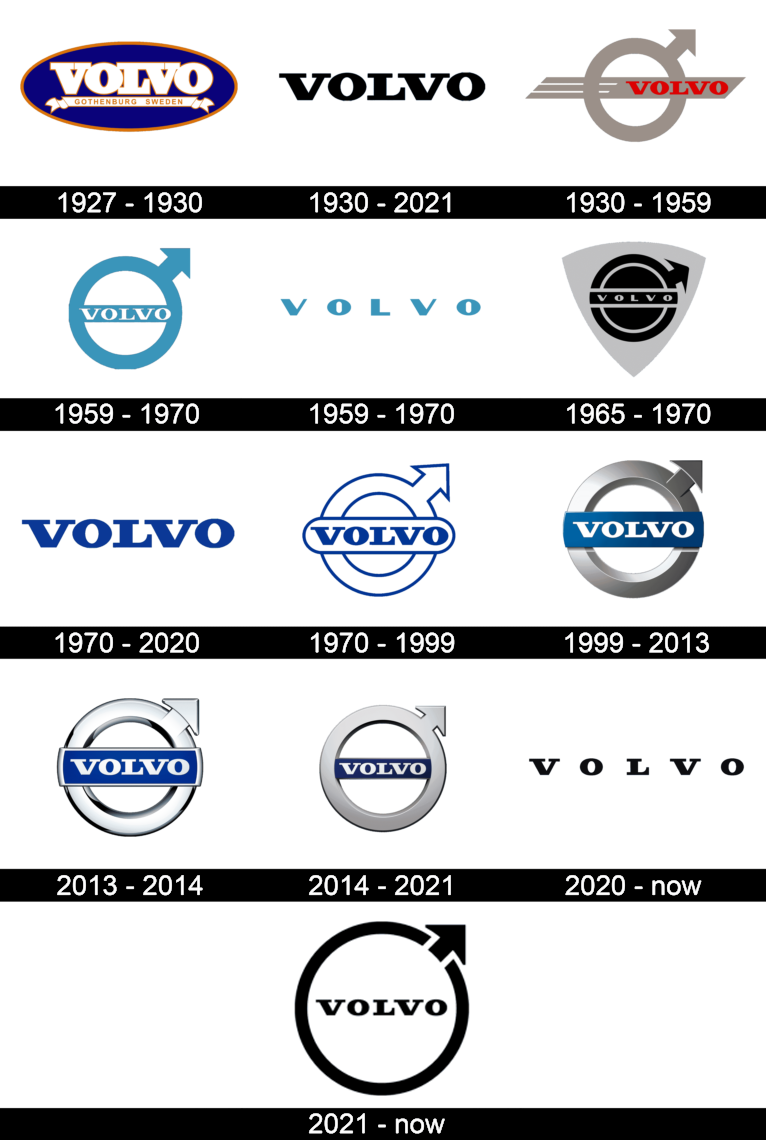
Volvo’s earliest emblem, introduced in 1927, paired a deep blue oval with a gold-brown frame and a crisp white wordmark. “Gothenburg Sweden” appeared beneath, proudly identifying its industrial birthplace. On the cars themselves, however, Volvo used a separate silver badge featuring the now-iconic circle and arrow — simple, refined, and elegant enough to stand alone on the grille.
From the beginning, Volvo communicated its values in restraint and quality rather than flamboyance.
1930–2021: Modernist Minimalism
In 1930, Volvo introduced a stark black-and-white wordmark. It was minimal, timeless, and typographically strong — a perfect reflection of Scandinavian design long before the term became globally recognized. The serif lettering remained similar to the original but cleaner, wider, and more confident.

1940–1959: The Birth of the Iron Mark
A decisive step occurred around 1940, when Volvo adopted a full circular emblem with a diagonal line bisecting the badge — the structural ancestor of the emblem we know today. The red all-caps wordmark sat atop a silver frame, while three fine horizontal stripes suggested motion, speed and mechanical precision.
This was the moment when Volvo’s visual identity aligned with its engineering philosophy: strength, movement, and technical clarity.
1959–1970: The Strong Arrow and Teal Identity
By 1959, the Iron Mark was fully integrated. The arrow and ring were placed around a rectangular banner holding the “VOLVO” name in crisp white letters. The background color — a unique teal-turquoise — conveyed balance, renewal and trustworthiness.
This was also the era when Volvo became globally known for safety innovation, making the Iron Mark a symbol not only of strength but of reliability and responsibility.
Parallel to this emblem, Volvo introduced a clean sans-serif wordmark in the same teal tone, used independently on marketing materials.
1965–1970: The Shield Emblem
During the late 1960s, Volvo experimented with a more assertive black-and-white variant: the Iron Mark placed on a downward-pointing shield. The design evoked security, craftsmanship, and the brand’s growing reputation for robust engineering.
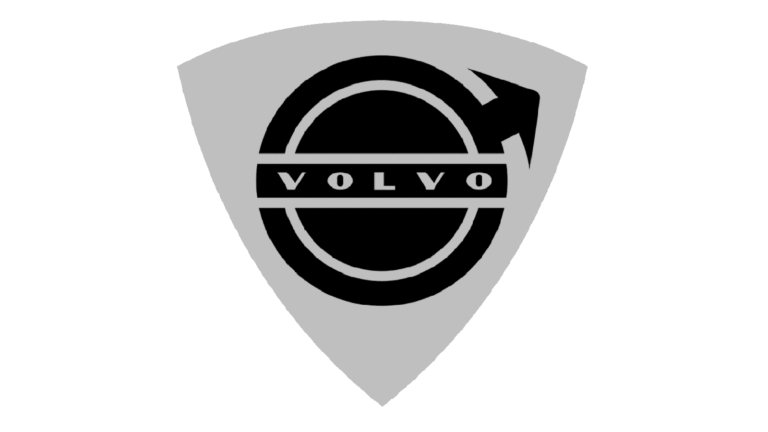
1970–1999: Black, Silver, and Nordic Modernism
In 1970, Volvo embraced a polished black-silver palette. The Iron Mark appeared inside a softened square frame, the wordmark resting on a rounded rectangular platform.
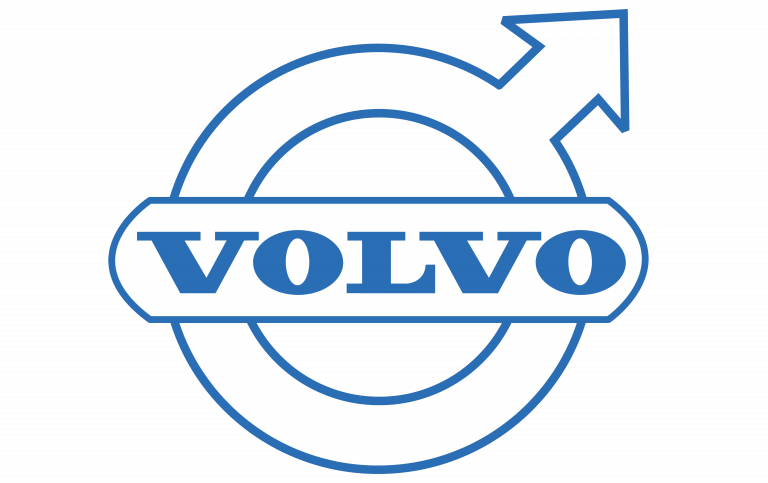
Another stripped-down version introduced that year featured only the copper-toned Iron Mark with the serif wordmark — clean, modern, and strikingly ahead of its time.
1999–2013: Blue Takes Center Stage
Volvo’s modern palette began in 1999. Silver and royal blue became the foundation for a refreshed emblem. The Iron Mark was drawn in sleek metallics, while the wordmark sat on a bold blue banner that signified quality, confidence and Scandinavian stability.
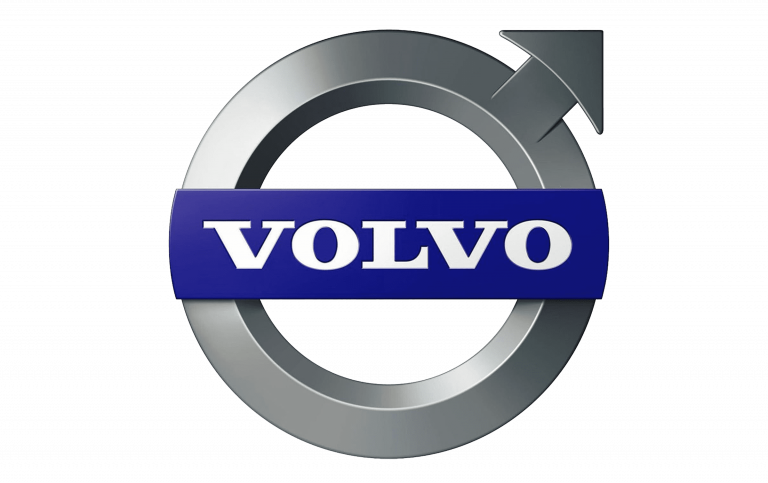
2013–2014: Gloss and Refinement
In 2013, Volvo lightened the badge. The silver frame gained a cooler, glossier finish, and the blue banner received a thin, elegant silver outline. The proportions felt more architectural — a perfect alignment of Scandinavian precision and contemporary luxury.
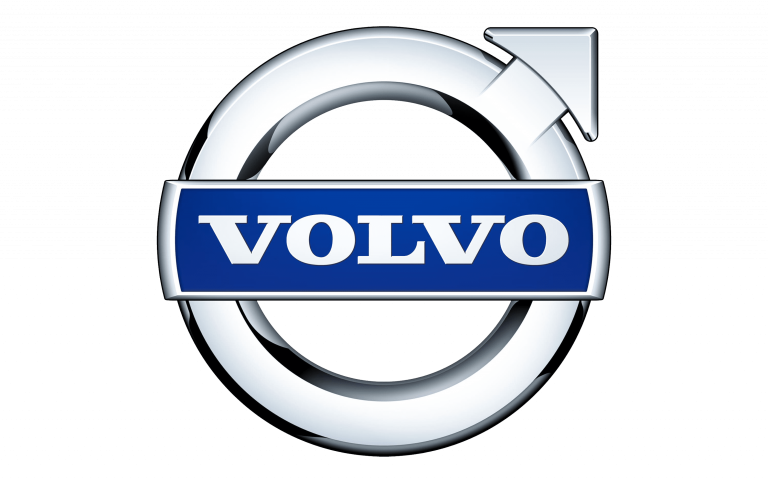
2014–2021: A Deepened 3D Era
The 2014 emblem intensified its three-dimensional quality. Bolder lines, sharper metals, and more dramatic depth expressed the industrial beauty of Volvo’s high-end sedans and SUVs. Blue and silver became inseparable from the brand’s visual language.
2020–Present: The Minimalist Wordmark
In 2020, Volvo stepped briefly into ultra-minimalism, adopting a pure black serif wordmark on white. The spacing was generous, airy and sophisticated — a modern design approach aligned with luxury brands and digital-first environments.
2021–Today: The Return of the Iron Mark
In 2021, Volvo reintroduced the iconic circle-and-arrow emblem in a completely flat, monochrome form. The mark is now black, stripped of gradients, and accompanied by a smaller, tightly spaced serif wordmark beneath the arrow.
This updated Iron Mark is both ancient and contemporary: a historic symbol rendered in the clean geometry of modern Nordic design.
Symbolism: The Iron Mark and Swedish Identity
The Volvo logo is rooted in one of the oldest symbols in human history: the circle with an arrow pointing diagonally upward. In Roman tradition, it represented Mars — god of war — and was used to denote iron and strength.
In ancient metallurgy, the symbol stood for the chemical element iron.
In engineering, it signified durability and structural integrity.
In Volvo’s hands, it became a symbol of Sweden’s legendary steel production and a quiet promise:
Every Volvo is built from the strongest foundations.
The six o’clock banner anchoring the word “VOLVO” symbolizes clarity and grounding, while the circle conveys unity, protection and completeness — an apt representation of a company globally respected for safety.
Typography: Nordic Craftsmanship in Letterform
The Volvo wordmark uses a refined serif typeface with confident verticals, geometric proportions and thin square serifs. It carries the subtle traits of Scandinavian typography: clarity, restraint and modernity built on classical roots.
The consistent line weights convey neutrality and precision.
The squared serifs evoke structural stability.
The openness between letters suggests breathability and elegance.
This is typography engineered rather than decorated — a perfect match for Volvo’s ethos.
Color: Blue, Silver, Black — The Nordic Palette
-
Blue symbolizes trust, intelligence, and Scandinavian calm. Its use in Volvo’s banners evokes deep lakes, open skies and Nordic clarity.
-
Silver represents innovation, technology and the purity of Swedish steel.
-
Black, in the most recent versions, communicates minimalism, luxury and timelessness.
Volvo’s color palette has always expressed its cultural roots more than trends — cool tones, simple contrasts and disciplined elegance.
A Century of Strength in a Single Symbol
Few automotive brands have preserved their identity as faithfully as Volvo. From its origins in Swedish metallurgy to its modern role as a global leader in safety and engineering, the Volvo logo has remained a consistent expression of integrity, clarity and purpose.
The Iron Mark is more than an emblem — it is a distillation of Volvo’s ideals: strength without aggression, innovation without extravagance, and timeless design rooted in centuries-old symbolism.
In an industry where visual identities constantly shift, Volvo stands apart with a mark that has rolled forward since 1927, never losing sight of its origins or its promise.
Volvo Logo FAQ – History, Meaning, Symbolism and Evolution
What does the Volvo logo represent?
The Volvo logo is based on the ancient chemical/alchemical symbol for iron — a circle with an arrow. It represents strength, durability, Swedish steel heritage and mechanical excellence.
Why did Volvo change its logo?
Volvo updated its logo in 2021 to reflect modern, minimalist design standards while preserving the historic Iron Mark. The new flat black version aligns with digital environments and contemporary luxury branding.
What does the name Volvo mean?
“Volvo” comes from the Latin volvere, meaning “I roll.” It was originally registered by SKF for ball bearings in 1915.
What symbol does Volvo use?
Volvo uses the Iron Mark: a circle with a diagonal upward arrow. Historically associated with the god Mars and the metal iron, it symbolizes strength and engineering purity.