
Vanguard Logo History: Meaning, Symbolism & Brand Heritage
Vanguard is one of the rare global investment institutions whose visual identity remained virtually untouched for nearly half a century. While many financial brands pursued constant modernization to signal innovation, Vanguard relied on continuity, allowing its reputation, structure, and philosophy to define the brand. When the company finally chose to simplify its logo in 2020, the decision marked not a rejection of heritage, but a recalibration of how that heritage should be communicated in a modern financial landscape.
In this respect, Vanguard follows a different path from the incremental refinements seen in the Fidelity Investments logo history or the patriotic symbolism embedded in the Bank of America logo history. Within the broader context of investment management logo heritage, Vanguard represents a transition from literal symbolism to conceptual authority.
Meaning and History: The Origin of the Vanguard Identity
Vanguard was founded on May 1, 1975, by John C. Bogle. The company was established as a new fund division at Wellington Management, built on a radical idea for its time: an investment firm owned by its clients rather than outside shareholders. This structure allowed Vanguard to operate at lower costs, aligning directly with investors’ interests.
The name “Vanguard” was chosen deliberately. It references HMS Vanguard, a British Royal Navy battleship and the flagship of Vice-Admiral Horatio Nelson during the Battle of the Nile in 1798. The word itself means “the forefront” or “the leading position,” a direct expression of the company’s ambition to lead rather than follow within the investment world.
This philosophy became the foundation of Vanguard’s logo meaning, long before visual trends or branding strategies entered the conversation.
Logo Meaning: Leadership, Discipline, and Client Ownership
The Vanguard logo meaning has always centered on leadership and forward momentum. In its original form, this meaning was expressed literally through the depiction of a flagship, a vessel leading a fleet into battle. The symbolism aligned perfectly with John Bogle’s vision of Vanguard as a firm setting a new standard in investing.
After 2020, the meaning shifted from literal representation to conceptual authority. The absence of imagery places full emphasis on the name itself, reinforcing Vanguard as an idea rather than a narrative illustration.
Logo Symbolism: From Flagship to Authority
For decades, Vanguard’s logo symbolism revolved around the image of a ship. The detailed rendering of the flagship communicated stability, navigation, and leadership, qualities associated with long-term investing. The ship also symbolized discipline and direction, reinforcing the idea that Vanguard guided investors through complex financial waters.
The 2020 redesign removed this symbolism entirely. While this decision sparked debate, it reflected a strategic choice: Vanguard no longer needed a visual metaphor to explain its role. Its scale, reputation, and market position had become self-explanatory.
Vanguard Logo History Timeline
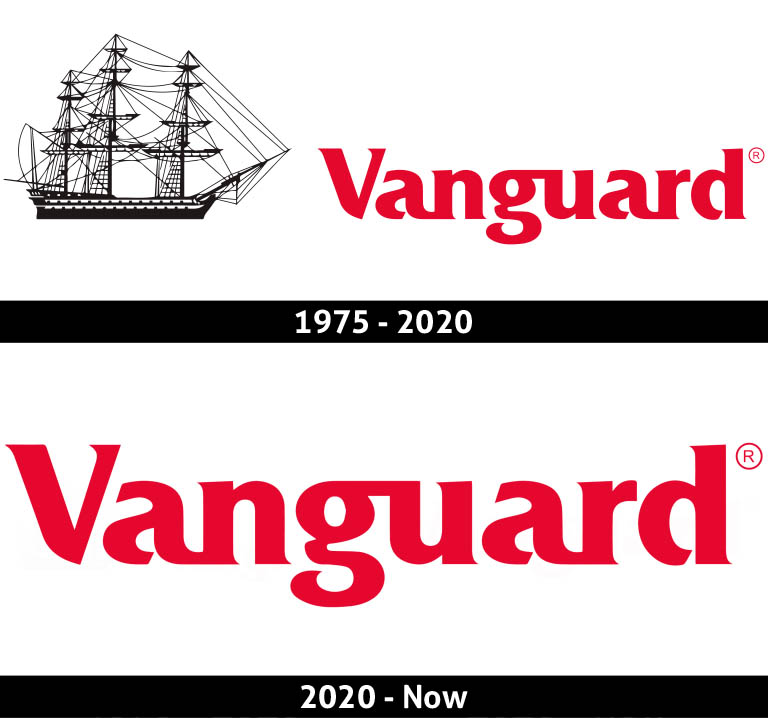
1975–2020: The Flagship Era
The original Vanguard logo was introduced shortly after the company’s founding and remained largely unchanged for nearly 45 years. It featured a detailed illustration of a historic sailing ship, complete with masts, rigging, and sails, positioned above or alongside a serif wordmark.
This emblem was unusually elaborate for a financial institution, even at the time of its introduction. However, it perfectly embodied the company’s philosophy and name. The logo served as a visual manifesto, emphasizing leadership, tradition, and principled investing.
Over time, as branding trends moved toward minimalism, the ship began to appear increasingly complex. Despite this, Vanguard leadership resisted change, viewing the emblem as inseparable from the company’s identity.

2020–Present: Wordmark-Only Modernization
In the fall of 2020, Vanguard officially retired the ship emblem. The new logo consists solely of a refined wordmark, marking the most significant visual shift in the company’s history.
The redesign was the result of collaboration with a branding agency and reflected years of gradual movement away from the emblem across digital and print materials. While some observers cited generational leadership changes and reputational considerations as contributing factors, the official rationale emphasized clarity, adaptability, and modern communication.
The new logo is understated, confident, and scalable, aligning Vanguard’s visual identity with contemporary financial branding without abandoning its core values.
Typography and Color Palette
Typography plays a central role in the Vanguard logo description. The current wordmark uses a classic serif typeface with elegant proportions and subtle variations in stroke width. This choice preserves a sense of tradition and authority while improving legibility across digital platforms.
The brand retained its signature maroon color, a deep and dignified shade associated with seriousness, experience, and institutional confidence. Unlike brighter financial palettes, Vanguard’s color choice avoids urgency, reinforcing its long-term investment philosophy.
Logo Heritage and Strategic Restraint
Vanguard’s logo heritage is defined by restraint rather than experimentation. By maintaining a single core identity for decades, the company built extraordinary brand recognition and trust. The 2020 redesign did not erase this heritage, but distilled it, shifting focus from historical narrative to present authority.
Within analyses of asset management logo history, Vanguard is often cited as a case where brand equity was strong enough to survive, and even benefit from, radical simplification.
Vanguard Logo as a Statement of Maturity
The Vanguard logo tells a story of evolution through discipline. From a detailed flagship symbolizing leadership to a refined wordmark representing authority, the brand’s visual identity matured alongside its market position. Vanguard’s logo heritage demonstrates that true leadership does not require constant visual reinforcement, only clarity, consistency, and trust earned over time.
FAQ: Vanguard Logo Meaning and History
What does the Vanguard logo represent?
The logo represents leadership, forward movement, and disciplined investing.
Why did Vanguard remove the ship from its logo?
The ship was removed in 2020 to modernize the brand and improve clarity and scalability.
What inspired the original Vanguard logo?
The logo was inspired by HMS Vanguard, a British naval flagship symbolizing leadership.
What color is associated with the Vanguard brand?
Vanguard is strongly associated with a deep maroon color, symbolizing authority and stability.