
Under Armour Logo History: Meaning, Symbolism & Brand Heritage

At first glance, the Under Armour logo appears deceptively simple, almost unchanged since its earliest days: a bold, symmetrical crisscross formed by the letters “U” and “A.” Yet behind this apparent simplicity lies a carefully refined visual system that mirrors the brand’s rapid ascent in the global sportswear industry. Much like the disciplined evolution explored in the Nike logo history or the restrained consistency seen in the Adidas logo heritage, Under Armour built its identity around clarity, repetition, and immediate recognition. Positioned within the broader universe of sportswear logo history, the brand’s visual language reflects a modern American approach to performance, innovation, and confidence.
From its origins as a functional apparel startup to its emergence as a global athletic powerhouse, the Under Armour logo has played a central role in shaping brand perception. Its logo history reveals not constant reinvention, but a series of calculated refinements that strengthened recognition while preserving the core idea.
Meaning and History: The Origin of the Under Armour Identity
Under Armour was founded in 1996 by former University of Maryland football player Kevin Plank. The brand emerged from a simple but disruptive idea: creating performance apparel that regulated body temperature and enhanced athletic comfort. From the very beginning, functionality drove every design decision, including the logo.
The logo meaning is rooted in protection, strength, and physical performance. Rather than adopting a pictorial symbol or mascot, Under Armour relied on a typographic monogram that fused the first letters of its name. This approach aligned perfectly with the brand’s early positioning as a no-nonsense, athlete-first company. The overlapping “U” and “A” visually suggest compression, structure, and containment—subtle references to the apparel itself.
The brand name, notably spelled “Armour” with a British “U,” was chosen not for heritage reasons but for practical branding considerations, including phonetic distinction and availability. This pragmatic mindset carried over into the logo design, reinforcing the brand’s focus on utility over ornamentation.
Logo History Timeline
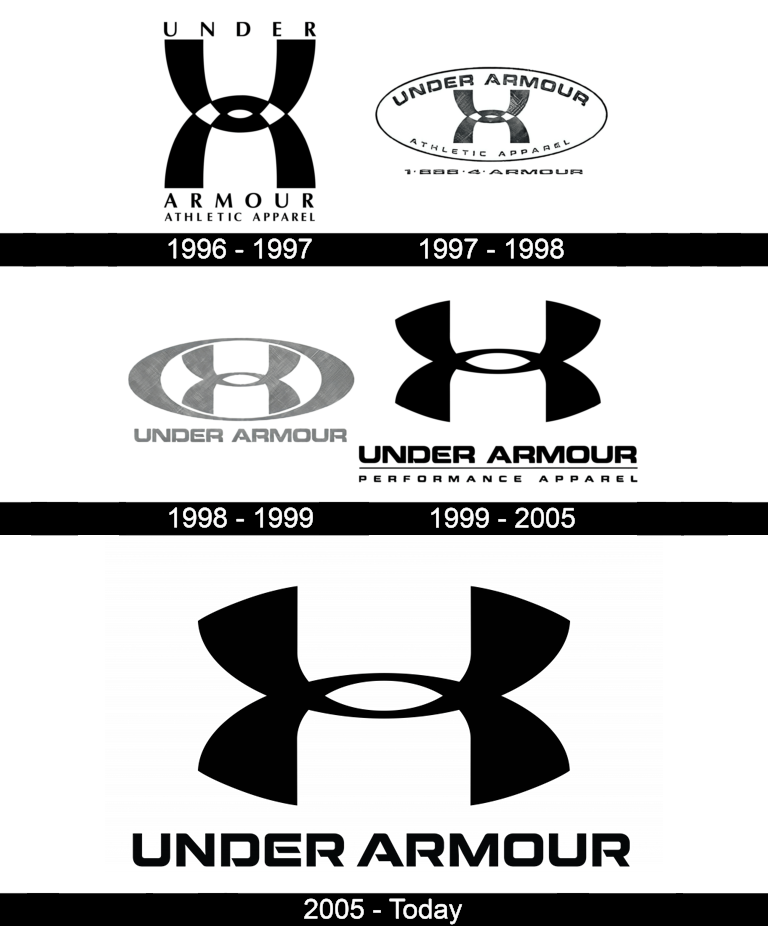
1996–1997: The Original Monogram Introduction
The first Under Armour logo debuted in 1996, featuring the now-iconic interlocking emblem rendered in monochrome. At this stage, the symbol was accompanied by serif lettering reading “Under” above and “Armour” below, along with the tagline “Athletic Apparel.” The typography introduced an unexpectedly refined tone, lending a sense of credibility to a then-unknown startup while contrasting with the logo’s modern geometry.
1997–1998: Oval Framing and Typographic Shift
In 1997, the logo was enclosed within a horizontally stretched oval frame. The wordmark moved to the top of the composition, while the tagline was repositioned beneath the emblem. During this period, the typeface transitioned to a bold sans-serif style with softened angles, signaling a shift toward a more contemporary and athletic visual identity.

1998–1999: Simplification and Modernization
By 1998, the oval frame became thicker and more prominent, rendered in a single gray tone. The tagline was removed entirely, allowing the emblem and wordmark to stand on their own. The typography was further refined, adopting sharper proportions and a more confident presence that aligned with the brand’s growing visibility in competitive sports.
1999–2005: Monochrome Authority and Performance Focus
In 1999, Under Armour embraced a strict black-and-white palette. The emblem appeared bolder and more assertive, paired with a futuristic custom wordmark. A new descriptor, “Performance Apparel,” briefly appeared beneath the main logo, separated by a horizontal line. This iteration emphasized the brand’s commitment to athletic functionality and technical innovation.
2005–Today: The Definitive Under Armour Logo
The 2005 redesign marked the final refinement of the logo. All secondary elements were removed, leaving only the iconic monogram and the custom wordmark. This minimalist configuration remains in use today, demonstrating the strength of the original concept and its adaptability across products, media, and global markets.
Logo Symbolism: Strength, Balance, and Performance
Although technically a monogram, the Under Armour logo functions symbolically through its symmetry and density. The mirrored arches form a compact, stable structure that conveys strength and resilience. The central overlap suggests compression and support, echoing the performance-enhancing qualities of the brand’s apparel.
Unlike logos that rely on motion or abstract symbolism, Under Armour’s mark communicates confidence through stillness and balance. Its geometry feels deliberate and controlled, reinforcing the brand’s image as a serious competitor in the athletic performance space.
Typography and Color Palette
The custom sans-serif typeface used in the Under Armour wordmark plays a critical role in the logo symbolism. While highly legible, it features subtle cutouts where strokes intersect, creating a distinctive mechanical character. These details enhance memorability without compromising clarity.
Color has remained intentionally restrained throughout the brand’s logo history. The black-and-white palette emphasizes contrast, ensuring maximum visibility across fabrics and environments. This neutrality allows the logo to adapt seamlessly to different sports, teams, and cultures while maintaining a strong, authoritative presence.
Under Armour Logo Heritage and Brand Identity
The Under Armour logo heritage illustrates how disciplined design can support rapid brand growth. Rather than chasing trends, the company invested in a stable visual system that reinforced trust and recognition. Over time, the logo became synonymous with performance innovation, appearing consistently across apparel, footwear, and global marketing campaigns.
This approach mirrors strategies seen in other enduring athletic brands, where logo heritage is built through consistency rather than constant reinvention. Under Armour’s identity demonstrates that a well-conceived origin can sustain relevance for decades with only minimal refinement.
Under Armour Logo History and Lasting Impact
The Under Armour logo history is a study in restraint, focus, and strategic refinement. From its origin as a functional monogram to its status as a globally recognized symbol of performance, the logo has remained true to its core meaning. Its enduring presence underscores the power of clarity in design and the long-term value of a strong visual foundation within modern brand heritage.
FAQ: Under Armour Logo Meaning and History
What does the Under Armour logo represent?
The logo represents strength, protection, and athletic performance through a minimalist monogram formed by the letters “U” and “A.”
Who designed the Under Armour logo?
The logo was developed internally during the brand’s founding period, under the direction of Kevin Plank and early creative collaborators.
Why is Under Armour spelled with a “U”?
The British spelling of “Armour” was chosen for branding distinction and practical considerations, including trademark availability.
Has the Under Armour logo changed over time?
Yes, but only through refinements. The core concept introduced in 1996 remains intact, with the final simplified version established in 2005.