
Twitch Logo History: Meaning, Symbolism & Brand Heritage
Twitch didn’t start as a standalone empire. It grew out of the gaming category on Justin.tv, where game streams quickly became the most magnetic content on the platform. That origin shaped everything that followed, including the brand’s visual identity. In the bigger conversation around YouTube Logo History and Discord Logo History, Twitch stands apart because its branding has always looked like the internet feels: fast, bold, a little “glitchy,” and built for community. Within Internet Logos, Twitch is one of the clearest examples of how a wordmark can become a cultural badge—recognized instantly on thumbnails, overlays, stream panels, and live chat.
What makes the Twitch logo history compelling is its disciplined simplicity. The brand has changed its identity in a small number of decisive steps, and each one moved closer to what Twitch actually is: a live, interactive platform where conversation is as important as video.
Twitch Logo Meaning and History: From Justin.tv Spin-Off to Streaming Icon
Twitch launched in 2011 as TwitchTV, designed specifically to separate gaming from Justin.tv’s broader “everything” format. That early positioning mattered. Twitch wasn’t trying to be television in the traditional sense—it was trying to look like an interface: direct, blocky, and legible at speed. The first logo leaned into that idea with a metallic wordmark and a “TV” element that nodded to screens and broadcasting.
In 2012, the brand tightened its identity and dropped the “TV” from the name. This wasn’t a cosmetic edit. It was the moment Twitch started acting like a destination brand rather than a category label. The visual identity became more distinctive, more geometric, and more aggressively readable.
Twitch’s brand heritage also includes a major business shift in 2014, when it became part of Amazon. But the logo never pivoted to look “corporate.” Instead, Twitch doubled down on what made it native to streaming culture: bold shapes, sharp angles, and a purple presence that could own a crowded screen.
By 2019, Twitch introduced a more complete system—pairing a refined wordmark with the iconic “Glitch” mark. That icon transformed the brand from a recognizable name into a symbol that could live on its own.
Twitch Logo Symbolism: The Glitch, the Chatbox, and the Purple Signal
The core Twitch logo symbolism is built on interaction. Twitch is not just about watching; it’s about reacting in real time. That’s why the brand’s most memorable element isn’t a camera, a play button, or a broadcast tower. It’s a shape that reads like a chatbox fused with a screen—an emblem that visually blends conversation and live content into one icon.
The “Glitch” mark works because it can be interpreted instantly. At a glance, it suggests a stylized display panel. Look a second longer, and it becomes a chat container with personality. That ambiguity is the point: Twitch is where video and community overlap.
Purple is the second major symbol. In a world where many tech platforms default to blue, Twitch’s purple acts like a signal flare—distinct, energetic, and unmistakably “Twitch.” It communicates a kind of creative intensity while remaining consistent across digital environments, from mobile icons to esports sponsorship walls. The result is a logo meaning that doesn’t need explanation: Twitch is live, loud, and interactive—even when the mark appears without text.
Twitch Logo History Timeline: Year-by-Year Evolution of the Wordmark and Icon
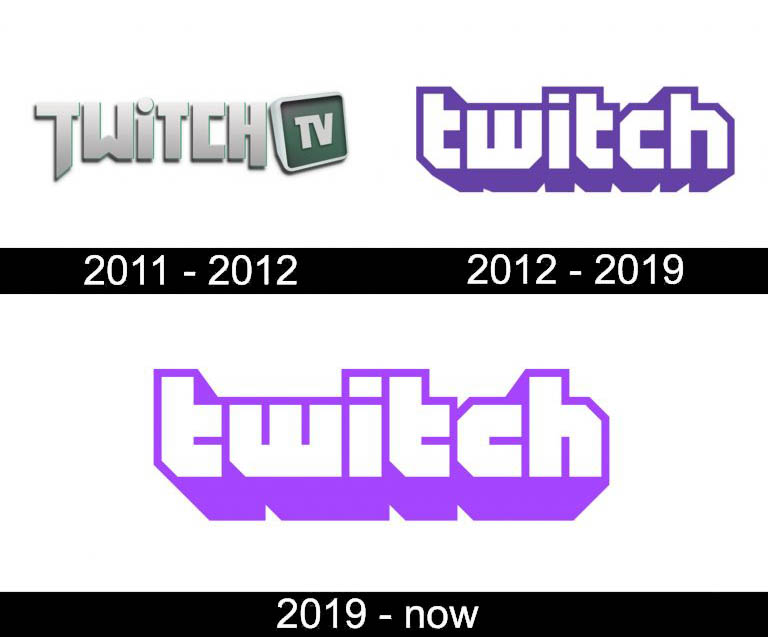
2011–2012: TwitchTV Origins and the Early Broadcast Identity
The earliest Twitch identity used a dimensional wordmark paired with a “TV” emblem. The metallic feel and screen-like framing leaned into the idea of broadcasting, reflecting a platform still establishing itself as a dedicated home for gaming streams. This era’s logo description prioritized “live video” cues and a more traditional screen metaphor.

2012–2019: The Bold Twitch Wordmark and a Stronger Digital Personality
In 2012, Twitch removed “TV” from the name and introduced a more distinctive, blocky wordmark. The design language became sharper and more confident, built for digital clarity. This period cemented the brand heritage most people associate with Twitch’s rise: a wordmark that looked like it belonged inside an interface, not on a billboard.

2019–Today: The Glitch Icon Era and Modern Brand System Refinement
The 2019 refresh introduced a full system: a refined wordmark and the standalone Glitch icon. The emblem became a flexible symbol for favicons, app icons, and social avatars—critical for a platform that lives across devices and stream overlays. This era strengthens legibility, improves consistency, and turns Twitch’s identity into something streamers can wear, place, and remix within the boundaries of brand recognition.
Twitch Logo Heritage Conclusion: How a Wordmark Became a Cultural Stamp
The Twitch logo history is a story of getting more specific over time. It began with a broadcast-minded identity and evolved into a symbol of live internet culture. The brand didn’t chase constant redesigns—it made a few bold moves that aligned the logo meaning with how Twitch actually functions: live video powered by chat, community, and creator energy.
Today, Twitch’s logo heritage is anchored by two elements that work everywhere: a distinctive wordmark built for instant readability and the Glitch icon that captures Twitch’s personality in one compact shape. In the streaming world, where attention is measured in seconds, that clarity is the real advantage.
Twitch Logo History FAQ: Meaning, Symbolism, and Brand Origin
What does the Twitch logo mean?
The Twitch logo meaning is rooted in live interaction. The wordmark signals a bold digital identity, while the Glitch icon blends the ideas of streaming and chat into a single recognizable symbol.
Why is Twitch associated with purple?
Purple became a defining part of Twitch’s logo heritage because it stands out strongly on screens and differentiates the platform from other tech brands that rely on blue-heavy palettes.
What is the Twitch Glitch icon supposed to be?
The Glitch mark is often read as a stylized screen or chatbox. Its symbolism reflects Twitch’s core identity: live video shaped by real-time conversation.
When did Twitch change its logo?
Twitch made major identity shifts in 2012, when it dropped “TV” and introduced a stronger wordmark, and in 2019, when it refined the system and emphasized the Glitch icon.
Is Twitch owned by Amazon?
Yes. Twitch is owned by Amazon, but its branding has remained distinctly creator-first and streaming-native rather than corporate in tone.