TurboTax Logo History: Meaning, Symbolism & Brand Heritage

In the highly regulated and trust-driven world of financial software, visual identity plays a critical role in establishing credibility. TurboTax, one of the most widely used tax preparation platforms in the United States, developed a logo system designed to communicate clarity, confidence, and correctness rather than emotional storytelling. The TurboTax logo history reflects the evolution of a product that transformed tax filing from a professional-only service into a guided, consumer-friendly digital experience. When viewed alongside the fintech branding strategies explored in the Intuit logo history and the software-driven identity examined in the QuickBooks logo heritage, TurboTax represents a defining case within modern software logo history.
The TurboTax logo meaning is rooted in reassurance. From its earliest iterations to its current refined identity, the brand’s visual language has focused on confirmation, accuracy, and simplicity, aligning closely with the emotional needs of users navigating complex tax systems.
Meaning and History: The Origin of the TurboTax Identity
TurboTax was originally developed in the late 1980s by Michael Chipman, founder of Chipsoft, with the goal of simplifying personal tax preparation through software. In 1993, Intuit acquired Chipsoft, securing ownership of TurboTax and integrating it into what would become one of the most influential ecosystems in financial software.
From its origin, TurboTax was designed as a utility product rather than a lifestyle brand. This foundation shaped its visual identity. The logo origin prioritized function, clarity, and trust over abstraction or emotional symbolism. As TurboTax expanded across operating systems and user segments, its branding evolved to reflect modern software aesthetics while preserving its core message: the software gets taxes done correctly.
The logo meaning mirrors this philosophy. Each redesign reinforced ease of use, professional reliability, and user confidence, supporting TurboTax’s position as a market leader in digital tax preparation.
Logo Symbolism: Accuracy, Confirmation, and Simplicity
The TurboTax logo symbolism is centered on one universal concept: confirmation. The checkmark icon, consistently present across multiple logo generations, serves as a visual shorthand for correctness and completion. In the context of tax filing, this symbol carries significant psychological weight, reassuring users that their work is accurate and approved.
The circular shape enclosing the checkmark reinforces completeness and closure, while the restrained use of color avoids unnecessary distraction. Unlike brands that rely on abstract shapes or metaphorical imagery, TurboTax uses a direct visual cue that aligns perfectly with its functional promise.
Color symbolism further supports this message. Red conveys urgency and action, white communicates clarity and transparency, and blue, introduced in later versions, reinforces trust, stability, and institutional credibility.
TurboTax Logo History Timeline
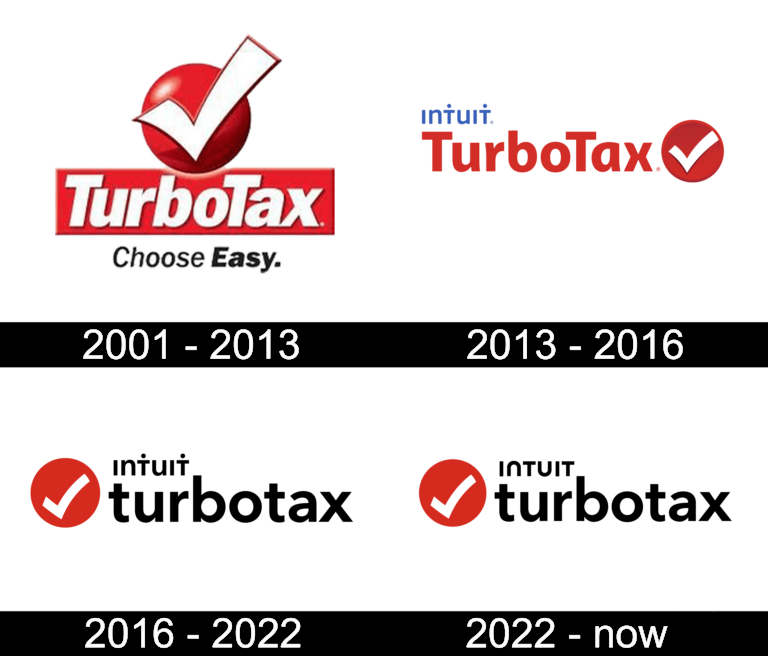
2001–2013: Banner Identity and Instructional Messaging
The first widely recognized TurboTax logo, introduced in 2001, featured a horizontally stretched red rectangular banner containing a bold white wordmark. Above the banner sat a three-dimensional red dot with an enlarged white checkmark, establishing the confirmation symbol that would become central to the brand’s identity.
A slanted black tagline reading “Choose Easy” accompanied the design, reinforcing the product’s core value proposition. This logo reflected early 2000s software branding trends, combining dimensional elements with instructional messaging to guide consumer perception.

2013–2016: Flat Design and Brand Integration
In 2013, TurboTax adopted a flatter, more contemporary visual identity. The color palette shifted to red, white, and blue, aligning the product more closely with financial and institutional branding standards. The wordmark was rewritten in a clean, modern sans-serif typeface using title case lettering, signaling a transition toward maturity and digital refinement.
The red dot with the white checkmark was repositioned to the right of the logotype, while a subtle blue “Intuit” wordmark appeared above, indicating corporate ownership without overshadowing the product brand. This redesign reflected broader shifts toward flat design and improved scalability across digital platforms.

2016–2022: Icon-Centered Identity and Brand Confidence
The 2016 update marked a significant simplification of the TurboTax logo. The wordmark transitioned to lowercase lettering, executed in a bold, smooth sans-serif typeface that conveyed approachability without sacrificing authority.
The red circular checkmark emblem became fully autonomous, functioning as a standalone brand icon across apps and digital interfaces. This iteration emphasized speed, reliability, and clarity, aligning with the growing importance of mobile-first software experiences.
The visual system during this period established TurboTax as a confident, mature platform capable of guiding users through increasingly complex tax requirements.

2022–Present: Subtle Refinement and Corporate Alignment
In 2022, TurboTax introduced a minor update aligned with Intuit’s broader brand refresh. The primary TurboTax elements remained unchanged, preserving continuity and recognition. The adjustment focused on the Intuit wordmark, which adopted a more rounded typeface and removed the dots above the “T.”
This subtle refinement softened the overall corporate appearance while maintaining the product’s established visual authority, reinforcing consistency across Intuit’s software portfolio.
Typography and Visual Construction
Typography within the TurboTax logo is deliberately utilitarian. The sans-serif typeface prioritizes legibility, neutrality, and digital clarity. The shift to lowercase lettering introduced a more conversational tone, reducing intimidation without compromising professionalism.
Spacing and weight are optimized for screen-based environments, ensuring readability across devices and resolutions. The emblem and wordmark maintain a balanced hierarchy, allowing the checkmark symbol to function independently while remaining visually connected to the brand name.
TurboTax Logo Heritage and Brand Positioning
The TurboTax logo heritage is defined by consistency of purpose rather than dramatic reinvention. While visual styles evolved in response to design trends and technological shifts, the core symbolism remained intact. This continuity reinforces trust, a critical factor in financial software adoption.
TurboTax’s branding positions the product as an authority that simplifies complexity. The logo communicates reassurance rather than excitement, aligning perfectly with user expectations in tax preparation. Within the broader context of software logo heritage, TurboTax stands as an example of how clarity and restraint can outperform novelty.
TurboTax Logo History and Functional Trust
The TurboTax logo history demonstrates how a functional product can build enduring visual identity through clarity and symbolic precision. From early instructional branding to a refined, icon-driven system, the logo’s evolution mirrors the software’s growth and increasing sophistication. In the landscape of technology logo heritage, TurboTax proves that trust, consistency, and purposeful symbolism are the most powerful branding tools in regulated digital environments.
FAQ: TurboTax Logo Meaning and History
What does the TurboTax logo represent?
The logo represents accuracy, completion, and trust through the universal checkmark symbol.
Why does TurboTax use a checkmark in its logo?
The checkmark signifies confirmation and correctness, reinforcing confidence in tax filing accuracy.
Has the TurboTax logo changed significantly over time?
The logo evolved stylistically, but its core symbolism has remained consistent since 2001.
What changed in the 2022 TurboTax logo update?
The update refined the Intuit wordmark while preserving all core TurboTax logo elements.