Tigerair Logo History: Meaning, Symbolism & Brand Heritage

The visual identity of Tigerair reflects a defining era in Asian low-cost aviation, when affordability, visibility, and brand personality became decisive competitive tools. Launched in the early 2000s as a budget subsidiary backed by Singapore Airlines, Tigerair adopted a logo strategy built around immediacy and energy rather than tradition. Its logo history mirrors the airline’s broader mission: fast growth, regional reach, and unmistakable recognition.
Within airline logo history, Tigerair belongs to the same experimental generation as AirAsia logo history and Scoot logo meaning, where low-cost carriers rejected conservative flag-carrier aesthetics in favor of bold, accessible branding. As part of the wider airline logo heritage, Tigerair illustrates how short-lived brands can still leave a lasting visual footprint through focused design decisions.
Meaning and History: The Origin of the Tigerair Identity
Tigerair was founded in 2003 in Singapore as a low-cost carrier supported by Singapore Airlines. Initially launched under the name Tiger Airways, the airline targeted price-sensitive travelers across Asia-Pacific, offering no-frills service with an emphasis on efficiency and punctuality.
From the outset, the logo meaning was closely tied to the brand name itself. The tiger, widely associated with strength, agility, and dominance across Asian cultures, served as a powerful metaphor for speed and confidence. Unlike national carriers that rely on flags or abstract symbols, Tigerair embraced an instantly recognizable animal identity that required no explanation.
As the airline expanded rapidly across Southeast Asia and beyond, the brand evolved toward simplification. This shift culminated in a streamlined identity shortly before Tigerair was fully merged into Scoot in 2017, marking the end of the brand as an independent visual entity.
Logo Symbolism: Energy, Agility, and Low-Cost Confidence
The symbolism of the Tigerair logo was direct and expressive. The tiger motif represented speed, alertness, and assertiveness, qualities that aligned perfectly with the competitive nature of the low-cost airline market. In its early years, the leaping tiger graphic communicated motion and boldness, reinforcing the airline’s ambition to stand out visually on crowded airport aprons and booking platforms.
Color played a strategic role. Yellow and orange accents conveyed energy and affordability, while black and gray typography added contrast and seriousness, preventing the brand from appearing frivolous. In its later iteration, Tigerair reduced symbolic complexity, allowing typography and selective color highlights to carry meaning more subtly.
This evolution from illustration to minimalism reflected broader trends in airline branding during the 2010s, where digital legibility and consistency became priorities.
Tigerair Logo History Timeline
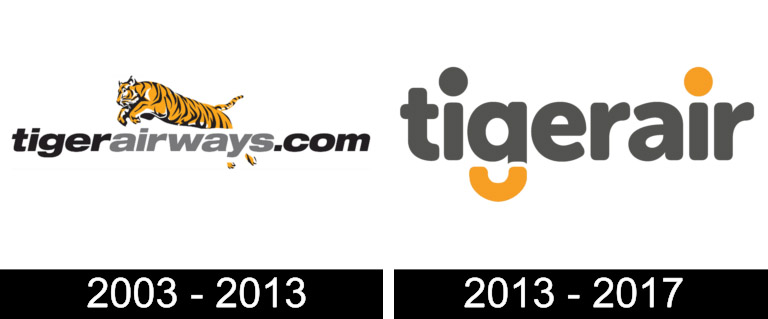
2003–2013: Tiger Airways Illustrated Identity Era
The original logo introduced in 2003 featured the full “TigerAirways” name set in lowercase, slanted sans-serif lettering. Above the wordmark appeared a vivid illustration of a leaping tiger rendered in yellow and black. This composition emphasized motion and strength, making the airline instantly recognizable and visually distinct among Asian carriers.
The combination of animal imagery and italicized typography reinforced speed and dynamism, aligning closely with the airline’s low-cost, high-frequency operating model.

2013–2017: Minimalist Tigerair Wordmark
In 2013, the airline shortened its name to Tigerair and introduced a redesigned logo. The leaping tiger graphic was removed entirely, replaced by a clean, lowercase wordmark in gray. Selective orange accents, notably on the tail of the “g” and the dot of the second “i,” provided continuity with the brand’s energetic past.
This redesign marked a decisive move toward minimalism and digital clarity. The simplified logo performed better across mobile booking platforms and signage, reflecting changing consumer interaction patterns.
Tigerair Logo Heritage and Brand Transition
Although Tigerair ceased to exist as a standalone brand after its 2017 merger with Scoot, its logo heritage remains significant within low-cost airline history. The brand demonstrated how aggressive, personality-driven visuals could rapidly build recognition in a competitive regional market.
When compared with identities discussed in Jetstar logo history or Vueling logo symbolism, Tigerair stands out for how clearly its branding communicated value and attitude. Even after its absorption into Scoot, elements of Tigerair’s visual philosophy—clarity, energy, and accessibility—continued to influence the combined brand’s approach.
Tigerair Logo as a Snapshot of Low-Cost Airline Evolution
The Tigerair logo history captures a moment when low-cost airlines reshaped aviation branding across Asia. From its expressive illustrated beginnings to its refined minimalist wordmark, Tigerair adapted its identity to changing market demands while preserving core symbolism. Within airline logo history and broader logo heritage analysis, Tigerair remains a compelling example of focused, purpose-driven brand design.
FAQ: Tigerair Logo Meaning and History
What did the Tigerair logo represent?
The logo represented speed, agility, and confidence through tiger symbolism and dynamic typography.
When was the Tigerair logo introduced?
The original Tiger Airways logo was introduced in 2003, with a redesigned version launched in 2013.
Why did Tigerair remove the tiger graphic from its logo?
The removal reflected a shift toward minimalism and improved digital usability.
What happened to the Tigerair brand?
Tigerair merged with Scoot in 2017 and ceased operating as a separate brand.