
The Evolution of the Honda Logo

When people think of reliability, engineering discipline and accessible innovation, Honda is one of the first automotive names that comes to mind. Part of this universal recognition comes not just from its vehicles, but from its remarkably stable visual identity. In fact, within global logo heritage discussions, the Honda emblem is often cited as one of the most consistent designs of the 20th century.
Unlike brands that reinvent their symbols every decade, Honda has kept its visual core intact, reflecting its commitment to clarity, trust and long-term engineering philosophy.
The story of the Honda logo is also the story of its founder, Soichiro Honda — a brilliant, self-taught engineer whose passion shaped one of the world’s most iconic automotive identities.
Honda Logo History: From a Small Workshop to Global Recognition
Honda Motor Company traces its roots back to 1946, when Soichiro Honda began crafting engines for motorized bicycles. By 1948, his company was officially established, and within just a few years Honda had evolved from small engines to full motorcycles — and eventually to automobiles.
Though many believe Honda didn’t use logos in its early decades, a closer look at its logo history shows that the stylized “H” appeared consistently across its products, even before the company formally standardized its badge. That iconic shape — resembling a reassuring, wide-framed seat — symbolized comfort, safety and a uniquely human approach to mobility.
By the early 1960s, Honda entered the automobile market. The Honda Civic and the brand’s first commercial vehicles carried versions of the “H” emblem that would later become internationally recognizable.
Honda Emblem Timeline
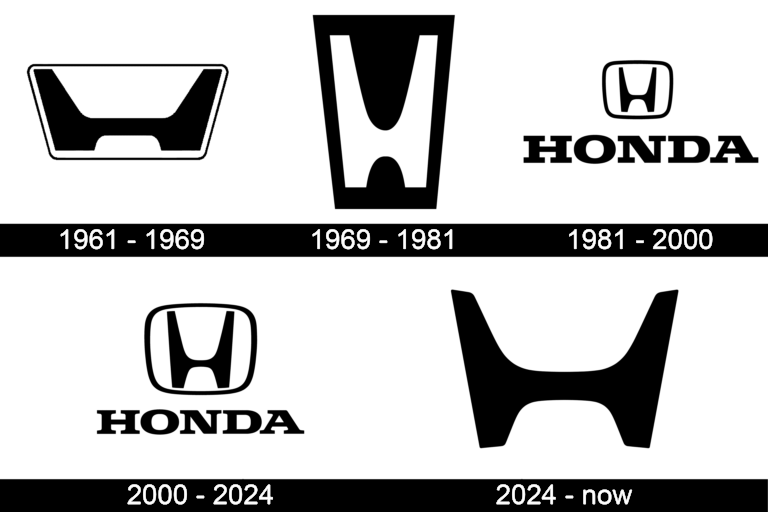
1961–1969 — The First Automobile Emblem
The earliest Honda car logo featured a burgundy rectangular badge with a stylized “H” at the top and a clean serif logotype underneath. This version felt mechanical and handcrafted — much like the company itself at that time.
1969–1981 — Toward Minimalism
Honda simplified the badge dramatically, removing the wordmark and turning the symbol into a tall, narrow “H” inside a vertical black rectangle. This shift marked Honda’s confidence and growing international presence.
1981–2000 — A More Refined Identity
This era reversed the colors, introduced softer corners and paired the emblem with a bold serif “HONDA” wordmark. The visual message became unmistakable: precision engineering with a strong identity.
2000–2024 — The Metallic Modern Age
A three-dimensional chrome-like finish was added, making the emblem more suitable for modern car design. The “H” became elongated and elegant, while the red logotype balanced modernity with tradition.
2024–Present — A Confident Return to Minimalism
Honda’s newest logo returns to flat design principles. The stretched black “H” appears without a frame, creating a clean look that feels both retro and futuristic. It echoes the earliest Honda identity while embracing today’s digital-first aesthetics.
Honda Motorcycle Logo Heritage
Honda’s motorcycle emblem evolved separately, often more expressive and symbolic than the car badge.
-
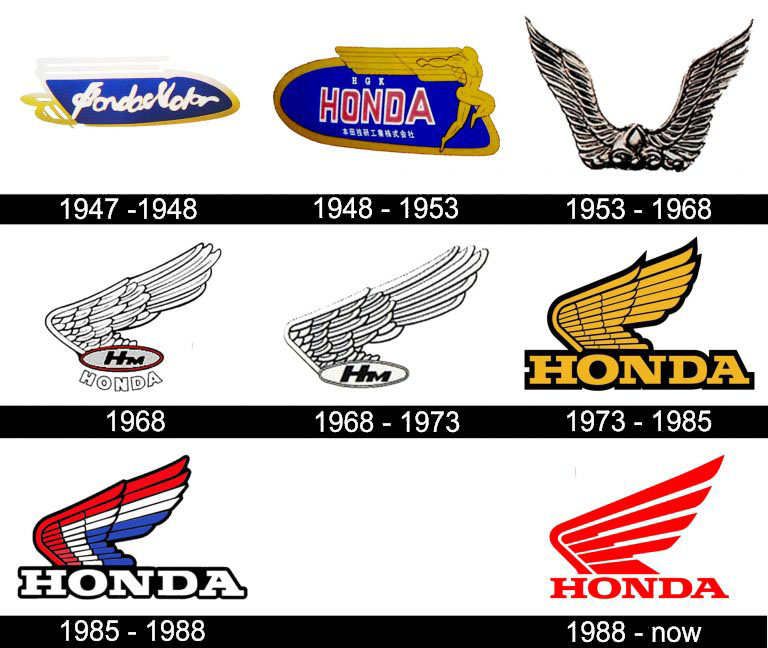
1947–1948: A cursive “Honda Motor” script on a blue badge with early wing-like elements.
-
1948–1953: A bolder, more dynamic badge featuring a running figure with a gold wing — symbolizing motion and freedom.
-
1953–1968: The iconic standalone metallic wings, representing power, speed and independence.
-
1968–1973: Oval badge, “HM” lettering and a structured wing — more industrial in feel.
-
1973–1985: The golden wing paired with a bold serif “Honda” wordmark, now unmistakably iconic.
-
1985–1988: A more colorful modernized version, adding blue, red and white details.
-
1988–Today: The simplified red wing — strong, dynamic, instantly recognizable worldwide.
Among motorcycle enthusiasts, the Honda Wing remains one of the most celebrated marks in all logo heritage conversations.
Meaning Behind the Honda Symbol
The iconic “H” is more than the founder’s initial. Its wide, seat-like shape conveys:
-
comfort
-
reliability
-
stability
-
safety
Soichiro Honda wanted to build machines that felt approachable and human. The gentle, reassuring silhouette of the logo communicates exactly that.

Font and Typography
Honda’s wordmark has always leaned toward bold, serifed typography — strong yet elegant. The heavy serifs mirror the thickness of the “H” emblem, creating harmony across branding. The letterforms are minimalistic, clear and engineered, much like Honda’s vehicles.
Colors and Visual Style
Today’s Honda branding primarily uses:
-
Chrome / silver — symbolizing engineering precision
-
Black — clarity, strength, modernism
-
Red — energy, ambition, Japanese heritage
The chrome badge on vehicles and the red wordmark across print and advertising create a balance between technical excellence and emotional identity.
FAQ — Honda Logo (Original)
Why is the Honda logo shaped the way it is?
The wide, open “H” was intentionally designed to suggest comfort and stability — inspired by the shape of an armchair or motorcycle saddle.
Has Honda ever changed its logo dramatically?
No. Honda’s logo history is one of the most stable in the automotive world. The core “H” has remained nearly unchanged for over six decades.
Why do Honda motorcycles use a wing logo?
The wing symbolizes speed, freedom and the pioneering spirit of Soichiro Honda, who adored aviation engineering.
What color represents Honda?
Red is historically Honda’s signature color, symbolizing energy, passion and Japanese identity.
Is the Honda car logo different from Honda’s motorcycle logo?
Yes. Honda cars use the framed “H,” while motorcycles carry the separate “Honda Wing” emblem — two identities under one brand philosophy.