
The Chevrolet Logo: The Evolution of an American Icon

Few emblems in the automotive world carry as much history, debate, and personality as the Chevrolet bowtie. For more than a century, this unmistakable symbol has represented American engineering, mass-market innovation, and a brand that became deeply woven into U.S. culture. The Chevrolet logo’s story is layered with myths, interpretations, and a fascinating visual evolution that illustrates how a simple geometric shape became one of the most enduring marks in logo history.
The Chevrolet bowtie did not appear when the company was founded in 1911. Instead, it arrived two years later—an unusual detail in logo heritage—adding an air of mystery to its origins. Over time, the famous bowtie would shift colors, proportions, materials, and typefaces, yet never lose its recognizable core silhouette.
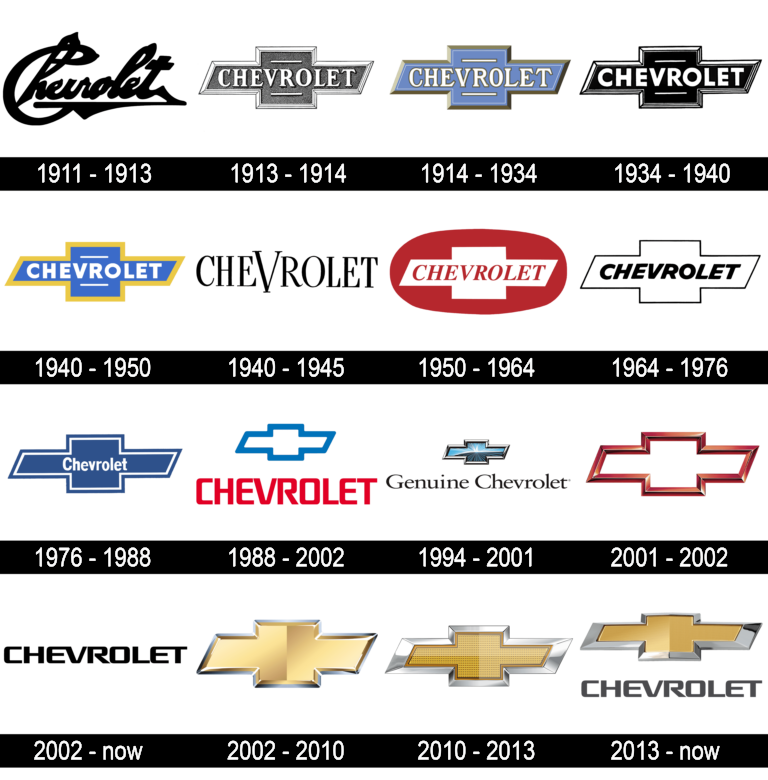
Early Beginnings: 1911–1914
Chevrolet’s first identity was not a bowtie at all but the handwritten signature of Louis Chevrolet. Elegant and confident, the script represented the personal craftsmanship of a young automaker entering a booming industry.
The turning point came in 1913 when William C. Durant introduced the first geometric cross-shaped emblem. With its sharp angles and bold serif lettering, this early mark laid the foundation for the future bowtie. By 1914, the logo transformed again—now in light blue and gold—with the proportions and character that would define Chevrolet for decades.
Experimentation and Refinement: 1930s–1950s
As Chevrolet expanded rapidly, its logo followed suit. The brand moved into a more masculine, monochrome identity in the 1930s before returning to brighter tones around 1940, adopting soft sky blue and warm yellow.
Unusually, 1940 also saw a minimalist typographic logo featuring a dramatic oversized “V.” It was a departure from the traditional bowtie and remains one of the most distinctive experiments in Chevy’s visual history.
By the 1950s, Chevrolet embraced bold red and white, matching the energetic optimism of the post-war era. The cross became thicker, cleaner, and more expressive.
Modernization and Color Identity: 1960s–1990s
The 1960s introduced a stripped-down, italicized wordmark with a thin bowtie outline — one of the most minimal looks in the brand’s history. The 1970s brought a return of confident blue hues, accompanied by sharper contours and subtle shadows.
In the 1980s and 1990s, Chevrolet leaned heavily into color and dimension. Variants featured glossy blue, red outlines, and later a fully 3D metallic cross framed in silver. The brand was transitioning toward a more premium visual language, reflecting changes in the automotive market and consumer expectations.
The Golden Bowtie: 2000s–Today
The early 2000s marked the era of the golden bowtie — the version most people instantly associate with Chevrolet today. Rendered in shimmering gold and wrapped in polished silver, this emblem became the brand’s signature for nearly two decades. Updated textures, gradients, and metallic finishes modernized the logo while preserving its legacy.
In 2013, Chevrolet refined the design once again, balancing the gold tone with a cooler gray in its official palette. The result is a logo that feels both contemporary and classic — a perfect example of how logo heritage can evolve while staying true to its core.
The Bowtie Symbol
At its essence, the Chevrolet bowtie is a wide, stylized cross — a geometric shape that has remained unchanged since 1914, even as its colors and detailing evolved. The simplicity of the form is part of its power: instantly recognizable, easy to reproduce, and adaptable to nearly any visual environment.

Font and Color
Modern Chevrolet typography uses a custom heavy sans-serif typeface with futuristic, block-like proportions. Bold, mechanical, and confident, the lettering mirrors Chevrolet’s image as a brand rooted in durability and American engineering.
Color has played a major role in Chevy’s identity. Gold and silver dominate the modern era, symbolizing quality, achievement, and refinement. The addition of gray in 2013 balanced these metallics, giving the logo a more grounded and professional look.
Conclusion
The Chevrolet logo stands as one of the most enduring symbols in automotive logo history. From elegant scripts and bright blue forms to dimensional golden emblems, each version reflects a chapter in the brand’s evolution. The bowtie is more than a shape — it is a century of engineering, innovation, and American cultural identity distilled into one powerful mark.
FAQ
Why is the Chevrolet logo called the “bowtie”?
The brand itself coined the term. Its elongated cross shape resembles a stylized bowtie.
Who designed the original Chevrolet bowtie?
Most accounts credit William C. Durant in 1913, though the exact inspiration remains debated.
What does the gold color in the modern logo symbolize?
Gold represents quality, achievement, and Chevrolet’s aspiration toward premium craftsmanship.
Has the shape of the bowtie ever changed?
No. While the logo has seen many color and style updates, the essential silhouette has remained the same since 1914.
Is the logo the same on all Chevrolet models?
While the shape is consistent, certain performance or special-edition models may use blacked-out or monochrome variations.