
The 15 Most Famous Hotel Logos in the World: Meaning, Symbolism, and Brand Heritage
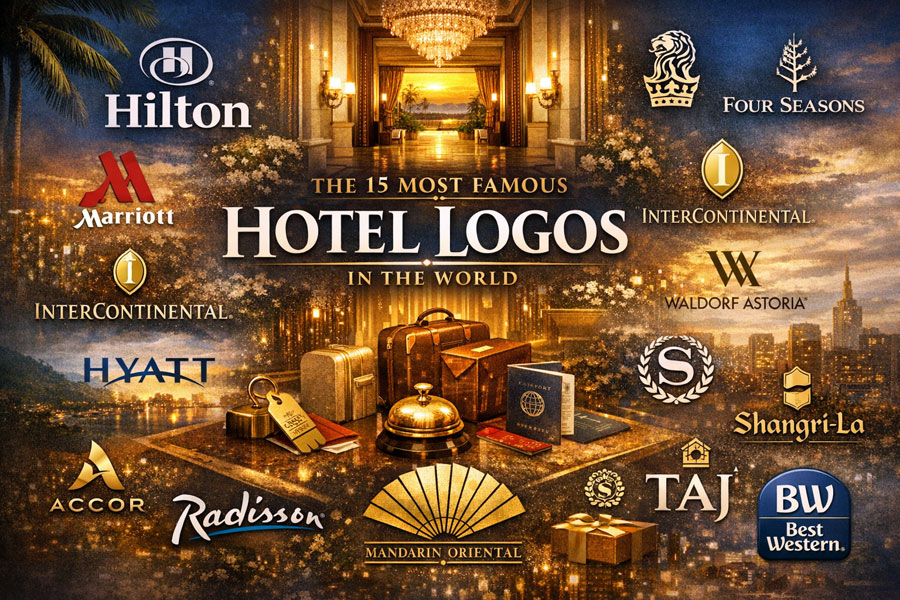
In the hospitality industry, logos are not decorative elements. They are visual contracts that communicate trust, quality, and emotional assurance before a guest ever books a room. The most famous hotel logos in the world have achieved longevity not through constant redesigns, but through disciplined evolution, strong symbolism, and deep alignment with brand purpose.
This curated Top 15 focuses on hotel logos that define luxury, comfort, and hospitality through meaning, structure, and heritage. Each of these identities has shaped global expectations of what a hotel brand should represent.
Hilton Hotels & Resorts Logo Meaning and Brand Heritage
The Hilton logo is one of the most structurally confident marks in hospitality branding. Centered around a bold, architectural “H” enclosed within a refined oval frame, it communicates stability, order, and operational excellence. The emblem feels deliberately engineered rather than decorative, reinforcing Hilton’s role as a global benchmark in full-service hospitality.
Its restrained blue-and-white palette enhances trust and professionalism, while the geometry of the symbol echoes pillars, gateways, and hotel facades. This balance of simplicity and authority has allowed the Hilton logo to remain timeless while scaling across thousands of properties worldwide, making it a cornerstone of modern hotel logo history.
Marriott Logo Meaning and Global Hospitality Authority
Marriott’s logo heritage reflects corporate leadership and scale. The iconic “M” functions as both a letterform and a symbolic gateway, suggesting openness and welcome while maintaining authority. Its deep red tone conveys confidence and legacy, reinforcing Marriott’s status as one of the world’s largest hotel operators.
The logo’s strength lies in its adaptability. Whether displayed on luxury resorts or business hotels, the mark retains clarity and gravitas. Marriott’s visual identity demonstrates how institutional branding can remain warm without losing professionalism.
Ritz-Carlton Logo Symbolism and Luxury Identity
The Ritz-Carlton logo is one of the clearest expressions of luxury symbolism in hospitality branding. The crowned lion draws from European heraldry, representing nobility, authority, and refinement. Gold tones reinforce exclusivity and timeless elegance.
This logo does not aim to be modern or minimal. Instead, it deliberately embraces tradition. The logo meaning aligns with the brand’s service philosophy: ritual, formality, and personalized excellence. In luxury hotel logo heritage, Ritz-Carlton stands as a reference point for aristocratic branding.

Four Seasons Logo Meaning and Timeless Brand Philosophy
The Four Seasons logo is a literal yet powerful translation of brand identity. The tree divided into four seasonal quadrants symbolizes continuity, balance, and renewal. It visually communicates the promise of consistent excellence regardless of location or time of year.
The restrained black-and-white palette reinforces timelessness. Unlike trend-driven luxury logos, Four Seasons relies on symbolic clarity rather than aesthetic novelty. Its logo heritage reflects architectural thinking and long-term brand discipline.

Hyatt Logo Meaning and Experiential Branding
Hyatt’s logo centers on a single arched line crossing the letter “A,” functioning as a bridge. This subtle design choice transformed a conventional wordmark into a meaningful symbol of connection, journey, and transformation.
The logo meaning aligns closely with Hyatt’s experiential positioning. It speaks less about accommodation and more about emotional engagement. Clean typography and minimal structure make the logo adaptable across luxury and lifestyle sub-brands within the Hyatt portfolio.

InterContinental Hotels Logo Meaning and Global Prestige
The InterContinental logo is rooted in mid-century aviation luxury. The golden oval enclosing a bold “I” suggests global reach, cultivated elegance, and exclusivity. Its three-dimensional appearance adds depth and institutional weight.
This logo bridges corporate heritage and luxury hospitality. It communicates internationalism without cultural specificity, making it effective across diverse global markets.
Sheraton Logo Meaning and Community-Centered Evolution
Sheraton’s logo evolution reflects a shift from formality to connection. The iconic “S,” once framed by laurel wreaths, now sits within a clean circle representing the world and the energy of gathering.
The logo meaning emphasizes familiarity and global belonging. While modernized, the identity preserves its historical core, reinforcing Sheraton’s role as a social hub within the hospitality landscape.

Mandarin Oriental Logo Symbolism and Cultural Luxury
The Mandarin Oriental fan is one of the most culturally sophisticated symbols in hotel branding. Inspired by East Asian tradition, the fan represents hospitality, grace, and refinement.
Its geometric precision allows the emblem to remain timeless, while localized variations reinforce emotional connection in different markets. The logo heritage balances global luxury with cultural authenticity.
Accor Logo Meaning and Corporate Hospitality Heritage
Accor’s logo centers on the Bernache goose, a symbol of travel, unity, and collective movement. The modern gold rendering introduced in recent years enhances digital clarity while preserving symbolic depth.
As a multi-brand hospitality group, Accor’s logo functions as an umbrella identity, uniting diverse hotel categories under a shared philosophy of welcome and progress.
Holiday Inn Logo Meaning and Trust-Based Hospitality
Holiday Inn’s green logo is a textbook example of color psychology in hospitality branding. Green conveys relaxation, safety, and balance, reinforcing the brand’s promise of comfort and familiarity.
The logo avoids complexity, relying on color consistency and legibility to maintain recognition across thousands of locations worldwide.

Taj Hotels Logo Meaning and Cultural Prestige
The Taj logo blends a rising sun with domed architecture, drawing from Indian royal heritage. Gold dominates the palette, symbolizing prestige, warmth, and cultural pride.
This logo meaning positions Taj as both a national symbol and a global luxury brand, bridging tradition with international hospitality standards.
Shangri-La Logo Symbolism and Asian Luxury
Shangri-La’s stylized “S” is inspired by Chinese seals and landscape symbolism. Mountains reflected in water evoke serenity, escape, and harmony.
The logo communicates sanctuary rather than spectacle, aligning with the brand’s promise of refined Asian hospitality.
Radisson Logo Meaning and Modern Hospitality Warmth
Radisson’s logo evolution returned to typographic clarity inspired by early American signage. Clean lines and confident lettering balance heritage with modern expectations.
The logo meaning emphasizes warmth, authenticity, and dependable service, particularly in urban and business-focused markets.
Westin Logo Meaning and Wellness-Centered Design
Westin’s logo is intentionally minimal, reflecting its wellness-driven philosophy. Soft typography and balanced spacing create a sense of calm, aligning with the brand’s focus on sleep, health, and renewal.
This visual restraint strengthens emotional resonance, positioning Westin as a sanctuary rather than a spectacle within the luxury hospitality space.
Best Western Logo Meaning and Global Reliability
Best Western’s circular “BW” emblem is built for clarity and memorability. Its blue-and-white palette conveys trust and dependability, while the monogram ensures instant recognition.
The logo’s success lies in its universality. It adapts seamlessly across regions while maintaining a consistent promise of value and comfort, reinforcing Best Western’s global presence.

Why Famous Hotel Logos Endure Across Generations
The world’s most famous hotel logos share one defining characteristic: discipline. They are not driven by trends, marketing gimmicks, or short-term aesthetics. Instead, they are built on long-term thinking, symbolic clarity, and emotional reliability.
Luxury hotel logos rely on heritage, heraldry, and restraint. Midscale and business-focused brands prioritize clarity, trust, and standardization. Wellness and lifestyle brands use minimalism to communicate calm and balance. Despite these differences, all successful hotel logos perform the same fundamental role: they reduce uncertainty.
In hospitality, trust is the currency. A strong logo reassures guests before they book, before they arrive, and before they experience service. This is why logo heritage matters. It is not nostalgia, but accumulated credibility.
As travel continues to evolve, the most enduring hotel brands will remain those that understand one truth:
a hotel logo does not shout — it reassures.
FAQ: The Most Famous Hotel Logos in the World
What makes a hotel logo “famous” in global hospitality?
A hotel logo becomes famous when it achieves instant recognition across markets and holds that recognition for years, sometimes decades. The most iconic hotel logos succeed because they are consistent, scalable, and emotionally clear. They communicate what guests care about most before booking: trust, comfort, safety, prestige, and reliability. In hotel logo history, fame is rarely about novelty. It is usually about repetition, disciplined brand governance, and a visual system that can live on buildings, keycards, apps, signage, uniforms, and advertising without losing meaning.
Why do luxury hotel logos often use crests, crowns, and heraldic symbols?
Luxury hotels commonly adopt heraldic symbols because they borrow visual language associated with legacy, aristocracy, and social status. Crests and crowns carry centuries of cultural meaning, signaling exclusivity and high standards without needing explanation. This is why brands such as Ritz-Carlton lean into classical symbolism. In luxury hospitality, logo symbolism is often designed to elevate perception immediately, suggesting the guest experience is ceremonial, refined, and premium.
Why do some famous hotel logos avoid symbols and rely only on typography?
Typography-only logos are common in hospitality because they are timeless and adaptable. A pure wordmark can feel confident, modern, and editorial, especially for brands that want to communicate sophistication through restraint. Minimalism also improves legibility across screens and small sizes. Brands like Westin prove that a disciplined wordmark can still convey a clear promise, such as wellness or calm, without using overt icons.
What is the most important psychological job of a hotel logo?
The most important job is reducing uncertainty. Hospitality is high-stakes for travelers because the purchase is experiential and time-bound. A hotel logo functions as a shortcut that tells guests, “You already know what to expect here.” Strong logo heritage builds a sense of predictability and safety. Even for luxury brands, the logo is not only about aspiration; it is about assurance.
How do colors influence hotel logo meaning?
Colors in hospitality branding are selected to trigger specific emotional expectations. Blue is widely used to communicate trust and professionalism, which is why it appears in brands such as Hilton and Best Western. Green often signals comfort, balance, and reassurance, which helps explain the staying power of Holiday Inn. Gold implies prestige and success, making it a natural fit for luxury identities like InterContinental Hotels & Resorts and Taj Hotels.
Why do hotel brands rarely make radical logo changes?
Because recognition is expensive to rebuild. Hotels operate in physical space, so a major logo change impacts signage, uniforms, printed materials, digital systems, loyalty programs, and architecture-level branding. More importantly, it risks breaking the emotional trust guests associate with the mark. That’s why successful hotel logo history is usually a story of refinement rather than reinvention, adjusting typography, spacing, and simplification while preserving identity anchors.
What role does “logo heritage” play in bookings and loyalty?
Logo heritage is a trust multiplier. When a logo has remained consistent, guests tend to transfer prior positive experiences to future bookings. Heritage does not mean “old-fashioned.” It means the brand has been stable enough to become familiar. Familiarity reduces perceived risk, which directly supports loyalty and repeat stays.
How can a new hotel brand learn from famous hotel logos without copying them?
The goal is to learn principles, not shapes. Famous hotel logos teach the value of disciplined typography, limited color palettes, strong contrast, and symbols that relate to brand origin or guest promise. A new brand should define its positioning first, then build identity around what guests must believe instantly. The best path is to design a logo that works as signage from the start, because hospitality branding is always both digital and physical.
Which design elements consistently work for hotel logos worldwide?
The most reliable elements are strong typographic hierarchy, high legibility, simple geometry, and a symbol that can function alone as an app icon or signage mark. Balanced spacing and a stable silhouette matter more than decorative detail. In modern hospitality, the best logos are those that remain clear at small sizes and still feel premium when enlarged on a facade.
How do hotel logos differ between luxury, business, and wellness-focused brands?
Luxury logos often use heritage cues like crests, monograms, or metallic palettes to communicate exclusivity. Business-oriented brands prioritize clarity, structure, and standardization, often using geometric forms and neutral colors. Wellness brands typically rely on minimalism and calm typography to project rest and renewal. These differences are not aesthetic trends; they reflect different guest expectations and purchasing psychology.