TD Bank Logo History: Meaning, Symbolism & Brand Heritage

TD Bank occupies a unique position in the North American financial landscape, operating at the intersection of Canadian banking heritage and the competitive United States retail banking market. While the TD name itself traces its origins back to the mid-19th century through its parent institution, the TD Bank brand familiar to American consumers today emerged through acquisition, consolidation, and deliberate visual repositioning. The logo history of TD Bank reflects this dual identity, combining institutional stability with a modern, customer-centric aesthetic.
As with other cross-border financial brands, visual consistency has played a crucial role in building trust and recognition. The evolution of the TD Bank logo follows a strategic path similar to what can be observed in the Bank of America logo and the Chase logo history, where clarity and restraint are prioritized over decorative complexity. Within the broader financial logo heritage, TD Bank stands out for how decisively it shifted visual language following a major corporate transition, using design as a signal of strategic renewal rather than incremental change.
Meaning and History: The Origin of the TD Bank Identity
The TD Bank brand in the United States was officially established in 2009, following the acquisition of Commerce Bancorp by Toronto-Dominion Bank. Prior to this moment, Commerce Bancorp had built a strong regional presence with its own distinct visual identity, tone, and corporate culture. The acquisition marked a turning point, not only operationally but also symbolically, as the new ownership sought to align the US subsidiary with the broader TD brand family.
The logo meaning introduced in 2009 was rooted in continuity with the Toronto-Dominion identity while signaling a new phase for American operations. The shift away from Commerce Bancorp’s red-and-black palette toward TD’s green-centric system was intentional, emphasizing growth, stability, and approachability. This transformation illustrates how logo heritage can be reshaped without erasing the operational legacy that preceded it.
Logo Symbolism: Stability, Accessibility, and Growth
The TD Bank logo symbolism relies on minimalism and color psychology rather than illustrative elements. The square emblem used by the brand communicates balance, reliability, and structural integrity—qualities traditionally associated with financial institutions. Within this square, the interconnected “TD” letterforms suggest unity and continuity, reinforcing the relationship between the US subsidiary and its Canadian parent.
Green dominates the visual system, a deliberate departure from the more aggressive tones historically used in banking identities. In logo symbolism, green is widely associated with growth, renewal, and financial well-being. For TD Bank, this choice aligns with its customer-focused positioning and emphasis on everyday banking accessibility rather than elite exclusivity.
TD Bank Logo History Timeline
1973–2009: Commerce Bancorp Corporate Identity
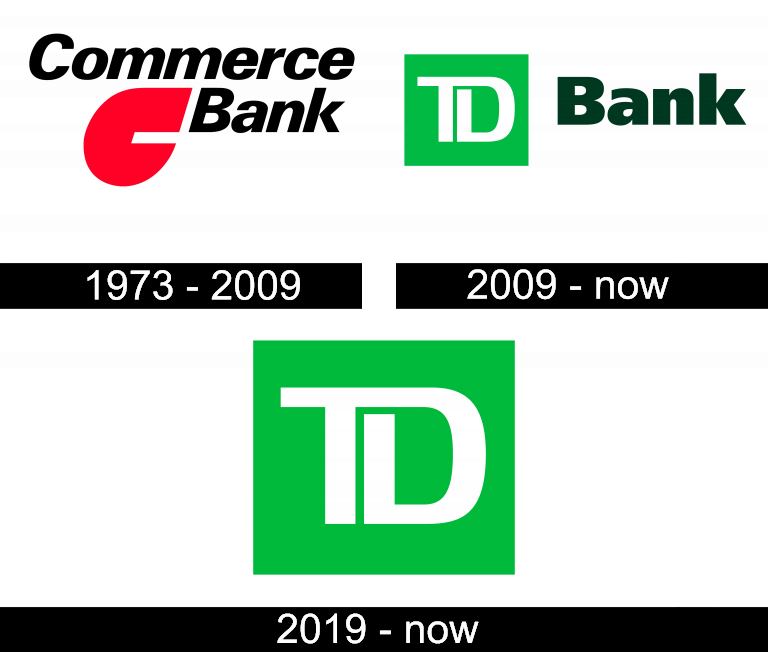
Before becoming TD Bank, the institution operated as Commerce Bancorp, supported by a logo introduced in 1973. This identity featured a two-line italicized wordmark set in a sans-serif typeface, rendered in a bold red, black, and white palette. The staggered alignment of the lettering created a sense of forward motion, while the abstract red emblem positioned alongside the text resembled a stylized letter “C.”
This design conveyed confidence, authority, and momentum, aligning with Commerce Bancorp’s aggressive growth strategy in regional US markets. Its longevity—remaining unchanged for more than three decades—cemented strong local recognition and reflected a stable corporate phase prior to acquisition.

2009–2019: Introduction of the TD Bank Visual System
In 2009, following the acquisition by Toronto-Dominion Bank, the Commerce Bancorp identity was fully retired. The new TD Bank logo introduced a radically different visual language centered on a bright green square containing the white “TD” monogram. To the right, the word “Bank” appeared in a dark green, extra-bold sans-serif typeface.
This redesign represented a clean break from the past. The simplified geometry, restrained typography, and cohesive color palette positioned TD Bank as part of a larger North American financial group while signaling modernization and customer accessibility. From a logo heritage perspective, this was not an evolution but a deliberate redefinition.

2019–Today: Emblem-Only Brand Expression
In more recent applications, TD Bank has increasingly relied on the standalone green square emblem without the accompanying wordmark. This secondary logo functions as a shorthand identifier, particularly effective in digital interfaces, mobile banking, and physical signage where space and speed of recognition are critical.
The adoption of the emblem-only mark reflects growing brand equity and confidence. Much like other established banking brands, TD Bank reached a point where the symbol alone was sufficient to communicate identity, trust, and continuity.
Typography and Color Palette
TD Bank’s typography is grounded in a modern sans-serif typeface with heavy weight and rounded proportions. This choice enhances legibility while softening the institutional tone often associated with financial branding. The letterforms project confidence without appearing rigid, reinforcing approachability.
The color palette is dominated by green and white, with darker green accents used for contrast and hierarchy. In logo meaning, green conveys prosperity and balance, while white introduces clarity and transparency. Together, they support TD Bank’s positioning as a dependable yet customer-friendly financial institution.
TD Bank Logo as a Strategic Brand Reset
The TD Bank logo history demonstrates how visual identity can be used as a strategic tool during periods of corporate transformation. Rather than gradually modifying the Commerce Bancorp design, TD Bank adopted a completely new visual language aligned with its parent company’s global brand system. This decision allowed the bank to quickly establish credibility, cohesion, and recognition within the competitive US market.
From a logo heritage perspective, TD Bank exemplifies how clarity, restraint, and symbolic consistency can accelerate brand integration while maintaining long-term relevance in a traditionally conservative industry.
FAQ: TD Bank Logo Meaning and History
What does the TD Bank logo represent?
The logo represents stability, growth, and accessibility, expressed through a balanced square form and a green color palette associated with financial well-being.
Why did TD Bank change its logo in 2009?
The logo was changed following the acquisition of Commerce Bancorp by Toronto-Dominion Bank to align the US operations with the parent company’s brand identity.
What does the green color in the TD Bank logo symbolize?
Green symbolizes growth, renewal, trust, and financial stability, reinforcing TD Bank’s customer-focused positioning.
Has the TD Bank logo changed since 2009?
The core logo has remained consistent, with the main change being the increased use of the emblem-only version in recent years.