
TAG Heuer Logo History: Meaning, Symbolism & Brand Heritage
There are luxury watch brands admired for their craftsmanship, and then there is TAG Heuer, a house whose identity has become inseparable from speed, precision, engineering, and a spirit of bold innovation. Its logo — a shield filled with color, geometry, and Swiss character — is one of the most recognizable visual marks in the global watchmaking world.
Unlike many haute horlogerie brands that embrace subtle monograms, TAG Heuer has cultivated a more assertive emblem: bright colors, strong lines, and typography that conveys an unmistakable energy.
To understand why the TAG Heuer logo became what it is today, one must begin in the mid-19th century, when a 20-year-old watchmaker named Edouard Heuer opened his workshop in Saint-Imier. More than a century and a half later, the brand’s emblem continues to reflect the personality of its founder — a pioneer who valued technical mastery, mechanical elegance, and industrial audacity. The TAG Heuer logo has changed only twice, yet its core geometry has remained, creating one of the most enduring shield-shaped trademarks in European industrial design.
The Meaning Behind the TAG Heuer Emblem
The TAG Heuer logo is built on a set of values the brand has embodied since its earliest days: precision, modernity, performance, and innovation. Throughout its evolution, the emblem has been rooted in the heritage of the original Heuer name — a family legacy deeply connected to chronographs and timing instruments used in motorsport. When the company merged with TAG Group in 1985, the rising spirit of engineering and technology was added to this heritage.
The shield defines the logo’s identity: strong, architectural, masculine. It suggests precision and robustness, like the case of a finely engineered chronograph. Inside the shield, the contrasting fields of red and green symbolize energy, dynamism, excellence, and Swiss tradition.
The bold white lettering cuts through these colors with the clarity of a timing instrument, reflecting confidence and absolute legibility — a crucial feature in sports where fractions of a second determine victory.
TAG Heuer’s symbolism sits at the intersection of luxury and adrenaline. Its logo is not merely decorative; it communicates the disciplines that define the brand’s legacy: speed, measurement, and a refusal to compromise.
Logo Evolution Timeline
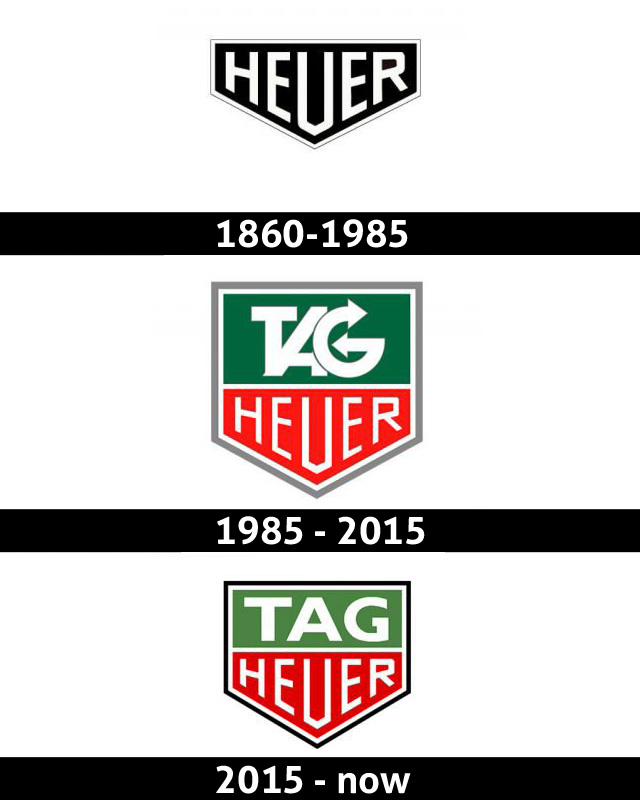
1860–1985: The Heuer Shield — A Modernist Beginning
The very first Heuer logo, introduced when the brand was founded in 1860, was remarkably ahead of its time. It featured a monochrome, geometrically confident shield that extended horizontally, ending in a downward-facing triangular point. This emblem, drawn in white over a solid black field and framed by a thick white outline, displayed the name “HEUER” in bold uppercase letters that perfectly mirrored the contours of the shield.
This early badge was minimalist yet strong — almost industrial — reflecting a young company intent on precision engineering rather than ornamentation. It remained largely unchanged for more than a century, becoming the foundation for every future iteration and establishing one of the most iconic silhouettes in horology.

1985–2015: The Birth of TAG Heuer — A New Identity
In 1985, the Heuer family legacy merged with TAG Group, a company known for advanced engineering and technology. The merger created TAG Heuer, and with it came a dramatic transformation of the brand’s visual identity.
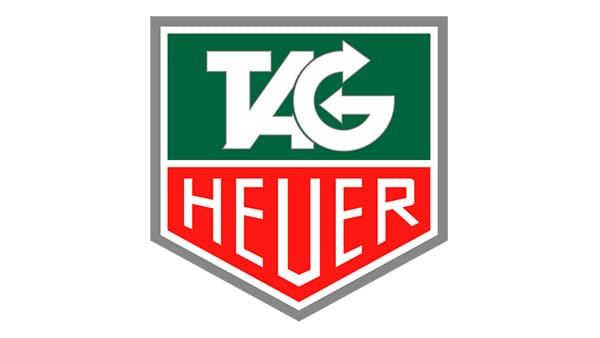
The historic shield remained, but its proportions shifted from horizontal to vertical, granting more presence and authority. The badge was now divided into two vibrant color fields: green on top and red at the bottom. The new “TAG” lettering appeared in bold white capitals across the green field — futuristic, compact, and overlapping — with the ends of the “G” stylized like directional arrows. Beneath it, the iconic “HEUER” logotype remained in its traditional geometric serif, maintaining the visual continuity of the brand’s origins.
This version of the logo embodied the spirit of the 1980s: bold, technical, energetic. It celebrated the fusion of watchmaking heritage with advanced engineering, aligning perfectly with TAG Heuer’s deepening association with motorsport.
2015–Today: Refinement and Modern Luxury
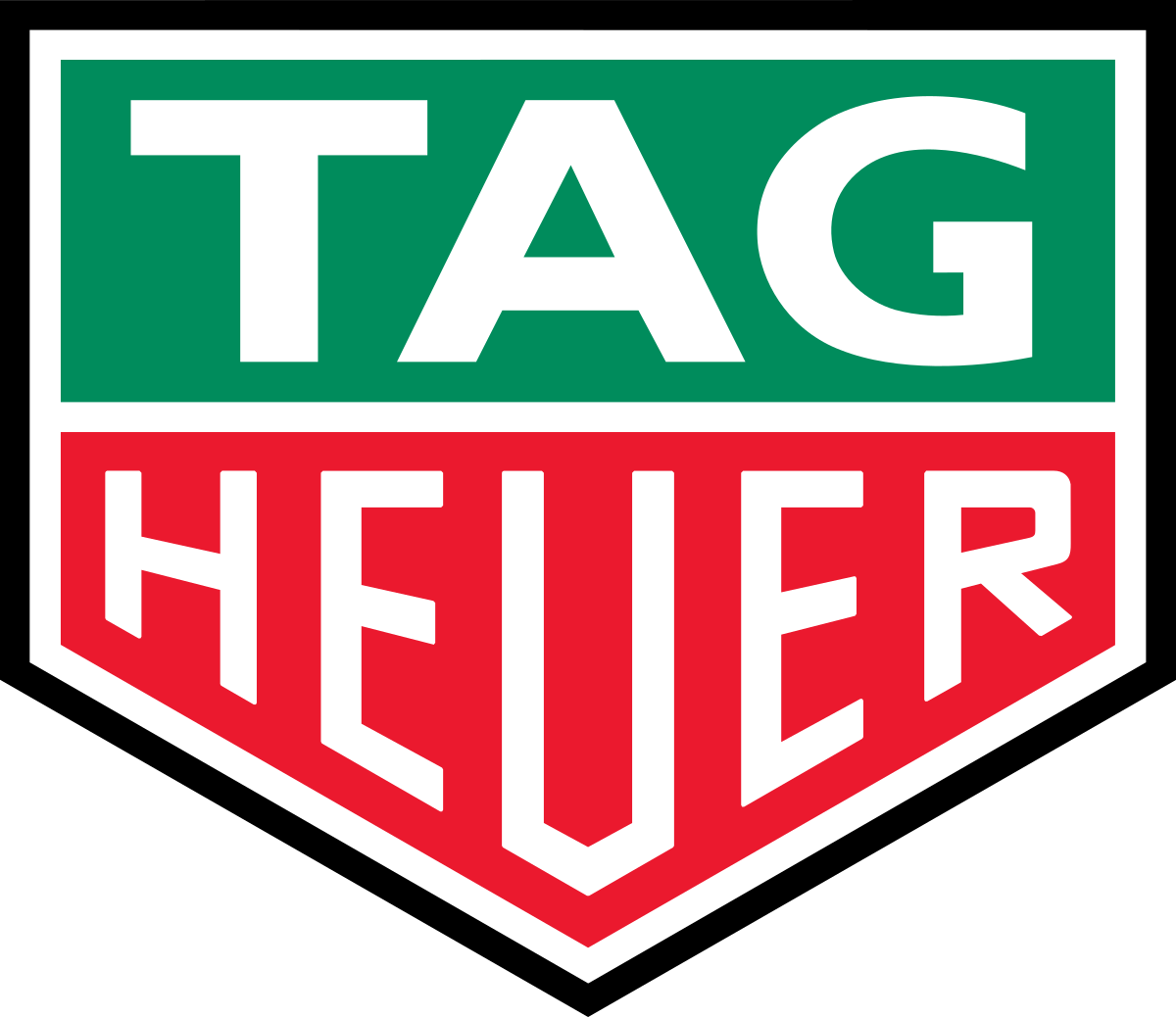
The most recent redesign, introduced in 2015, was an evolution rather than a reinvention. The crest was subtly widened, giving the emblem a more balanced silhouette. The “TAG” inscription was redrawn in a modern sans-serif typeface with thick, stable strokes, eliminating the arrow-like terminals and embracing a cleaner and more contemporary aesthetic.
The outline of the shield was simplified to a crisp white exterior line framed by a thin black border, enhancing contrast and making the emblem look sharper and more luxurious. The trademark red and green colors remained — a reminder of the logo’s heritage — but their saturation and tonal balance became more refined, making the badge visually more suited to the modern luxury market.
Font & Typography
Typography plays a central role in TAG Heuer’s visual identity. Historically, the brand has used variations of Gill Sans, a quintessentially British typeface designed by Eric Gill. The contrast between the fonts for “TAG” and “HEUER” — bold for the former and lighter for the latter — reflects the dual identity of the brand: modern technology paired with classical watchmaking finesse.
The modern TAG Heuer wordmark leans toward bold geometric sans-serifs, emphasizing clean lines and architectural simplicity. This typographic clarity is essential for chronograph instruments and underscores the brand’s reputation for precision.
Color Palette
TAG Heuer’s color system is unusually vivid for a luxury watchmaker. Its palette consists of green, red, white, and black — a lively yet harmonious combination.
– The green signifies innovation and forward momentum.
– The red represents energy, adrenaline, motorsport culture, and determination.
– White ensures legibility and purity of form.
– Black contributes structure, contrast, and timelessness.
Together, these colors create an emblem that stands apart in an industry traditionally dominated by metallic or monochrome logos. TAG Heuer embraced color to express its personality: bold, confident, sporty, and modern.
A Shield Forged in Precision
From the 19th-century workshops of Edouard Heuer to the global prestige of today, the TAG Heuer logo has remained a symbol of precision, innovation, and the relentless pursuit of excellence. Few luxury brands possess such a consistent visual heritage — a shield that has endured through eras and mergers without losing its identity.
The TAG Heuer emblem continues to reflect the brand’s fundamental values: engineering prowess, racing spirit, and timekeeping mastery. It is not just a logo; it is an icon of Swiss performance, a guardian of legacy, and a celebration of precision that has shaped the brand’s reputation for more than 160 years.
FAQ
What does the TAG Heuer logo represent?
It represents precision, innovation, and the fusion of traditional Swiss watchmaking with advanced engineering. The shield shape conveys robustness and heritage, while the red and green fields reflect energy, excellence, and modernity.
Why did TAG Heuer change its logo in 1985?
The redesign marked the merger of Heuer with TAG Group. The new name — TAG Heuer — required the visual identity to reflect both engineering innovation and watchmaking tradition.
Why does the TAG Heuer logo use bright colors?
The red and green palette distinguishes the brand from its competitors and reflects its sporty, dynamic, and high-tech identity, closely tied to motorsport.
Is the Heuer shield still used today?
Yes. Although modernized, the triangular shield remains the foundation of TAG Heuer’s corporate identity.