
Super Mario Logo History: Meaning, Symbolism & Brand Heritage
Few video game franchises have achieved the cultural permanence of Super Mario. Introduced in the mid-1980s, the series became a cornerstone of interactive entertainment and a defining force in how video games communicate identity, character, and joy. More than just a platformer, Super Mario evolved into a global media phenomenon, shaping generations of players and redefining what a video game mascot could represent.
Much like the long-term consistency behind the Nintendo logo history and the playful authority established through the Pokémon logo heritage, Super Mario’s visual identity relies on clarity, repetition, and emotional familiarity. The logo, though often adapted for individual titles, gradually developed into a recognizable system that reflects the franchise’s core values: fun, accessibility, and imagination.
Meaning and History: The Origin of the Super Mario Identity
The Super Mario franchise was created by Shigeru Miyamoto and published by Nintendo. The series officially began in 1985 with the release of Super Mario Bros. for the Nintendo Entertainment System. While the earliest games did not emphasize a unified visual identity, they introduced foundational concepts that would later inform the franchise’s logo meaning.
In its early years, Super Mario was defined more by gameplay mechanics and character design than by branding. The logo functioned primarily as a title treatment rather than a long-term emblem. Only as the franchise expanded into multiple generations of consoles did the need for a consistent visual language become apparent.
The evolution of the Super Mario logo mirrors the growth of the franchise itself, transitioning from simple typographic labels to expressive wordmarks capable of representing a vast fictional universe.
Super Mario Logo History Timeline
1985: Super Mario Bros.
The first Super Mario Bros. release featured a straightforward typographic treatment rather than a fully developed logo. The title was set in a simple sans-serif typeface, with “Mario Bros.” displayed prominently and the word “Super” placed above in smaller lettering. Red was chosen as the primary color, offering strong contrast against the dark background.
This design served a functional purpose and lacked the personality that would later define the franchise’s visual identity.
1996: The Birth of the Iconic Super Mario Logo
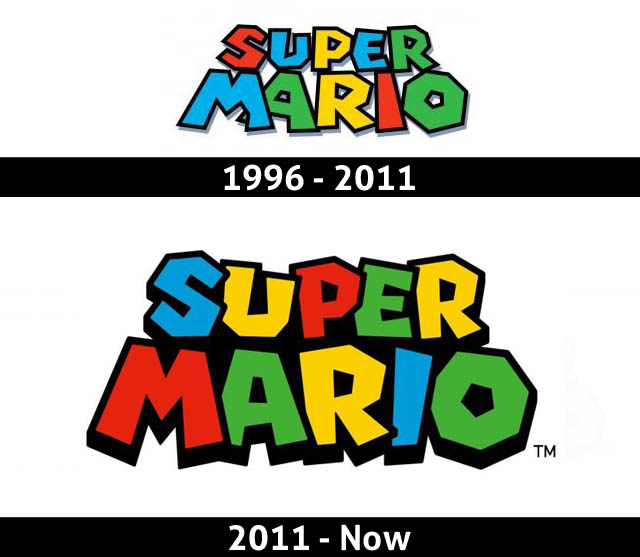
A significant shift occurred in 1996 with the release of Super Mario 64. This era introduced the first widely recognized Super Mario logo, inspired by earlier titles such as Super Mario World while establishing a new standard for the franchise.
The wordmark featured chunky, playful letters in bright primary colors, including red, blue, yellow, and green. Each letter was uniquely shaped, with deliberate irregularities that added charm and motion. Black outlines and subtle shading gave the logo depth, making it feel energetic and dimensional.
This version of the logo remained influential across multiple releases and defined the Super Mario logo heritage for more than a decade.
2011: Refined Playfulness
In 2011, the logo underwent refinement with the release of Super Mario 3D Land. The letterforms became slightly thicker and more structured, reducing some of the exaggerated distortions seen in earlier versions. Colors deepened, and black shading grew more prominent, increasing contrast and legibility.
Letters began to overlap more noticeably, creating a sense of density and cohesion. While the color palette remained consistent, the distribution of colors across letters changed, reinforcing freshness without abandoning familiarity.
This update preserved the franchise’s playful identity while adapting it to modern visual standards.
Logo Symbolism: Joy, Motion, and Accessibility
The symbolism of the Super Mario logo lies in its deliberate imperfection. The uneven letter shapes, vibrant colors, and overlapping forms communicate movement and spontaneity, reflecting the kinetic nature of platform gameplay.
Rather than relying on strict geometry or minimalism, the logo embraces exaggeration and asymmetry. This approach aligns with the franchise’s philosophy of welcoming players of all ages and skill levels, emphasizing enjoyment over precision.
Typography and Color Palette
Typography plays a central role in the Super Mario logo meaning. The custom letterforms are bold, rounded, and expressive, designed to feel friendly rather than authoritative. Each character contributes to a sense of individuality while remaining part of a cohesive whole.
The color palette draws from primary colors commonly associated with toys and childhood creativity. Red conveys energy, blue suggests reliability, yellow communicates optimism, and green adds balance. The consistent use of black outlines anchors the composition and ensures readability across different media.
Super Mario Logo Heritage and Cultural Impact
The Super Mario logo heritage demonstrates how flexibility can coexist with consistency. While individual games introduce variations, the core visual language remains instantly recognizable. This balance has allowed the franchise to adapt to new technologies and audiences without losing its identity.
Similar patterns can be observed across video game logo history, where long-running franchises rely on stable design systems rather than constant reinvention. As Super Mario continues to expand into films, merchandise, and theme parks, its logo remains a powerful symbol of fun, nostalgia, and creative longevity.
For readers exploring how playful branding achieves lasting cultural relevance, further examples can be found within the broader entertainment brand logo heritage archive and the evolving collection of classic gaming logo history studies.
FAQ: Super Mario Logo Meaning and History
What does the Super Mario logo represent?
The logo represents joy, movement, and accessibility, reflecting the playful nature of the franchise.
When did the first recognizable Super Mario logo appear?
The first widely recognized Super Mario logo was introduced in 1996 with Super Mario 64.
Why are multiple colors used in the Super Mario logo?
The bright primary colors convey energy, creativity, and fun, appealing to a broad audience.
Has the Super Mario logo changed over time?
Yes, the logo has evolved gradually, with refinements introduced in 2011 while preserving its core identity.