Subaru Logo History: Meaning, Symbolism & Brand Heritage

The Origin of Subaru
When Subaru entered the Japanese automotive landscape in the years following the Second World War, it emerged in a nation reshaping itself, redirecting its industrial strength toward civilian innovation. The military sector had vanished; the automotive industry was becoming a new engine of national recovery. In 1953, five companies joined together to form Fuji Heavy Industries, marking the beginning of a new technological era and giving birth to a brand that would carry a name rooted in both language and mythology.
“Subaru” is the Japanese word for unite, a fitting reflection of the merger that created the company. The term is also used in Japan to identify the Pleiades, a cluster of six visible stars in the Taurus constellation. In Greek mythology, these stars represent the daughters of Atlas, transformed into a luminous celestial group. The symbolism was powerful: six stars, one larger and five smaller — precisely mirroring the new industrial structure of Fuji Heavy Industries.
Choosing “Subaru” was more than a naming decision; it was the first time a Japanese automaker embraced a Japanese word as its official brand name. It expressed cultural identity, national pride, and a reverence for nature’s symbolism. The constellation, an ancient guide point in the night sky, became the foundation for the brand’s emblem — an oval holding six stars in a composition that has remained central to Subaru’s visual story for decades.
From these origins, Fuji Heavy Industries evolved into a global transportation group, while Subaru’s star-filled logo endured as one of the most poetic and culturally grounded emblems in automotive design, a permanent reminder of unity, heritage and celestial inspiration.
Subaru Logo Evolution: A Timeline Written in Stars

1953–1958: The First Starry Mark
The first Subaru emblem introduced in 1953 set the foundation for everything that would follow. Presented in monochrome, the emblem depicted six sharp, four-pointed stars enclosed within a horizontally stretched oval. The design was simple, geometric, and rooted in both Japanese minimalism and cosmological symbolism. A second version, released the same year, transformed the flat symbol into a glossy metallic badge with polished silver gradients—an early attempt to give texture and material presence to an emblem meant for car bonnets. It established the oval-and-stars structure that would define Subaru for decades.

1958–1959: The Golden Constellation
By 1958, Subaru introduced its first fully colored emblem: a gold oval housing six gold stars connected by thin, elegant lines. This version reflected a more ornamental and classical aesthetic, lending a sense of prestige to the young brand. It was refined, warm and unusually luxurious for a Japanese automaker of the era.

1959–1970: Red Sky, Silver Stars
The 1959 redesign embraced a vivid color shift—substituting the golden scheme with a red background and polished silver stars. The result felt bold and energetic, a palette that expressed movement, passion, and postwar modernity. Subaru was asserting its presence, and the logo mirrored that progress.
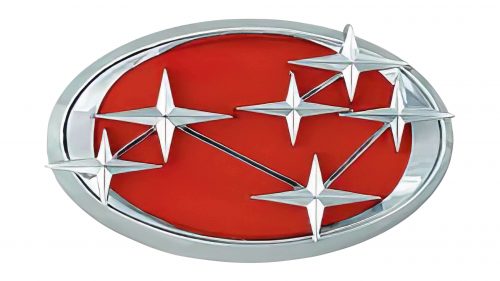
1970–1980: The U-Shaped Frame
In the early 1970s, the emblem took on a new architectural shell. The familiar oval now sat within a U-shaped frame with a flattened bottom. The lines grew bolder, the metallic surfaces more pronounced, and the dual-tone silver-black palette gave the brand a stronger industrial identity. This was Subaru entering a new technological age, and the emblem evolved accordingly.
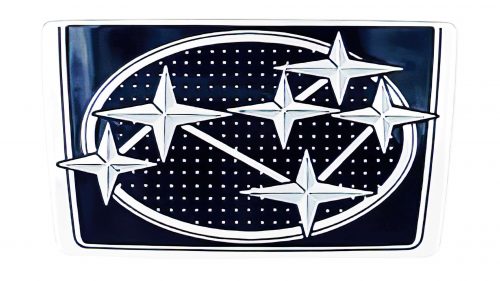
1980: A Confident Refinement
In 1980, Subaru returned to the clarity of its earlier versions. The six stars remained inside the extended horizontal oval, but now each element was accented with black outlines and stronger metallic contrasts. It was a logo built on precision, reflecting Subaru’s growing technical capabilities.

1980–2003: The Blue Night Sky
The design introduced in 1979 and carried well into the early 2000s marked the defining era of the Subaru emblem. The oval became deeper, the stars more polished, and the background adopted a rich blue hue—an unmistakable night sky. Subtle gradients created an illusion of depth and celestial glow, giving the emblem a distinctly atmospheric quality. This is the version that, for many, became synonymous with Subaru’s global rise.

1999–2003: Modernized Proportions
As the brand expanded internationally, Subaru streamlined its emblem by widening the oval, strengthening the outlines, and deepening the gradients. The stars gained crisper silhouettes, resulting in a cleaner, sharper, more contemporary design.

2003–Today: The Wordmark Joins the Constellation
In 2003, Subaru added its bold uppercase wordmark beneath the emblem, adopting a traditional sans-serif typeface. The clarity and thickness of the lettering introduced visual balance, allowing the dynamic emblem to pair with an assertive and readable brand name. This combination—an expressive astronomical symbol above a grounded industrial wordmark—remains central to Subaru’s identity today.
The Meaning Behind the Subaru Emblem
The Subaru logo is more than a constellation; it is a map of the brand’s cultural and corporate origins. The six stars represent the six companies that merged to form Fuji Heavy Industries, the parent company of Subaru. Their arrangement originally mirrored the real position of the brightest stars in the Pleiades cluster, though later adaptations adjusted the layout for design balance.
The largest star reflects Fuji Heavy Industries itself, while the five smaller stars represent its subsidiary companies. The emblem conveys unity, cooperation, and shared purpose—ideas central to Japanese industrial philosophy of the 1950s.
The blue background serves dual symbolic functions. It evokes the sky, connecting the emblem to its astronomical meaning, and recalls water, a recurring theme in Japanese culture often associated with clarity, purity, and aspiration.
The decision to connect some of the stars with thin lines in early versions added a metaphor for partnership—not just within the company, but also between Subaru and its customers, a relationship built on trust and reliability.

The Emblem Form: The Harmony of the Oval
Subaru deliberately avoided traditional Western heraldic shapes such as shields or perfect circles. Instead, designers chose a horizontally stretched oval—an important shape in Japanese visual culture. The oval conveys harmony, stability, and continuity, while the horizontal orientation signifies movement, direction, and ambition. The emblem became instantly recognizable in Japan, precisely because the form spoke to domestic aesthetics while remaining fresh to Western consumers.
Over time, the placement of the stars has shifted from astronomical accuracy to graphic balance. The largest star occupies the left portion of the oval, giving the emblem a sense of anchoring, while the remaining stars cluster to the right, creating visual motion across the badge.
Typography: A Wordmark of Equal Line Weight
Subaru’s typography is designed to complement the emblem without overpowering it. The uniform thickness of each line conveys simplicity and neutrality—qualities valued in Japanese design philosophy. Unlike the complex stroke variation of Japanese characters, the Latin lettering draws inspiration from European minimalist geometry, reinforcing Subaru’s global orientation while acknowledging its Japanese origins.
The typeface’s clarity ensures high readability, even from a distance, and its bold presence grounds the more expressive celestial emblem above it.
Color: Blue, White, and Black in Cultural Dialogue
Blue dominates Subaru’s visual identity. In Japanese tradition, blue carries mystical connotations, symbolizing sky, water, distance, and at times the supernatural. It is the color of aspiration and expansive vision—apt for a brand inspired by the stars.
White, used for the stars, symbolizes light, purity, and the sun—an imperial color with deep cultural significance.
Black, used for the wordmark, offers balance and formality. In Western culture, black conveys authority and dignity, giving Subaru’s global identity a grounded, universal appeal.
A Celestial Identity Rooted in Earthly Craftsmanship
Few automotive emblems balance storytelling and symbolism with such clarity as Subaru’s. From its postwar origins to its global presence today, the brand has remained loyal to a visual language rooted in the night sky and in Japanese cultural meaning. Every iteration of the emblem has preserved its essence: six stars bound by an oval, a constellation turned into a corporate signature. Subaru’s badge is not simply a logo; it is a reflection of heritage, aspiration, unity, and the philosophy of looking upward while moving forward.
Subaru Logo FAQ: History, Meaning, Symbolism and Evolution
What does the Subaru logo represent?
The emblem represents the Pleiades constellation, with six visible stars symbolizing the six companies that merged to form Fuji Heavy Industries, Subaru’s parent company. The seventh Pleiades star is traditionally invisible, hence the six-star composition.
Is Subaru owned by Toyota?
Toyota owns roughly twenty percent of Subaru, making it the largest individual shareholder, but Subaru remains an independent Japanese automaker.
Why are there only six stars on the Subaru logo?
The constellation known as The Seven Sisters includes one star that cannot be seen with the naked eye. Additionally, the number six represents the six founding companies behind Subaru.
Is Subaru an Australian company?
No. Subaru is a Japanese brand established in 1953, headquartered in Tokyo. Its popularity in Australia does not indicate Australian ownership.