
Studebaker Logo History: Meaning, Symbolism & Brand Heritage

The visual identity of Studebaker reflects one of the longest and most complex transformations in American industrial history. Few brands evolved as dramatically, both structurally and symbolically, moving from handcrafted wagons to avant-garde automobiles over more than a century of operation. The Studebaker logo did not merely identify a manufacturer; it documented ambition, adaptation, and survival in an industry defined by constant change.
Much like the long-term prestige preserved in Packard logo history and the early-industrial transition explored in Ford logo heritage, Studebaker’s logo meaning is inseparable from its origin story. Within the broader narrative of automotive logo heritage, Studebaker stands as a rare example of a brand whose visual identity evolved alongside fundamental shifts in transportation, technology, and consumer expectations. The logo symbolism captures growth, motion, and resilience rather than static luxury.
Meaning and History: The Origin of the Studebaker Identity
Studebaker’s roots date back to 1852, when Henry and Clement Studebaker founded a blacksmith shop in South Bend, Indiana, producing wagons and carriages. The early reputation for durability and craftsmanship allowed the family business to grow rapidly, especially after John Studebaker joined operations and production scaled up. Large contracts during the American Civil War further stabilized the company and accelerated expansion.
By the late 19th century, Studebaker had become the world’s largest producer of horse-drawn vehicles. This dominance shaped the brand’s identity long before automobiles entered the picture. When the company began experimenting with electric vehicles in 1902 and gasoline-powered cars soon after, it approached automotive manufacturing with a mature industrial mindset rather than that of a startup. This transition directly influenced the logo history, which emphasized familiarity, trust, and continuity rather than disruption.
As Studebaker fully committed to automobile production and eventually abandoned carriage manufacturing, its visual identity evolved to reflect speed, innovation, and mechanical confidence. Despite later financial challenges and increasing competition, the logo meaning consistently communicated movement forward, aligning with the company’s determination to adapt.
Logo Symbolism: Motion, Balance, and Industrial Confidence
The Studebaker logo symbolism relies heavily on circular geometry, diagonal movement, and contrasting colors. Circles dominated many iterations of the emblem, clearly referencing wheels and motion while reinforcing continuity and completeness. This symbolism aligned naturally with the brand’s evolution from carriage maker to automaker.
Diagonal wordmark placement introduced a sense of speed and ascent, visually reinforcing progress and ambition. The use of script typography added personality and approachability, preventing the logo from appearing overly mechanical or impersonal. Even as styles changed, the handwritten quality of the lettering preserved a connection to craftsmanship.
Color symbolism played a critical role in shaping logo meaning. Blue conveyed reliability, trust, and stability, essential traits for a brand transitioning into new technological territory. Red introduced energy, innovation, and leadership, while white balanced these forces with clarity and precision. Together, these elements created a logo description rooted in optimism and industrial confidence.
Studebaker Logo History Timeline
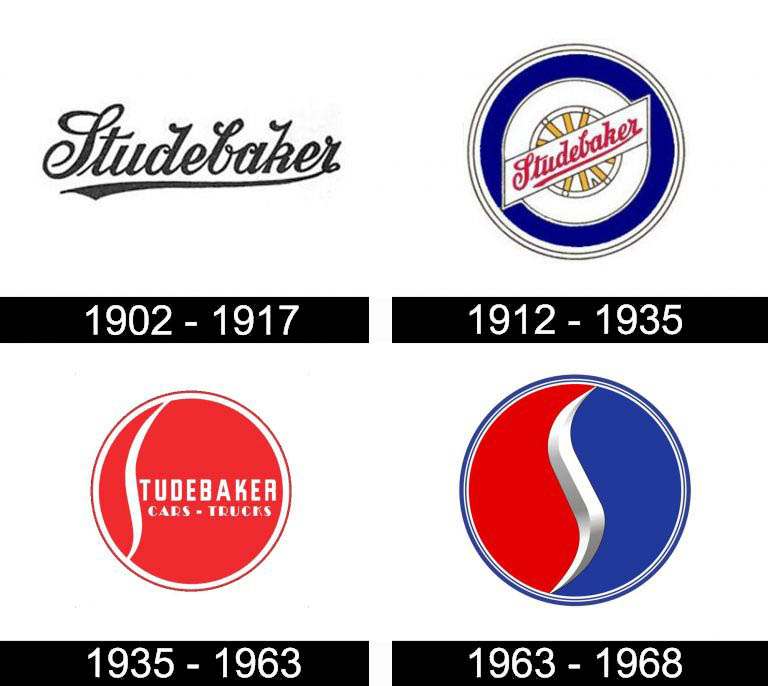
1902–1917: Script Emblem with Ribbon Motif
The earliest Studebaker logo adopted a decorative script style typical of the early 20th century. Rounded, connected lettering and calligraphic forms reflected contemporary signage trends while communicating elegance and approachability. A curved ribbon underline reinforced motion, suggesting progress and airflow, while the monochrome palette aligned the brand with modern visual standards of the era. This identity emphasized dynamism and relevance during Studebaker’s early automotive experimentation.

1912–1935: Circular Automotive Emblem Evolution
As the company grew in automotive confidence, the logo was redesigned around a circular form strongly associated with wheels and tires. The inscription moved diagonally across the center to heighten visual energy, while red lettering ensured strong brand visibility. Blue and white elements surrounding the center symbolized trust, authority, and openness to progress. This iteration marked a decisive shift toward an explicitly automotive logo heritage.

1935–1963: Refined Circular Identity with Product Messaging
Retaining the circular structure, Studebaker introduced a more information-rich emblem. The brand name and product focus appeared within a red central field, while a stylized letterform transformed typography into a conceptual design element. This period reflected maturity and leadership, balancing bold color with typographic sophistication. The logo meaning emphasized authority, innovation, and established reputation.

1963–1968: Abstract Circular Mark with Color Duality
In its final years as an automobile manufacturer, Studebaker adopted a simplified, abstract emblem built on flowing curves and color contrast. Red and blue fields were separated by a white, wave-like stripe, visually suggesting balance between opposing forces such as passion and stability. Although stylistically modern, the logo still relied on circular harmony, reinforcing continuity even as the company approached the end of automotive production.
Studebaker Logo Heritage and Industrial Legacy
The Studebaker logo history illustrates how visual identity can evolve alongside fundamental changes in industry and technology. From handcrafted wagons to advanced automobiles, the brand’s logo meaning consistently emphasized motion, balance, and resilience. Rather than clinging to a single static emblem, Studebaker allowed its logo heritage to adapt while preserving core symbolic themes.
Today, the Studebaker name survives primarily through collectors and historians, yet its logo symbolism remains a powerful reminder of American industrial ambition. Within automotive branding history, Studebaker stands as a testament to adaptation, longevity, and the enduring power of coherent visual storytelling.
FAQ: Studebaker Logo Meaning and History
What does the Studebaker logo represent?
The Studebaker logo represents progress, reliability, and motion, reflecting the brand’s evolution from carriage manufacturing to automobile production.
Why are circles prominent in Studebaker logos?
Circular shapes symbolize wheels, continuity, and mechanical movement, aligning the logo with automotive function and growth.
Did the Studebaker logo change often?
Yes, the logo evolved several times, adapting to new eras while maintaining consistent symbolic themes.
What colors define the Studebaker logo identity?
Blue, red, and white are central, representing trust, innovation, energy, and balance.