
Sprite Logo History: Meaning, Symbolism & Brand Heritage
Few beverage brands communicate instant freshness as effectively as Sprite. Introduced by The Coca-Cola Company in 1961, Sprite emerged at a time when lemon-lime sodas were becoming essential to the global soft-drink landscape. Originally launched in Germany under the name Fanta Klare Zitrone, the drink quickly evolved into the bright, crisp, citrus-forward product that millions enjoy today.
Sprite’s visual identity has played a defining role in shaping its international reputation. The brand’s logos have always emphasized vitality, clarity, and refreshment, relying on vibrant greens, lively yellows, and dynamic shapes to convey the unmistakable sensation of effervescence. Over the decades, Sprite’s logo history reflects not only changing design trends but also the cultural evolution of the beverage industry. Its meaning and symbolism revolve around youthfulness, energy, and the unmistakable burst of lemon-lime flavor.
Understanding Sprite’s logo heritage offers a unique look into how a simple citrus drink became a global cultural statement—one rooted in bold visual storytelling and an unbroken commitment to freshness.
Sprite Meaning and Symbolism
At its core, the Sprite logo embodies the meaning of freshness. Nearly every version of the emblem features sharp angles, energetic compositions, and a crisp palette of greens and yellows, echoing the bright, zesty flavor of the drink. The citrus imagery—whether a starburst, a lemon, a lime, or a subtle dot—serves as a symbolic shorthand for the product’s identity.
Green symbolizes natural freshness, coolness, and revitalization. Yellow represents citrus brightness and flavor intensity. Together, they create a visual metaphor for Sprite’s clean, sparkling taste. The rounded, playful shapes and italicized wordmarks that appear in many versions reinforce a sense of motion and effervescence, aligning the brand with youth, spontaneity, and modern energy.
Sprite Brand Heritage
Sprite’s heritage is closely tied to Coca-Cola’s response to increasing consumer demand for lemon-lime sodas during the mid-twentieth century. As markets shifted toward lighter, refreshing beverages, Coca-Cola introduced Sprite as a global contender—one that would rise to remarkable international prominence. Over time, Sprite became associated not just with flavor but with a cultural attitude reflected in decades of memorable campaigns.
Its logo evolution parallels its brand positioning: bolder, younger, more contemporary with each decade. From star-shaped accents to abstract citrus symbols and modern minimalism, Sprite’s visual identity consistently adapts to remain relevant while retaining the essence of its original meaning.
Sprite Logo History & Evolution Timeline
1961 – 1964: The Birth of Sprite’s Citrus Identity
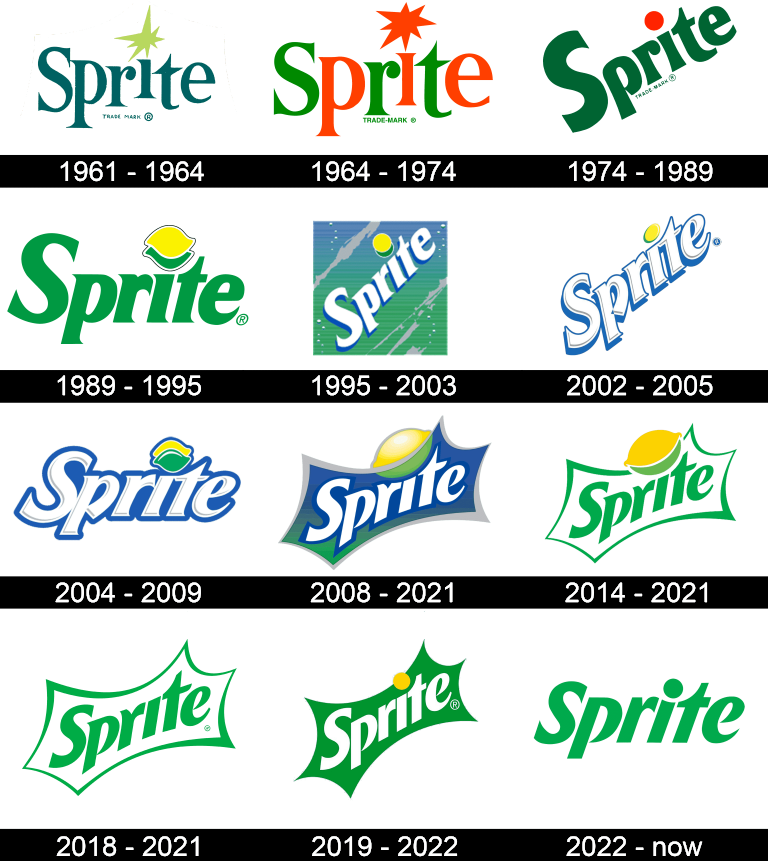
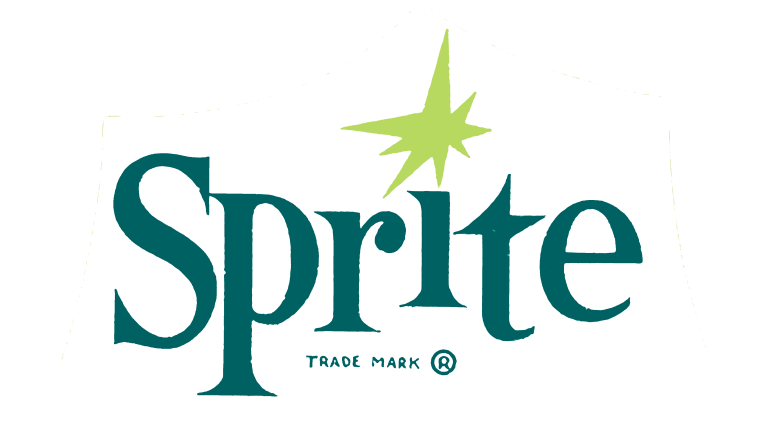
The first Sprite logo set the tone for decades of visual storytelling. The wordmark featured dark-green letters with sharp, extended serifs that looked as crisp as the drink itself. Instead of a simple dot, the lowercase “i” carried a lime-green eight-pointed star—a symbolic burst of citrus. This early emblem established Sprite’s enduring association with spark, flavor, and freshness.
1964 – 1974: A Playful, Two-Tone Experiment
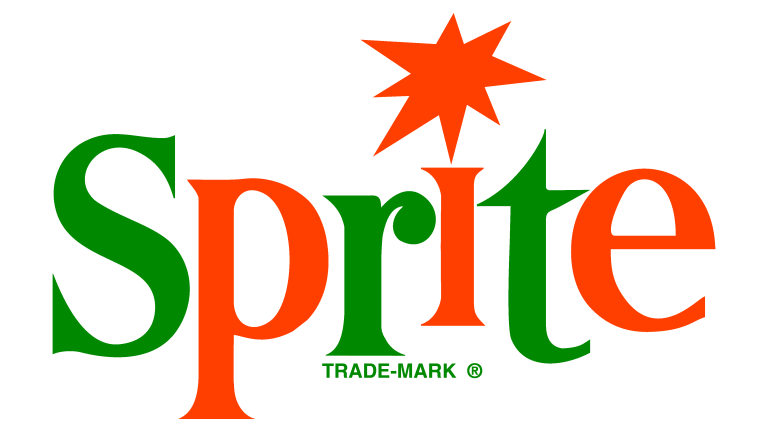
In 1964, the logo introduced a bold new color scheme. Half the letters appeared in bright red and the other half in grass-green. The star symbol above the “i” became larger and more pronounced. This version reflected a growing era of experimentation in beverage branding, giving Sprite a livelier, more expressive personality.
1974 – 1989: Modern Simplicity and Diagonal Motion
By 1974, Sprite embraced a smooth sans-serif typeface with softened angles, rendered in solid green. The wordmark was placed diagonally, adding a sense of refreshing movement. The red dot above the “i” delivered a subtle but impactful contrast. This cleaner, more minimalistic approach mirrored contemporary design trends and strengthened Sprite’s brand recognition.
1989 – 1995: The Iconic Lemon-Lime Emblem
One of the most beloved Sprite logos appeared in 1989. The light-green italicized wordmark was paired with a horizontally placed lemon and lime symbol, layered to emphasize the dual-citrus flavor. This imagery became instantly iconic, capturing both the taste and attitude of the brand. For many consumers, this version remains the quintessential Sprite look.
1995 – 2003: Abstract Citrus and Dynamic Backgrounds
The 1995 redesign replaced the realistic lemon-lime with overlapping abstract circles. The white diagonal wordmark floated against a striped gradient background of green and blue, symbolizing coolness and refreshment. This badge still appears on certain international packaging and is remembered for its vivid, energetic aesthetic.
2002 – 2005: Sharper Lettering and Bold Outlines
In 2002, Sprite refined its typography again. The white letters became sharper with angled cuts and blue accents, framed by a thin outline and a bold blue shadow. The lemon-lime dot was streamlined into a cleaner, modern citrus icon. Both vertical and horizontal layouts existed during this period, reflecting the brand’s growing global flexibility.
2004 – 2009: The Horizontal Citrus Emblem
The 2004 update emphasized a horizontal format. The lemon-lime combination became larger and more detailed, while thicker blue outlines defined the wordmark. The letters remained unchanged, maintaining consistency while updating composition for better shelf visibility.
2008 – 2021: The Starburst Shield and Oversized Lemon
In 2008, Sprite introduced a striking badge featuring a white wordmark outlined in deep blue and set against a gradient shield with arched sides. The oversized lemon above the “i,” partially green at its base, gave the logo a lively splash of citrus. This design captured early-2000s digital aesthetics with dynamic shading and bold color contrasts.
2014 – 2021: A Clean, Flat Evolution
The 2014 version simplified the previous emblem. The gradients and gloss disappeared, replaced by a flat green-and-white design with a stylized lemon still perched atop the inscription. This modern, cleaner visual language aligned Sprite with contemporary minimalistic trends.
2018 – 2021: Minimalism Without Citrus
A more radical simplification arrived in 2018, removing the lemon entirely. The logo maintained its previous structure but focused on pure typography and shape, signaling a streamlined approach to branding.
2019 – 2022: Bold Green and a Subtle Citrus Nod
In 2019, Sprite reversed its palette. The wordmark became white and was placed within a sharply angled green badge. Instead of a lemon, the dot above the “i” became a solid yellow circle—simple but still symbolic of citrus brightness. This redesign embraced geometric modernity while preserving the brand’s essence.
2022 – Today: Pure Minimalist Confidence
The latest Sprite logo is the most minimalistic in the brand’s history. A clean green wordmark placed horizontally serves as the entire identity. The dot above the “i” sits closer to the stem, forming a subtle “smile”-like cutout. The upper curve of the “r” was also updated, adding refinement to the overall form. This modern interpretation returns Sprite to its core meaning: clarity, freshness, and effortless simplicity.
Typography and Color
Sprite’s typography has evolved from sharp serif lettering to soft sans-serif forms and bold modern custom typefaces. The modern Sprite wordmark features a stylized sans serif with angled terminals, curved contours, and dynamic geometry. The letters communicate energy without chaos—freshness in visual form.
Its color palette remains rooted in the heritage of citrus flavors. Green has always symbolized natural coolness, lime zest, and crisp refreshment. Yellow stands for brightness and lemon tang. Together, they form the unmistakable Sprite “flavor identity,” a palette that delivers immediacy and emotional resonance.
The Enduring Symbolism of the Sprite Logo
Across more than six decades, Sprite’s logo has evolved more dramatically than many beverage brands, yet it has remained consistent in meaning. Every redesign—whether detailed or minimal—has reinforced the core message of freshness, citrus clarity, and youthful energy. Sprite’s visual heritage tells a story of bold experimentation, cultural adaptation, and a deep understanding of what consumers expect from a lemon-lime soda.
Today, the Sprite logo stands as a distilled symbol of pure refreshment, balancing timeless identity with contemporary design principles. It is a rare example of a brand whose meaning remains unmistakable even as its form continues to evolve.
Sprite Logo FAQ
What does the Sprite logo symbolize?
It symbolizes freshness, citrus brightness, and energetic flavor through its green-and-yellow palette and dynamic shapes.
Why does Sprite use green and yellow?
Green represents coolness and lime flavor, while yellow conveys lemon brightness—together capturing the drink’s signature taste.
Which Sprite logo is the most iconic?
Many consider the 1989 version—with its classic italicized wordmark and lemon-lime symbol—to be the most recognizable.
Why was the Sprite logo simplified in 2022?
To create a modern, minimal identity that focuses on clarity, flavor, and brand consistency across global markets.
What font does the Sprite logo use?
A custom sans-serif typeface with angled cuts and smooth curves, designed to convey motion and freshness.