Spirit Airlines Logo History: Meaning, Symbolism & Brand Heritage
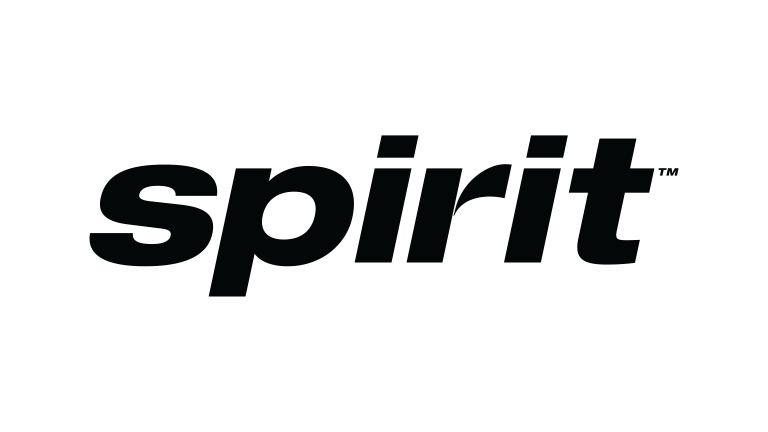
Within contemporary aviation logo history, Spirit Airlines represents one of the most visually direct and unapologetically minimal identities among American carriers. As an ultra-low-cost airline, Spirit built its brand around efficiency, price transparency, and high visibility rather than emotional storytelling or legacy symbolism. This philosophy is clearly reflected in the evolution of its logo, which steadily moved toward reduction, bold typography, and unmistakable presence.
Much like the aggressive simplicity seen in JetBlue logo history or the disruptive branding approach explored in Southwest Airlines logo heritage, Spirit Airlines adopted a visual language that favors clarity over ornament. Within the broader airline branding landscape, its logo evolution mirrors the carrier’s operational model: stripped down, functional, and instantly recognizable.
Meaning and History: The Origin of the Spirit Airlines Logo
Spirit Airlines was established in 1983 under the name Charter One Airlines, initially operating as a charter service. Commercial flights under the Spirit Airlines name began in the early 1990s, coinciding with the airline’s transition toward a low-cost business model. From the outset, Spirit’s branding avoided traditional airline symbolism, such as wings or globes, focusing instead on typographic strength.
The logo meaning of Spirit Airlines aligns closely with its pricing strategy and market positioning. Rather than projecting luxury or heritage, the visual identity emphasizes straightforwardness and confidence. Over time, the airline’s logo heritage evolved toward extreme simplicity, reflecting a brand that communicates value through directness rather than reassurance.
Spirit Airlines Logo History Timeline
2002: Dimensional Typography and Industrial Texture
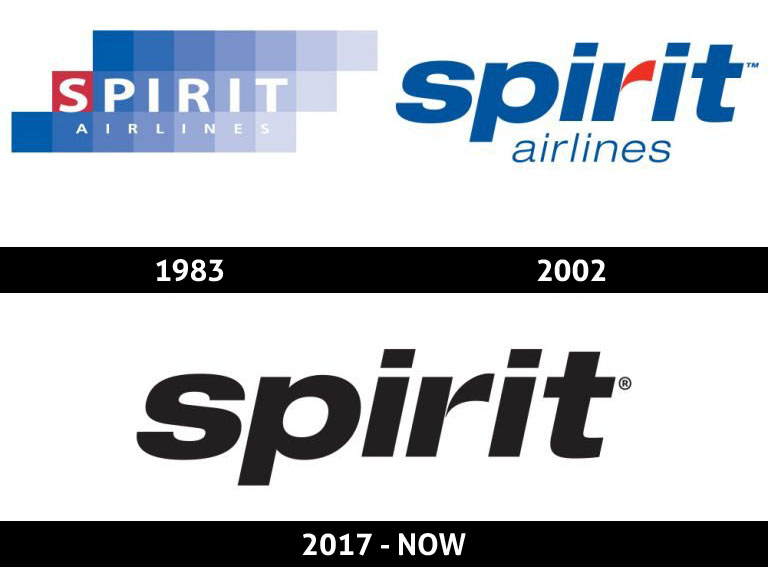
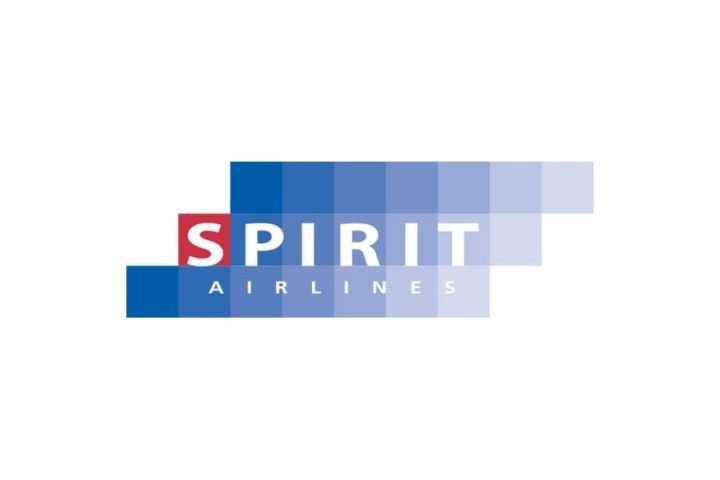
The first distinctive Spirit Airlines logo appeared in 2002, departing sharply from generic airline visuals. The wordmark was set against a background resembling a wall of blue bricks, creating a textured and industrial appearance. A gradient overlay added depth, softening the rigid geometry of the brick pattern.
This logo description suggested durability and mass presence, reinforcing the airline’s growing footprint while differentiating it visually from competitors relying on conventional aviation imagery.
2007: Streamlined Wordmark and Motion Emphasis
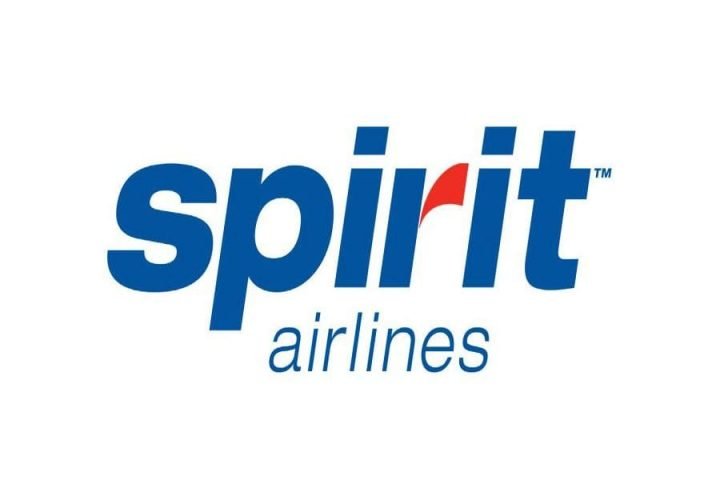
In 2007, Spirit Airlines introduced a more legible and contemporary identity. The brick motif was removed entirely, replaced by a clean italicized wordmark. Both “spirit” and “airlines” appeared in lowercase, though “spirit” dominated visually through scale and weight.
A distinctive red curve embedded in the letter “r” served as the only color accent, introducing motion and personality into an otherwise restrained composition. The mix of sharp angles and smooth curves conveyed speed and assertiveness, aligning with Spirit’s expanding route network.
2014: Radical Reduction and Brand Confidence
The 2014 redesign marked the most decisive shift in Spirit Airlines logo history. All secondary elements were removed, leaving only the word “spirit” rendered in bold black lowercase lettering. The word “airlines” disappeared entirely, signaling confidence in brand recognition.
This minimalist approach positioned Spirit alongside modern consumer brands rather than traditional airlines. The absence of color and symbols reinforced a message of transparency and efficiency, core values of the ultra-low-cost model.
Logo Symbolism: Strength Through Reduction
The symbolism of the Spirit Airlines logo lies in its refusal to embellish. Bold italicized typography conveys movement and urgency, while lowercase letters soften the otherwise aggressive form, creating balance between approachability and strength.
Black, as the sole color, communicates authority and permanence. Unlike blue-heavy airline palettes that evoke calm skies and reassurance, Spirit’s monochrome identity emphasizes decisiveness and cost discipline. Within logo symbolism analysis, this approach reflects a brand unconcerned with traditional airline aesthetics and fully aligned with its operational philosophy.
Spirit Airlines Logo History and Minimalist Brand Identity
The Spirit Airlines logo history demonstrates how visual identity can mirror business strategy with precision. Each redesign moved closer to essentialism, shedding decorative layers in favor of typographic dominance. This evolution reflects Spirit’s role within the aviation industry as a carrier built on efficiency, scale, and price leadership.
Today, the Spirit Airlines logo stands as a clear example of how restraint and confidence can define brand recognition. Its stark simplicity reinforces memorability, proving that in competitive aviation branding, clarity can be more powerful than complexity.
FAQ: Spirit Airlines Logo Meaning and History
What does the Spirit Airlines logo represent?
The logo represents simplicity, confidence, and efficiency through bold typography and minimal design.
Why is the Spirit Airlines logo black?
Black conveys strength, professionalism, and timelessness while emphasizing clarity and cost transparency.
When did Spirit Airlines remove the word “Airlines” from its logo?
The word “Airlines” was removed in the 2014 redesign to reinforce brand recognition.
Has Spirit Airlines changed its logo often?
Spirit Airlines has redesigned its logo several times, with each update simplifying the identity further.