
Sony Logo History: Meaning, Symbolism & Brand Heritage
Few technology brands have shaped modern culture as profoundly as Sony. From pioneering the transistor radio to revolutionizing gaming with PlayStation, Sony has spent nearly eight decades redefining how the world listens, watches, and plays. Yet behind its constant reinvention lies an unexpected truth: Sony’s logo — one of the most iconic wordmarks in tech history — has barely changed since the late 1950s.
This commitment to typographic clarity and restrained design sets Sony apart from nearly every major technology company. While consumer electronics brands have repeatedly refreshed their identities to match decades of shifting aesthetics, Sony made a bet long before minimalism was fashionable: a strong name, elegantly set in timeless typography, could carry the weight of a technological empire.
That bet paid off.
Today, the Sony logo is not just a brand mark — it’s a symbol of quality, engineering excellence, and cultural impact. But to understand its enduring power, we must begin at the very beginning.
Origins of Sony: From Postwar Workshop to Global Innovator
Sony was founded in 1946 in Tokyo by Masaru Ibuka and Akio Morita, two young visionaries who believed postwar Japan could rebuild itself through innovation. Their small company, then called Tokyo Tsushin Kogyo (Tokyo Telecommunications Engineering Corporation), focused on repairing and developing communication equipment.
The name Sony would come later — a fusion of sonus, the Latin word for sound, and sonny, American slang for a young boy. The new name represented youth, creativity, and the universal language of audio. It was short, memorable, international, and suitable for a brand dreaming far beyond Japan’s borders.
Its logo, however, took far longer to reach the smooth, confident form we know today.
The Evolution of the Sony Logo: From Symbol to Typographic Purity
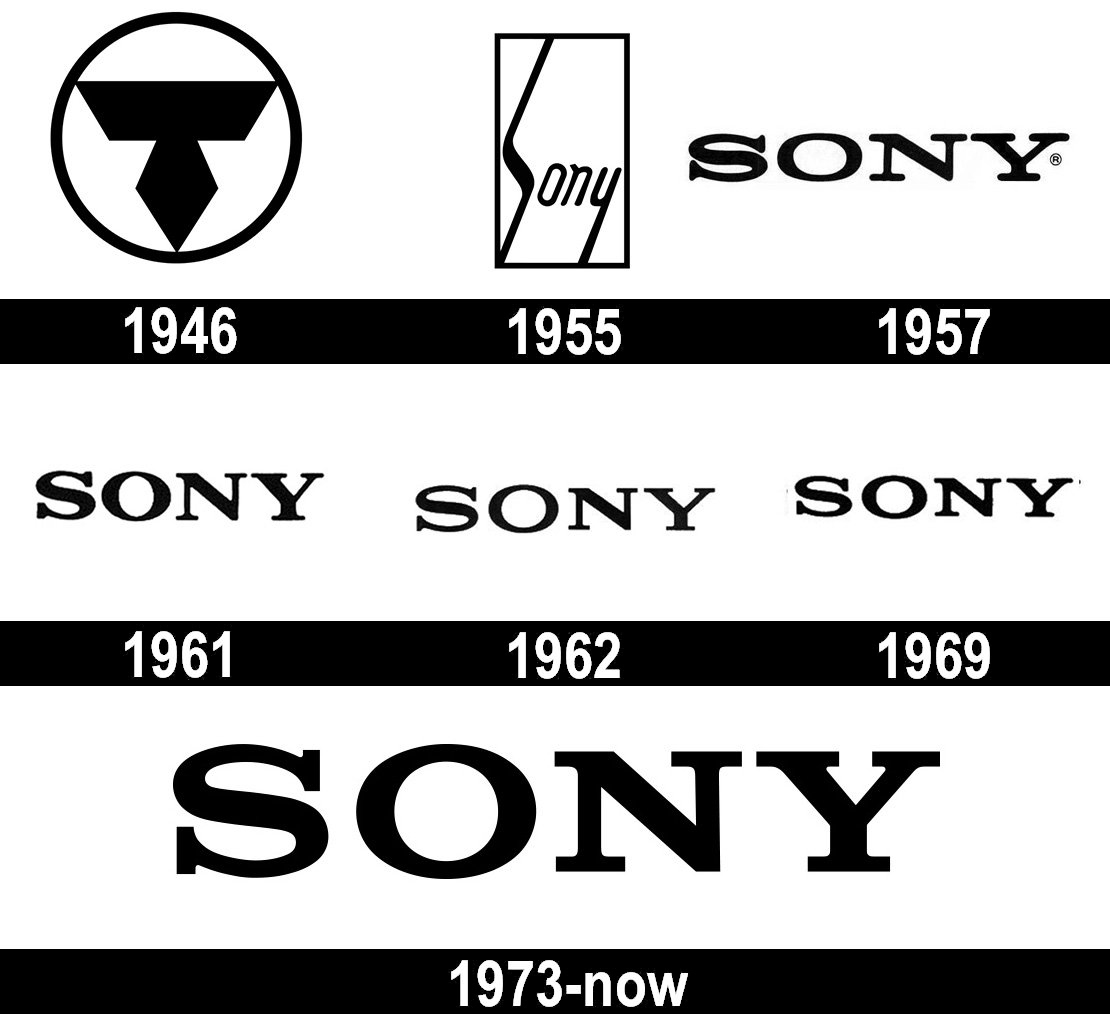
Sony has undergone six redesigns, yet only the first two bore symbolic imagery. The rest reflect a meticulous, decades-long refinement of serifs, proportions, and letter spacing — a masterclass in typographic heritage.
1946–1957: The Abstract Monogram Era
The first Sony logo was strikingly unlike the Sony of today.
A bold, geometric symbol combining a trapezoid and rhombus formed an emblem that resembled an automotive badge more than a tech company. It felt industrial, formal, and rooted in a postwar design language.
While visually compelling, it lacked the universality Sony would need as it prepared for international expansion.

1955–1957: The Script Experiment
Sony’s first major redesign replaced the geometric emblem with a handwritten wordmark inside a slim vertical frame. The elongated “S” and sculptural “Y” added flair, but the aesthetic felt fragile and overly decorative for a brand stepping into precision electronics.
Sony needed something stronger — something that conveyed reliability, clarity, and global ambition.

1957–1961: The Birth of a Legacy
This redesign marked a turning point in Sony’s visual identity.
The handwritten style was replaced by a bold serif logotype, with stretched capitals and rounded serifs. It was modern, confident, and unmistakably international.
This was the moment Sony discovered its design soul.

1961–1962: Sharpening the Edges
The logo was refined to lift the letters and lighten the composition. Serifs became smaller and more delicate, giving the mark better legibility — an essential consideration for a brand soon to appear on radios, TVs, and tape recorders.

1962–1969: Toward Timeless Simplicity
Horizontal strokes straightened, contours slimmed, and the letters acquired a more elegant serif structure. Sony was becoming minimalist long before minimalism was cool.
This version introduced a classic, almost literary quality that matched Sony’s rising reputation in audio technology.

1969–1973: Balanced and Confident
Designers rounded the serifs once more, subtly stretching the letters. The result was harmonious, stable, and warmly recognizable — the closest ancestor to the modern logo.

1973–Today: The Definitive Sony Wordmark
The 1973 redesign marked the moment when Sony’s visual identity crystallized into the enduring form we know today. The brand refined its typography once again, removing earlier ornamental tendencies and adopting a sharper, more balanced serif structure. Every line in the logo was tightened, every curve carefully reconsidered, resulting in a wordmark that combined elegance with absolute clarity.
The serif strokes became clean and assertive, the proportions more disciplined, and the overall construction radiated a confidence born from decades of technological progress. This was no longer just a corporate signature — it was a global emblem of quality.
Since 1973, this logo has remained untouched, a testament to the belief that once a brand captures its true essence, change becomes unnecessary. The Sony wordmark’s longevity reflects its timeless construction and the company’s unwavering commitment to precision and craftsmanship. It is rare for a technological brand to maintain a single visual identity across half a century, but Sony has proven that when a design is truly iconic, it needs no reinvention.
The Meaning and Symbolism of Sony’s Iconic Wordmark
The Sony logo communicates its meaning not through imagery or metaphor, but through the strength of its typography. The choice of a refined serif typeface — something strikingly uncommon in the technology sector — signals a deep respect for tradition and craftsmanship. The clarity of the letterforms, with their precisely balanced strokes and intentional spacing, reflects the discipline and engineering rigor that have defined Sony’s products since its earliest days.
There is a quiet authority in the logo’s structure. The thick verticals convey stability and trust, while the restrained serifs underscore precision without resorting to ornamentation. The monochrome palette reinforces this message, presenting Sony as a brand that does not rely on visual theatrics to express its value. Instead, the wordmark itself becomes a statement of confidence: strong enough to stand alone, memorable enough to be instantly recognized, and timeless enough to transcend shifting design trends.
The Sony logo also symbolizes universality. By reducing the brand’s identity to its name — with no icons, no embellishments, and no cultural references — Sony created a mark that speaks clearly across languages, markets, and product categories. Whether appearing on a camera, a gaming console, a television, or a pair of headphones, the logo carries with it the same promise of quality and innovation.
In a world where most technology companies constantly reinvent their identities, Sony’s wordmark stands as proof that true modernity is not always found in change, but in the enduring power of great design.
Typography & Color: The Design DNA of the Sony Logo
Font Heritage
The Sony logo is based on the Clarendon family, but custom-modified for sharper contrast and stronger geometry. These refinements ensure perfect clarity at any scale, from a television bezel to a video game startup screen.
Color Philosophy
Sony has always stayed loyal to a pure black-on-white palette, a decision rooted in:
– simplicity
– neutrality
– timelessness
– premium positioning
This monochrome identity reinforces the brand’s focus on substance over decoration.
Conclusion: The Enduring Heritage of the Sony Logo
Sony’s Typographic Heritage: A Masterclass in Timeless Identity
In a world where technology brands constantly chase the next visual trend, Sony stands alone. Its logo — unchanged since 1973 — is a testament to the power of restraint, clarity, and typographic excellence.
Sony’s logo heritage proves that innovation and tradition can coexist beautifully. As the brand continues to shape the future of audio, gaming, imaging, and entertainment, its iconic wordmark remains one of the most respected and enduring symbols in global design.

FAQ: Sony Logo & Brand Identity
1. Why has the Sony logo barely changed since 1973?
Because its structure is timeless. Sony’s wordmark was built on classic serif typography that doesn’t age, allowing the logo to remain modern and relevant for decades.
2. What font is the Sony logo based on?
A custom-modified version of Clarendon Medium, adjusted for balance, contrast, and legibility.
3. Why doesn’t Sony use a symbol or emblem?
Sony believes the name itself is strong enough to serve as the brand. The wordmark reflects clarity, trust, and international accessibility.
4. What does the Sony logo represent?
Precision, craftsmanship, reliability, and a commitment to innovation grounded in heritage.