
SEAT Logo History: Meaning, Symbolism & Brand Heritage

The visual identity of SEAT is inseparable from the modern industrial history of Spain itself. Founded in 1950 to accelerate the country’s motorization, SEAT began its life as a state-backed manufacturer closely tied to Fiat. That relationship shaped not only its engineering but also its earliest visual language. Over the decades, as SEAT moved from dependency to independence and finally into the Volkswagen Group, its logo evolved in parallel—shifting from heraldic symbolism to sharp geometry, and ultimately to contemporary minimalism.
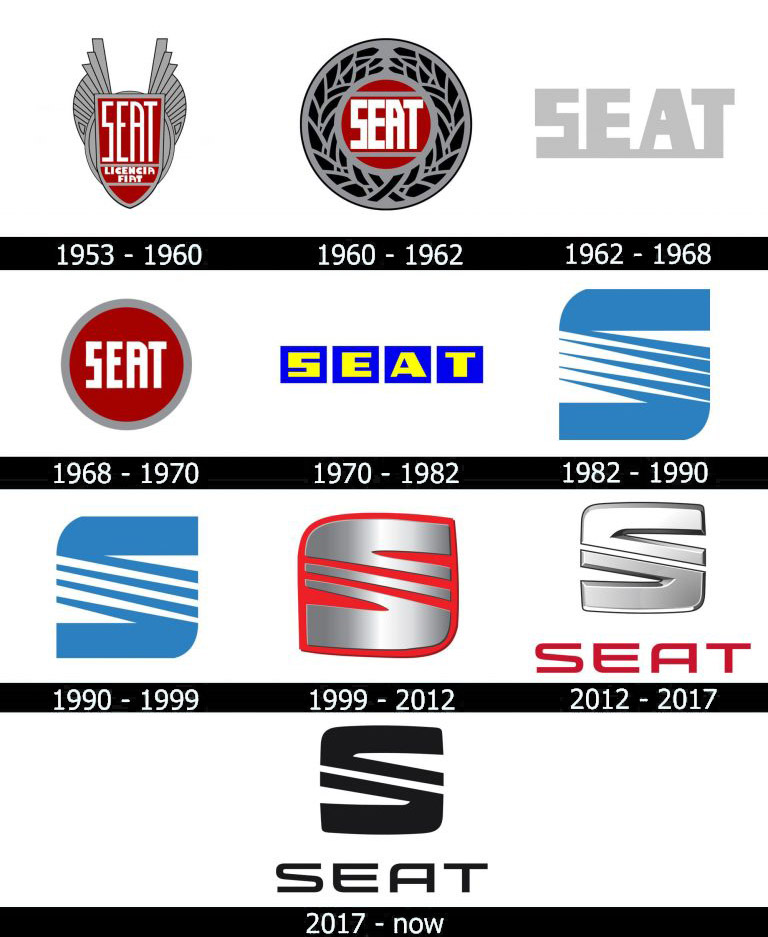
The SEAT logo timeline is a precise visual record of this transformation. Each redesign reflects a specific moment in the brand’s history: political context, technological ambition, and the gradual emergence of a confident European identity.
SEAT Logo Timeline and Evolution
1953–1960: The Fiat-Era Crest
SEAT introduced its first official logo in 1953. This emblem was ornate, ceremonial, and deeply influenced by traditional European automotive heraldry. A red shield outlined in dark gray sat at the center of the composition, flanked by stylized wings extending outward from a gray oval. The wordmark appeared in multiple tiers, with “SEAT” emphasized prominently and “Licencia Fiat” placed beneath it, leaving no doubt about the technical partnership behind the brand.
This logo communicated legitimacy and authority at a time when SEAT was still building trust in a newly industrializing Spain. The visual language leaned heavily on symbolism rather than branding, reflecting the company’s institutional role rather than market competition.

1960–1962: Ornamental Refinement
In 1960, the logo was redesigned into a more polished and luxurious badge. The new emblem adopted a rounded form with a glossy red background and a thick silver outline decorated with leaf-like ornaments. The main SEAT lettering turned white, while the Fiat reference remained visible in silver.
This version retained its formal tone but appeared more refined and commercially mature, aligning SEAT visually with established European manufacturers while still emphasizing its licensed status.

1962–1968: The First Typographic Identity
A radical simplification occurred in 1962. SEAT abandoned crests, wings, and ornamental frames in favor of a pure wordmark. The logo became a bold black inscription set in an extra-heavy sans-serif typeface, resting on a thin horizontal line.
This shift marked SEAT’s first real step toward modern branding. The logo no longer relied on symbolism but instead placed confidence in the brand name itself, signaling growing industrial stability.

1968–1970: Minimal Color Contrast
In 1968, SEAT introduced a flat circular emblem with a red background and a thin gray outline. At its center sat a bold white “SEAT” wordmark. All additional text and decorative elements were removed.
This design focused entirely on contrast and clarity. The restrained composition suggested a brand becoming more self-assured, while the red color added energy and visibility in an increasingly competitive market.

1970–1982: The Modular Letter Era
The 1970 logo was one of the most distinctive in SEAT’s early history. Each letter of the word “SEAT” was placed inside its own electric-blue square, while the letters themselves appeared in bright yellow.
This modular construction conveyed industrial efficiency, progress, and optimism. It reflected both the graphic trends of the era and SEAT’s expanding ambitions within the Spanish and European automotive markets. The logo remained in use for more than a decade, becoming strongly associated with SEAT’s formative growth years.

1982–1990: The Birth of the Stylized “S”
The most important turning point in SEAT logo history came in 1982. With the end of its Fiat partnership, SEAT unveiled an entirely new symbol that marked its independence.
The new logo centered on a stylized letter “S,” constructed from diagonal segments with sharp, pointed ends. Rendered in blue and white, the fractured form suggested speed, motion, and technical precision. For the first time, SEAT had a symbol that was uniquely its own.
This emblem established the foundation for all future SEAT logos.

1990–1999: Strengthening the Symbol
In 1990, the stylized “S” was refined. The number of diagonal segments was reduced, and the remaining shapes became thicker and more balanced. The overall silhouette gained visual weight, making the logo more stable and authoritative.
The color palette remained unchanged, reinforcing continuity while improving legibility and impact.

1999–2012: Metallic Identity and Brand Integration
The 1999 redesign introduced a more premium, automotive-oriented look. The emblem turned metallic silver and was placed on a red background, reconnecting with SEAT’s historical color while embracing a modern finish.
The stylized “S” was simplified further, and a custom sans-serif wordmark appeared beneath the emblem for the first time in years. This integration of symbol and name strengthened brand recognition across international markets.

2012–2017: Sharpened Geometry
In 2012, SEAT refined its logo to appear more technical and angular. The emblem was diagonally split by a single white line, and the silver tones were rendered with subtle gradients to create depth.
The wordmark was redesigned with a thinner, more futuristic typeface, aligning the brand with contemporary automotive design and digital interfaces.

2017–Today: Flat, Monochrome Minimalism
The current SEAT logo, introduced in 2017, embraces flat design and absolute simplicity. All colors were removed in favor of a monochrome black-and-white palette. The emblem and wordmark are now clean, sharp, and highly adaptable across digital and physical environments.
This version represents SEAT’s maturity as a brand—confident enough to rely solely on form, proportion, and typography.
The Meaning Behind the SEAT Logo
Throughout its evolution, the SEAT logo has mirrored the company’s strategic position. Early logos emphasized legitimacy and partnership, while later designs focused on speed, autonomy, and modernity. The stylized “S,” introduced in 1982, remains the core symbol of the brand, representing movement, engineering precision, and forward momentum.
The shift to monochrome reflects stability, confidence, and readiness for the future, aligning SEAT with modern European design standards.
Typography and Color in SEAT Logo Heritage
SEAT’s typography evolved from traditional serif-influenced forms to a fully custom sans-serif system. The current wordmark features sharp angles and balanced spacing, echoing the geometry of the emblem itself.
Color experimentation defined much of SEAT’s history, but the final move to black and white marks the culmination of decades of refinement, signaling clarity and control rather than experimentation.
A Logo That Grew with Spain’s Automotive Identity
The SEAT logo timeline tells a precise story of transformation—from a state-supported manufacturer under foreign influence to a confident, design-driven European brand. Each redesign captured a moment of transition, reflecting broader economic, political, and technological shifts.
Today’s SEAT logo stands as a refined expression of logo heritage, modern identity, and enduring symbolism—proof that strong branding evolves not through reinvention alone, but through continuity shaped by time.
FAQ: SEAT Logo History, Meaning, and Evolution
What does the SEAT logo mean?
The modern SEAT logo is built around a stylized “S” that suggests motion, precision, and technical engineering. Introduced during SEAT’s post-Fiat independence era, the symbol became a visual shorthand for a faster, more modern Spanish automaker with a clear European direction.
When was the SEAT “S” symbol introduced?
SEAT introduced the stylized “S” emblem in 1982, a pivotal moment in the brand’s identity as it moved away from its earlier Fiat-influenced period and began shaping a more independent design language.
Why did SEAT change its logo so many times?
SEAT’s logo changes reflect shifts in ownership, market positioning, and design trends. Early crests communicated authority and partnership, while later redesigns focused on international legibility, modern automotive styling, and digital adaptability—especially with the move to flat, monochrome branding.
What is the current SEAT logo style called?
The current SEAT logo (introduced in 2017) follows a flat, minimalist identity system. It removes gradients and heavy color usage in favor of clean geometry and a monochrome palette that works consistently across apps, screens, and physical badges.
What colors were historically associated with the SEAT logo?
Across its logo history, SEAT has used red, blue, yellow, silver, black, and white. Red appears repeatedly as a high-energy automotive color, while silver became prominent in the late 1990s and 2000s to convey a more premium, industrial feel. Since 2017, SEAT has primarily used black and white for maximum clarity and versatility.
Is SEAT owned by Volkswagen?
Yes. SEAT operates as part of the Volkswagen Group, and its modern branding reflects the broader shift toward streamlined, internationally consistent design systems common across major automotive groups.