
Salesforce Logo History: Meaning, Symbolism & Brand Heritage

From the very beginning, Salesforce positioned itself as a company built for the internet age. While many enterprise software brands relied on abstract or technical symbolism, Salesforce chose a metaphor that was instantly understandable: the cloud. This decision shaped not only its product strategy but also its visual identity, turning the logo into a clear statement of purpose rather than a decorative mark.
In the wider context of enterprise software logo history, Salesforce follows a conceptual path similar to Zoom logo heritage, where functionality directly informs form, and Slack logo history, where clarity and scalability guide design decisions. Salesforce’s logo meaning has remained remarkably consistent, even as its visual execution evolved, making it one of the most coherent examples of logo heritage in modern cloud computing.
Meaning and History: The Origin of the Salesforce Identity
Salesforce was founded in 1999 as a cloud-first software company, challenging the traditional model of locally installed enterprise software. Its early positioning centered on accessibility, flexibility, and freedom from physical infrastructure. This philosophy was visually captured in the original logo, which featured the company name enclosed within a cloud.
The cloud metaphor was not merely illustrative. It communicated a radical shift in how software could be delivered and consumed. At a time when enterprise solutions were complex, expensive, and hardware-dependent, Salesforce presented itself as intuitive and future-focused. The logo history mirrors this strategic clarity, evolving stylistically without abandoning its original symbolic foundation.
Over the years, as Salesforce expanded into CRM, analytics, and enterprise consulting, the logo matured alongside the brand. Yet the core visual idea remained unchanged, reinforcing trust and continuity in a rapidly evolving technology landscape.
Logo Symbolism: Cloud Computing Made Visible
The Salesforce logo symbolism is one of the most literal and effective in the software industry. The cloud represents cloud architecture, remote access, and scalability, all central to the brand’s value proposition. Rather than abstracting these ideas, Salesforce chose direct representation, ensuring immediate comprehension across technical and non-technical audiences alike.
Color plays a defining role in the logo meaning. Blue evokes reliability, stability, and professionalism, while white reinforces clarity and openness. Together, they mirror the sky-and-cloud association, subtly reinforcing the brand’s promise of simplicity and freedom from traditional software constraints.
Typography contributes to the logo description as well. The shift from serif to sans-serif lettering marked Salesforce’s transition from early credibility-building to modern digital confidence, aligning the brand with contemporary interface-driven design standards.
Salesforce Logo History Timeline
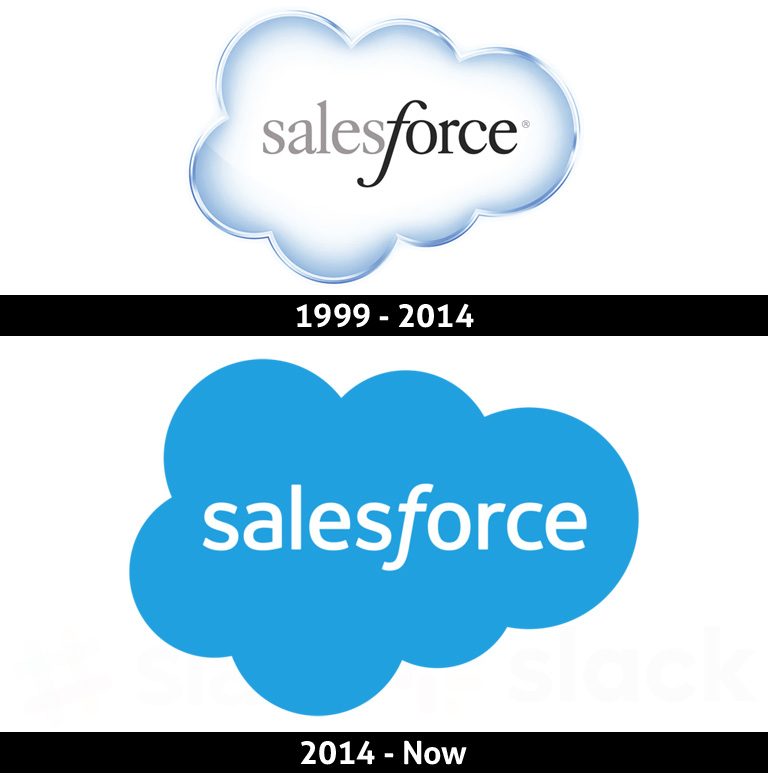
1999–2014: Three-Dimensional Cloud and Dual-Tone Wordmark
The original Salesforce logo, introduced in 1999, featured a voluminous cloud rendered in light blue and white with a pronounced silver outline. The gradient and 3D effects gave the cloud a tangible, almost physical presence, reinforcing the novelty of cloud computing at the time.
Inside the cloud sat the wordmark, split into two visual identities. “Sales” appeared in a calm gray serif typeface, while “Force” was rendered in black, with a distinctive stylized “F” featuring an elongated, curved vertical stroke. This contrast emphasized strength and reliability, underscoring the “Force” aspect of the brand name and positioning Salesforce as a serious enterprise solution.

2014–Present: Flat Design and Modern Simplicity
In 2014, Salesforce updated its logo to align with modern digital aesthetics. The three-dimensional effects and gradients were removed, replaced by a flat, vivid blue cloud. The wordmark became entirely white and transitioned to a clean sans-serif typeface, improving legibility across digital platforms.
This redesign reflected broader shifts in interface design and branding, prioritizing clarity, scalability, and consistency across screens of all sizes. Despite the stylistic simplification, the logo meaning remained intact, preserving the cloud as the central symbol of the brand’s identity.
The “No Software” Emblem and Brand Philosophy
Alongside its official logo, Salesforce popularized the “No Software” emblem as part of its marketing campaigns. Although never adopted as a formal logo, the emblem reinforced the company’s core message: liberation from traditional software installation and maintenance.
This secondary mark played a significant role in shaping Salesforce’s brand heritage, strengthening the association between the company and cloud-based innovation during its formative years.
Salesforce Logo Heritage and Cloud Authority
The Salesforce logo history demonstrates how a strong conceptual foundation can sustain a brand for decades. By anchoring its visual identity in a clear metaphor and refining execution rather than symbolism, Salesforce built a logo heritage that communicates trust, innovation, and continuity.
In the competitive world of enterprise technology, Salesforce’s logo meaning remains immediately recognizable, proving that clarity of purpose, when paired with thoughtful evolution, creates lasting brand authority.
FAQ: Salesforce Logo Meaning and History
What does the Salesforce logo represent?
The logo represents cloud computing, symbolizing remote access, scalability, and internet-based software delivery.
Why is the cloud central to the Salesforce logo?
The cloud visually communicates the platform’s core architecture and differentiates it from traditional software models.
When did Salesforce redesign its logo?
Salesforce redesigned its logo in 2014, shifting to a flat, modern design while retaining the cloud symbol.
What is the “No Software” emblem?
It is a marketing symbol created by Marc Benioff to promote Salesforce’s cloud-first philosophy.