Ritz-Carlton Logo History: Meaning, Symbolism & Brand Heritage

Ritz-Carlton stands among the most influential luxury hospitality brands ever created, a name that has become synonymous with refined service, ritualized elegance, and timeless prestige. From its origins in early 20th-century Europe to its modern global presence under the Marriott International portfolio, the Ritz-Carlton identity has been carefully protected and consistently expressed. Few hotel brands demonstrate such restraint and continuity in visual identity, making the Ritz-Carlton logo history a defining case study in luxury branding, logo heritage, and symbolic permanence.
Meaning and History: The Origin of the Ritz-Carlton Identity
The Ritz-Carlton name traces its philosophical and cultural roots to César Ritz, often described as the “king of hoteliers and hotelier to kings.” Although the modern Ritz-Carlton Corporation was formally established in 1983 in Boston, the spirit of the brand predates this by decades. The original Ritz hotels in Europe and the United States set unprecedented standards for hospitality, introducing private bathrooms, refined service etiquette, and an atmosphere of cultivated luxury that reshaped the hotel industry.
The contemporary Ritz-Carlton Corporation emerged when William Johnson acquired the Ritz-Carlton Hotel in Boston along with the rights to the name in the United States. This marked the transition from a legendary concept into a scalable luxury brand. In 1998, the company was acquired by Marriott International, a strategic move that expanded global reach while preserving operational independence and brand integrity. Today, Ritz-Carlton operates nearly one hundred luxury hotels worldwide, alongside branded residences, spas, golf resorts, and exclusive yachts.
From the beginning, the visual identity of Ritz-Carlton was never intended to follow trends. Its logo was designed as a symbol of inherited authority, one that visually communicated lineage, prestige, and trust rather than novelty.
Ritz-Carlton Logo Symbolism: Crown, Lion, and Authority
The Ritz-Carlton logo meaning is deeply rooted in European heraldic tradition. The emblem combines two dominant symbols: a crown and a lion. Together, these elements form a visual language of power, nobility, and guardianship.
The crown represents sovereignty, refinement, and ceremonial dignity. It signals that the Ritz-Carlton experience is elevated beyond standard luxury, aligning more closely with aristocratic tradition than commercial hospitality. The lion, historically a symbol of strength, protection, and authority, reinforces the brand’s promise of unwavering standards and disciplined service.
Unlike abstract or modernist symbols used by many contemporary hotel brands, the Ritz-Carlton emblem is intentionally historical. It does not attempt to reinterpret luxury; it preserves it. This deliberate conservatism is a cornerstone of the brand’s logo heritage, ensuring that guests associate the mark with continuity, not reinvention.
Ritz-Carlton Logo History Timeline
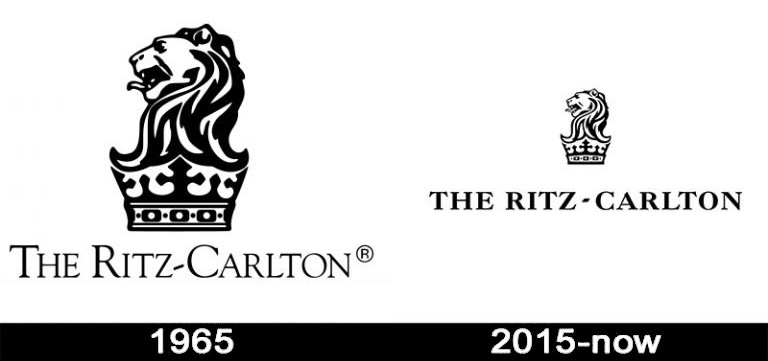
1965–2015: Refined Heraldry and Typographic Elegance
The earliest widely recognized version of the Ritz-Carlton logo featured the same foundational elements used today, though with more delicate execution. The lion emblem appeared slightly smaller, while the wordmark employed thinner strokes and mixed capitalization. This version emphasized grace and subtlety, aligning with mid-century luxury aesthetics that favored refinement over boldness.
The serif typography during this era conveyed tradition and discretion, reinforcing the brand’s identity as a hotel chain rooted in etiquette, ritual, and classical hospitality values.

2015–Today: Strengthened Iconography and Modern Authority
The 2015 refinement marked the only significant update in the brand’s modern history. Rather than redesigning the logo, Ritz-Carlton chose to strengthen it. The lion emblem was enlarged and given more visual presence, while the wordmark transitioned to fully uppercase lettering, increasing authority and legibility across digital and architectural applications.
This evolution preserved all symbolic elements while adapting the logo for contemporary use. The balance between heritage and modern functionality was carefully maintained, ensuring that the logo continued to communicate prestige without appearing outdated.
Typography and Color: Fashion-Level Restraint
The Ritz-Carlton wordmark is set in a classic old-style serif typeface characterized by elongated proportions and sharply defined serifs. The typography evokes luxury fashion houses and historic institutions rather than commercial hotel brands. This choice reinforces the idea that Ritz-Carlton is not simply a place to stay, but a lifestyle marker.
Color plays an equally restrained role. While the brand is often associated with a deep, memorable blue in applications, the core logo relies on black and white. This minimal palette ensures timelessness, adaptability, and consistency across global markets. By avoiding trend-driven color schemes, the Ritz-Carlton logo maintains its authority regardless of cultural or temporal context.
Ritz-Carlton Logo Heritage and Brand Philosophy
The Ritz-Carlton logo heritage reflects a brand philosophy built on continuity rather than disruption. In more than three decades of modern operation, the logo has been altered only once, and even then with extreme caution. This restraint mirrors the company’s service philosophy, where excellence is achieved through discipline, repetition, and respect for tradition.
The emblem does not attempt to appeal to every audience. Instead, it signals a clear promise to a specific one: guests who value refinement, discretion, and consistency above novelty. This clarity is what allows the Ritz-Carlton brand to remain relevant across generations while avoiding dilution.
A Logo That Commands, Not Competes
The Ritz-Carlton logo is a rare example of visual identity that does not compete for attention. It commands it. Through heraldic symbolism, disciplined typography, and an unwavering commitment to tradition, the logo communicates luxury as authority rather than excess.
In the broader context of hotel logo history, Ritz-Carlton demonstrates that the most powerful identities are not those that evolve constantly, but those that evolve carefully. Its logo stands as a visual embodiment of trust, legacy, and ritualized excellence, proving that true luxury branding is not about reinvention, but about preservation with purpose.
FAQ: Ritz-Carlton Logo Meaning and History
What does the Ritz-Carlton logo represent?
The logo represents luxury, authority, and heritage. The crown symbolizes refinement and sovereignty, while the lion conveys strength, protection, and disciplined service.
Has the Ritz-Carlton logo changed over time?
Only once in modern history. In 2015, the logo was refined to strengthen legibility and presence, while preserving all original symbolic elements.
Why does Ritz-Carlton use heraldic symbols?
Heraldic imagery reinforces the brand’s connection to European luxury traditions and positions Ritz-Carlton as an institution rather than a trend-driven hotel chain.
What font style is used in the Ritz-Carlton logo?
The logo uses an old-style serif typeface with elongated, sharp serifs, emphasizing elegance, tradition, and authority.
Why is the Ritz-Carlton logo mostly black and white?
A monochrome palette ensures timelessness, adaptability, and consistency across global applications, reinforcing the brand’s understated luxury.