
Raising Cane’s Logo History: Meaning, Symbolism & Brand Heritage
Raising Cane’s is one of those brands that never tried to be everything—and never needed to. Born in Baton Rouge, Louisiana, in the mid-1990s, the company grew by committing to a single idea and refusing to dilute it. That mindset shaped not only the menu and culture, but also the visual identity. The logo was never meant to impress with complexity. It was designed to communicate energy, friendliness, and focus at a glance.
The Raising Cane’s logo history fits naturally alongside other purpose-driven food brands explored in In-N-Out Burger logo history and Chick-fil-A logo history, where consistency and clarity matter more than trend-chasing. Within the broader fast food logo heritage, Raising Cane’s stands out as a case study in restraint: a brand that looks almost the same today as it did decades ago, because it got the fundamentals right early.
Meaning and History: The Origin of the Raising Cane’s Identity
Raising Cane’s was founded in 1996 by Todd Graves, alongside his friend Craig Silvey. The concept was disarmingly simple: focus exclusively on chicken fingers and do them better than anyone else. At a time when fast-food chains were expanding menus endlessly, this single-item philosophy felt almost radical.
The name came from Graves’ yellow Labrador retriever, Cane. This was not branding theater. The dog symbolized loyalty, friendliness, and approachability—traits Graves wanted embedded into the company’s culture. From hiring practices to store atmosphere, everything revolved around energy, hospitality, and consistency. The logo meaning grew directly out of this philosophy. It was never about polish or elegance. It was about being seen, recognized, and trusted.
Expansion followed the same logic. Growth was deliberate. Partners were chosen carefully. Community involvement was genuine rather than performative. As the company scaled across the United States and eventually internationally, the identity stayed familiar. The logo did not need reinvention because the values behind it never changed.
Logo Symbolism: Energy, Familiarity, and Focus
Raising Cane’s logo symbolism is straightforward by design. The wordmark, colors, and shapes communicate motion, warmth, and accessibility. There is no abstract icon or hidden metaphor. Instead, symbolism is carried through tone. Slanted lettering suggests movement and liveliness. Bold outlines ensure visibility from a distance. Rounded forms soften the presentation, keeping the brand friendly rather than aggressive.
The absence of a mascot or complex emblem reinforces the brand’s philosophy. Raising Cane’s does not distract from what it offers. The logo does the same. It tells you exactly what kind of place this is before you ever step inside.
Raising Cane’s Logo History Timeline
1996–2001: Foundational Wordmark with Personal Character
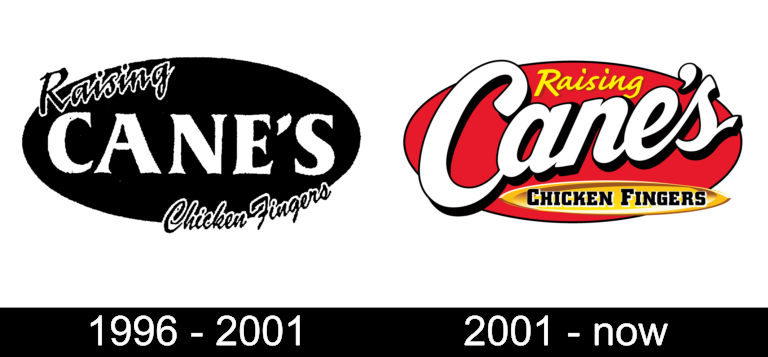
The original Raising Cane’s logo was purely typographic. “Raising” appeared in a loose cursive script, adding a personal, almost handwritten feel. “Cane’s” was rendered in heavier lettering, grounding the composition and giving it visual authority. A descriptive tagline sat beneath, clearly stating the restaurant’s focus.
Executed in black and white, the logo prioritized legibility and adaptability. It worked equally well on storefronts, highway signs, menus, and packaging. This early identity mirrored the brand itself at the time: small, focused, approachable, and purpose-driven.

2001–Today: Red Oval Identity and Visual Confidence
In 2001, the logo evolved into the form widely recognized today. A bold red oval background was introduced, instantly increasing visibility. “Raising” shifted to a warm yellow, italicized script, while “Cane’s” became a bold white cursive wordmark outlined in black and slightly tilted forward.
The tagline remained, reinforcing continuity. Red brought urgency and energy, yellow added warmth, and black-and-white outlines ensured contrast and clarity. This redesign did not change the brand’s personality—it amplified it. The result was a logo that felt louder and more confident without becoming complicated.
Typography and Color Palette
Raising Cane’s typography combines multiple custom styles into a single cohesive system. The main “Cane’s” wordmark uses a thick, shadowed cursive with rounded terminals, conveying friendliness and motion. The “Raising” script is lighter and more playful, while the tagline relies on strong uppercase lettering with squared serifs for stability.
The color palette is unapologetically bold. Red dominates, signaling energy and appetite. Yellow introduces warmth and optimism. Black and white provide structure and legibility. Together, these colors create a logo description that is instantly recognizable and highly functional across environments.
Raising Cane’s Logo as a Study in Consistent Simplicity
The Raising Cane’s logo history shows what happens when a brand understands itself early and stays disciplined. Rather than chasing visual trends, Raising Cane’s refined a strong core idea and let consistency do the work. The logo did not evolve because it needed correction, but because the brand gained confidence.
In an industry crowded with constant reinvention, Raising Cane’s proves that clarity, culture, and focus can build one of the most durable visual identities in fast food. Its logo heritage is not about transformation. It is about commitment.
FAQ: Raising Cane’s Logo Meaning and History
What does the Raising Cane’s logo represent?
The logo represents energy, friendliness, and focus, reflecting the brand’s simple approach to fast food.
Why is Raising Cane’s logo red and yellow?
Red conveys energy and appetite, while yellow adds warmth and approachability, reinforcing the brand’s welcoming atmosphere.
Has the Raising Cane’s logo changed much over time?
No. The logo has remained largely consistent since 2001, with only one major update from the original version.
Is Raising Cane’s named after a dog?
Yes. The brand is named after founder Todd Graves’ yellow Labrador, Cane, symbolizing loyalty and friendliness.