
Prime Video Logo History: Meaning, Symbolism & Brand Heritage
Prime Video is a rare example of a global streaming platform whose identity evolved in parallel with the strategic repositioning of its parent company. What began as a modest video download experiment inside Amazon’s ecosystem gradually transformed into one of the world’s most influential streaming services. This evolution is clearly reflected in the Prime Video logo history, where each redesign corresponds to a shift in scope, ambition, and market positioning.
Unlike brands that launch with a fully formed visual system, Prime Video’s logo heritage developed incrementally. Early versions leaned heavily on Amazon’s master brand, while later iterations asserted independence without abandoning lineage. This trajectory mirrors patterns seen in Netflix logo history and the ecosystem-driven clarity explored in Apple TV logo history, placing Prime Video firmly within the modern streaming logo history landscape.
Meaning and History: The Origin of the Prime Video Identity
Prime Video traces its origin to 2006, when Amazon introduced Unbox, a video download service designed to complement its growing digital marketplace. At that stage, the platform was transactional rather than experiential, focused on ownership rather than streaming. The visual identity reflected this limitation, functioning more as a sub-label than a standalone brand.
Between 2008 and 2015, the service underwent multiple renames—Amazon Video on Demand and Amazon Prime Instant Video—each reflecting a gradual shift toward subscription-based access. The introduction of Amazon Prime Instant Video marked a decisive step toward a model centered on continuous value rather than individual purchases.
The defining transformation occurred in 2017, when the platform adopted the Prime Video name and launched globally in a unified form. From that moment, Prime Video was positioned not merely as a feature of Amazon Prime, but as a competitive streaming destination. The logo meaning had to evolve accordingly, moving away from descriptive labels toward a symbol of premium entertainment.
Logo Symbolism: From Marketplace Utility to Entertainment Confidence
Prime Video logo symbolism is rooted in reassurance and accessibility. Early designs emphasized function, clearly communicating “video” and “on demand” through literal cues such as play buttons and descriptive taglines. These elements reduced ambiguity at a time when digital streaming was still unfamiliar to many users.
As the service matured, symbolism shifted toward confidence and emotional connection. The iconic Amazon arrow-smile became central, transforming from a navigational cue into a unifying underline. Stretching from letter to letter, the arrow suggests continuity, satisfaction, and range, echoing Amazon’s long-standing promise of breadth and reliability.
Blue gradually replaced green as the dominant color. While green initially signaled media playback, blue introduced associations with trust, stability, and professionalism, aligning Prime Video more closely with premium entertainment rather than digital retail.
Prime Video Logo History Timeline
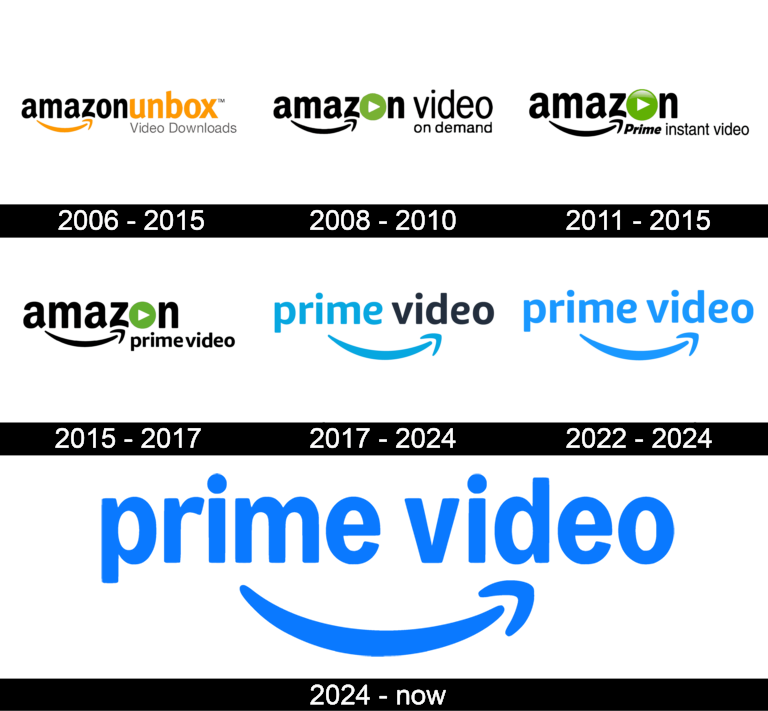
2006–2015: Amazon Unbox and Early Video Identity
The first logo associated with Prime Video appeared in 2006 with Amazon Unbox. It featured Amazon’s black lowercase wordmark with the signature orange arrow, paired with an orange “Unbox” inscription and a descriptive “Video Downloads” tagline. The logo functioned as a product descriptor rather than a brand, clearly tied to Amazon’s retail identity.

2008–2010: Amazon Video On Demand and Playback Symbolism
In 2008, the service was renamed Amazon Video on Demand. The logo introduced a green circular play button replacing the “O” in Amazon, reinforcing the shift toward streaming. Typography became more structured, while the “On Demand” tagline clarified the platform’s evolving function.

2011–2015: Amazon Prime Instant Video and Subscription Emphasis
The 2011 redesign coincided with the launch of Amazon Prime Instant Video. The logo featured a more dimensional green play button and emphasized the word “Prime,” signaling premium access. This version marked the transition from individual transactions to subscription-based consumption, a pivotal moment in the platform’s origin story.

2015–2017: Prime Video Name Consolidation
In 2015, the service adopted the Prime Video name. The logo simplified, placing “Prime Video” beneath the Amazon wordmark. The play button returned to a flatter design, reflecting broader trends in digital minimalism. This iteration prepared the brand for global expansion.

2017–2024: Independent Identity and Amazon Arrow Integration
The 2017 redesign represented a turning point. The Amazon wordmark was removed entirely, leaving “prime video” as a standalone name. The blue arrow-smile underlined the inscription, visually linking the platform to Amazon while allowing Prime Video to operate as an independent entertainment brand.

2022–2024: Typographic Emphasis and Premium Signal
A refinement introduced in 2022 emphasized the word “prime” through heavier typographic weight, subtly reinforcing exclusivity. The blue palette became more cohesive, and the arrow-smile gained prominence as the primary symbolic element.

2024–Today: Narrowed Forms and Confident Minimalism
The latest update sharpened the identity further. Letterforms were narrowed, and the blue became more intense, enhancing legibility across screens while conveying confidence. The overall structure remained unchanged, reinforcing continuity within the Prime Video logo heritage.
Typography and Color: Trust, Range, and Digital Clarity
Prime Video’s typography is based on Amazon’s corporate sans-serif system, optimized for clarity across interfaces. The lowercase execution softens the brand’s tone, making it approachable despite its scale.
Color plays a critical role in logo description. Blue dominates the current palette, signaling reliability and quality, while black provides balance and authority. The restrained palette ensures versatility across devices, from mobile apps to smart TVs.
Prime Video Logo Heritage and Streaming Authority
The Prime Video logo history illustrates how a platform can evolve from a utilitarian feature into a global entertainment brand without severing its roots. Each redesign refined rather than replaced meaning, preserving lineage while adapting to new expectations.
Within the broader context of streaming logo heritage, Prime Video stands out for its gradual, strategic evolution. Its logo meaning reflects confidence earned through scale and consistency, proving that strong brand heritage in digital media is built over time, not announced overnight.
FAQ: Prime Video Logo Meaning and History
What does the Prime Video logo represent?
The logo represents premium streaming entertainment, combining Amazon’s signature arrow with a confident, standalone identity.
Why was the Amazon name removed from the Prime Video logo?
The removal signaled Prime Video’s evolution into an independent global streaming brand while retaining visual ties to Amazon.
When did Prime Video get its current logo concept?
The current concept was introduced in 2017 and refined through subsequent updates.
What does the arrow under the Prime Video logo mean?
The arrow symbolizes satisfaction, continuity, and Amazon’s promise of range and reliability.