Phoenix Mercury Logo History: Meaning, Symbolism & Brand Heritage

Few franchises in women’s basketball have reshaped the game as aggressively and unapologetically as the Phoenix Mercury. From the very beginning, the team’s identity has been tied to speed, offensive freedom, and star-driven excellence. As one of the original franchises of the Women’s National Basketball Association, the Mercury built a culture where innovation was not optional—it was expected.
Sharing a home court and ownership ties with the Phoenix Suns, the Mercury developed a brand that feels unmistakably Arizona: intense, sun-drenched, and relentless. Much like the dynastic runs seen with the Los Angeles Sparks or the Seattle Storm, Phoenix combined elite talent with a clearly defined visual and philosophical identity. At the center of that identity stands a logo heritage that mirrors speed, heat, and constant motion.
Meaning and History: A Franchise Built for Offense and Impact
Founded in 1997, the Phoenix Mercury entered the league as one of its original teams and reached the WNBA Finals just one year later. While early success hinted at potential, true dominance arrived in the late 2000s. The Mercury captured their first championship in 2007, followed by titles in 2009 and 2014, placing them among the most decorated teams in league history.
The 2014 season, in particular, cemented the franchise’s legend. A record-setting 29 regular-season wins and an almost impenetrable home record turned Phoenix into a benchmark for offensive basketball. Led by icons such as Diana Taurasi and Penny Taylor, the Mercury embraced pace, spacing, and fearless shot-making long before it became league-wide doctrine.
The logo meaning evolved alongside this philosophy. The Mercury name itself references speed and transformation, drawn from Roman mythology. Visually, the franchise leaned into planetary motion, orbiting forms, and diagonal typography to express momentum rather than tradition. This approach set Phoenix apart from more heritage-driven identities and made its brand instantly recognizable.
Phoenix Mercury Logo History Timeline
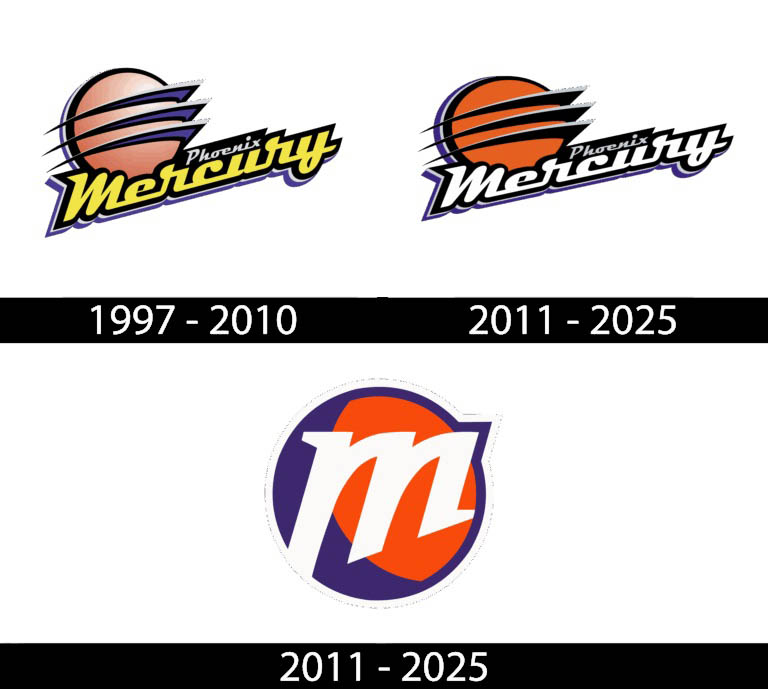
1997–2010: Planetary Motion and the Birth of a Fast Identity
The original Phoenix Mercury logo introduced a concept unlike anything else in the league. At its center sat an orange planet that doubled as a basketball, encircled by blue rings suggesting orbit and velocity. This planetary imagery directly reinforced the Mercury name, while also symbolizing constant movement and speed.
Below the planet, the wordmark appeared on a slight diagonal, adding forward momentum. “Phoenix” was rendered in small white lettering on a black base, while “Mercury” dominated the composition in a large, flowing cursive script. Executed in bright yellow with black and blue outlines, the lettering radiated energy and confidence. This logo defined the franchise’s early years and aligned perfectly with its offensive-minded evolution.

2011–2025: Refinement and Modern Authority
In 2011, the Mercury refined rather than reinvented their visual identity. The overall structure remained intact, but the color palette shifted toward maturity. Yellow gave way to white in the “Mercury” script, orange moved closer to a traditional basketball tone, and blue accents were replaced with black.
These changes simplified the logo and increased versatility across uniforms and merchandise. The identity became sharper and more authoritative, reflecting a franchise that had already proven itself on the court.

2025–Today: Precision, Legacy, and Digital Readiness
The most recent redesign, introduced in late 2025, marked a deliberate step toward modern minimalism. The flowing script was replaced by a crisp, angular “M” positioned above a simplified planetary form. Curves gave way to sharper lines, signaling focus and control.
A richer purple emerged as a core color, tying the redesign back to the franchise’s long-standing palette while updating it for contemporary digital use. The result is an emblem built for scalability—clean on jerseys, adaptable for social platforms, and unmistakably Mercury.
Logo Symbolism: Speed, Heat, and Controlled Chaos
The Phoenix Mercury logo symbolism has always revolved around motion. The planet-and-orbit motif communicates velocity and inevitability, while diagonal typography reinforces progression. Unlike mascots rooted in animals or landmarks, Mercury’s symbolism is abstract, universal, and future-facing.
Color plays a critical role. Orange and yellow convey heat, energy, and aggression, while black adds authority and balance. The recent introduction of deeper purple tones signals maturity and confidence, aligning with a franchise secure in its legacy.
Typography evolution tells a parallel story. The early cursive script suggested flair and freedom, mirroring Phoenix’s offensive creativity. The modern angular “M” reflects discipline, precision, and sustained excellence—traits forged through championships rather than promises.
A Logo Heritage That Moves as Fast as the Game
The Phoenix Mercury logo history stands as one of the most coherent visual narratives in women’s professional sports. Each redesign respected the franchise’s core values while adapting to new eras, technologies, and expectations. From orbiting planets to razor-sharp monograms, the Mercury identity never lost sight of what it represents: speed, boldness, and transformation.
Within the broader WNBA logo heritage, Phoenix occupies a unique position. It is neither nostalgic nor ornamental. Instead, it is relentlessly forward-moving—much like the team that wears it.
FAQ: Phoenix Mercury Logo Meaning and History
What does the Phoenix Mercury logo represent?
The logo represents speed, motion, and intensity, inspired by planetary orbit and the Roman god Mercury.
How many championships have the Phoenix Mercury won?
The Phoenix Mercury have won three WNBA championships.
When was the Phoenix Mercury logo redesigned most recently?
The most recent redesign was introduced in 2025.
Why does the logo feature planetary elements?
Planetary imagery reinforces the Mercury name and symbolizes velocity, transformation, and constant motion.