
Phillips 66 Logo History: Meaning, Symbolism & Brand Heritage
Phillips 66 is one of those rare corporate brands whose visual identity is inseparable from American history itself. Founded in 1927 and headquartered today in Houston, Texas, the company grew alongside the expansion of the U.S. highway system, the automobile industry, and the nation’s energy infrastructure. While many energy companies rely on abstract symbols or corporate minimalism, Phillips 66 chose a radically different path: it embraced geography, speed, and heritage.
The Phillips 66 logo is not just a corporate emblem. It is a visual snapshot of early 20th-century America, evoking road trips, gasoline stations, and the rise of mobility. Throughout decades of economic, technological, and industrial change, the company has remained remarkably loyal to its visual roots. The Phillips 66 logo history is therefore a story of continuity, symbolism, and respect for legacy.
Meaning and History of the Phillips 66 Logo
The name “Phillips 66” itself is steeped in factual and symbolic meaning. It originates from a series of coincidences that later became foundational to the brand’s identity. The gasoline developed by the company had a specific gravity close to 66. During testing, a vehicle powered by that fuel reached a speed of 66 miles per hour. The test itself took place on U.S. Route 66, one of the most iconic highways in American history.
Rather than distancing itself from these associations, the company embraced them. From its earliest days, Phillips 66 positioned itself not only as an energy producer but also as a companion to American mobility. This philosophy became deeply embedded in the Phillips 66 logo meaning, where the visual language draws directly from highway signage and national infrastructure.
Phillips 66 Logo Evolution Timeline
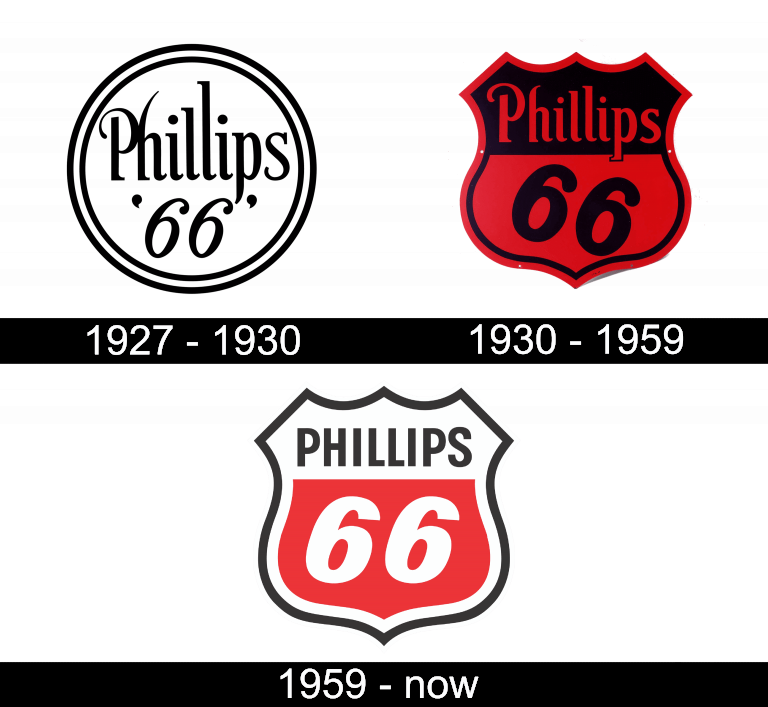
1927 – 1930: Inspiration from America’s New Highways
The earliest Phillips 66 logo emerged at a time when Route 66 itself was brand new. U.S. Route 66 officially became part of the federal highway system in 1926, and its road signs quickly became recognizable symbols of progress and connectivity.
The company’s earliest visual marks borrowed heavily from these signs. Shield-shaped forms appeared, echoing the design language used on American highways. Even at this early stage, the connection between the brand and the road was unmistakable, establishing the foundation of Phillips 66 logo heritage.

1930 – 1959: Decorative Script and Nostalgic Identity
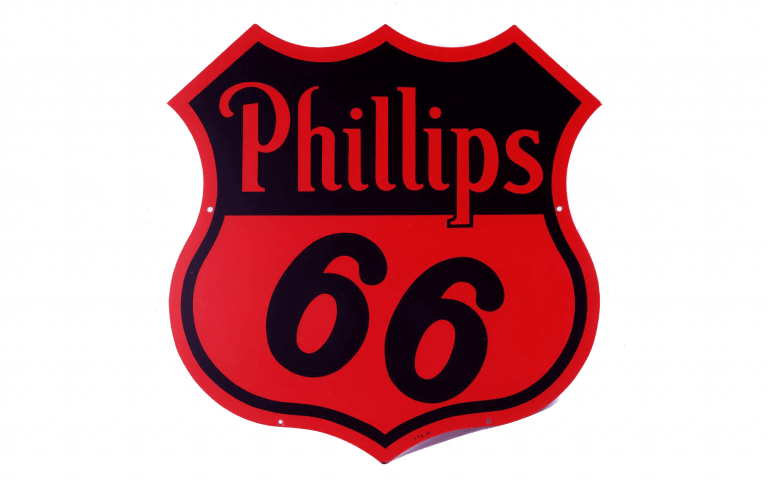
In 1930, Phillips 66 officially adopted the logo that would define its identity for decades. The emblem was based on a shield shape nearly identical to Route 66 road signs. The shield featured three peaks at the top, curved sides, and a single pointed base, a form that conveyed strength and direction.
The lower portion of the shield contained the number “66,” tilted slightly to create a sense of movement. The upper section displayed the word “Phillips” in a decorative script that contrasted sharply with the utilitarian typography of road signs. Letters featured curved strokes, uneven heights, and playful serifs, giving the logo a handcrafted, almost theatrical feel.
The color palette combined deep red and black, creating a dramatic and somewhat nostalgic appearance. While visually rich, this version increasingly felt outdated by the mid-20th century, especially as the energy industry became more modern and industrialized.
1959 – Present: Simplification and Timeless Recognition
By 1959, it became clear that the ornate logo no longer aligned with the company’s evolving identity. Rather than abandoning the iconic shield, designers chose to refine it.
The decorative script was replaced with a clean, minimalist sans-serif typeface. The number “66” remained slightly tilted but was visually stabilized through alignment and simplification. The heavy black-and-red palette was softened by introducing white, reducing visual weight while improving legibility.
This redesign struck a perfect balance. It preserved the historical structure of the logo while giving it a timeless, modern appearance. Remarkably, this version of the Phillips 66 logo has remained essentially unchanged for more than six decades, a rare achievement in corporate branding.
Phillips 66 Logo Symbolism
The Phillips 66 logo symbolism is deeply tied to American travel and infrastructure. The shield shape represents protection, reliability, and endurance, qualities essential to an energy company operating at national scale.
The number “66” is both literal and symbolic. It references Route 66, speed, performance, and the golden age of American road travel. Unlike abstract energy logos, Phillips 66 communicates its story instantly, even to those unfamiliar with the company’s history. This clarity is a cornerstone of its logo heritage.
Typography and Color
Typography plays a crucial role in the logo’s longevity. Since 1959, Phillips 66 has used a restrained sans-serif typeface that feels functional and confident. Its simplicity ensures readability across signage, fuel stations, and digital platforms.
The color palette is equally intentional. Red conveys energy, power, and motion, while white introduces balance and clarity. Black, once dominant, was reduced to accents, making the logo less heavy and more adaptable. This controlled palette reinforces both tradition and modernity.
Phillips 66 and the Strength of Visual Continuity
The Phillips 66 logo history demonstrates how deeply rooted symbolism can outlast trends. By anchoring its identity in national heritage and refining rather than reinventing its emblem, Phillips 66 built one of the most enduring logos in the energy sector.
Its logo heritage proves that authenticity and continuity can be more powerful than constant reinvention. In a rapidly evolving industry, Phillips 66 stands as a visual reminder that strong design, when grounded in history, becomes timeless.
Phillips 66 Logo FAQ
What does the Phillips 66 logo represent?
It represents American mobility, energy, and heritage, inspired by U.S. Route 66.
Why is the Phillips 66 logo shaped like a shield?
The shield mirrors historic Route 66 road signs and symbolizes protection and reliability.
What does the number 66 stand for?
It refers to gasoline performance, testing speed, and U.S. Route 66.
When was the current Phillips 66 logo introduced?
The modern version was introduced in 1959 and remains in use today.
Why hasn’t Phillips 66 changed its logo much?
Because the logo is deeply tied to its history and remains instantly recognizable.