Payoneer Logo History: Meaning, Symbolism & Brand Heritage
Payoneer entered the financial world in 2005 with a clear mission: to make cross-border payments simple, fast, and accessible to everyone. Long before global freelancing, online marketplaces, and cross-border e-commerce became mainstream, Payoneer positioned itself as a bridge between individuals, small businesses, and international platforms. Built in New York and expanded across more than 200 countries, the company grew from a small startup into a global financial network serving millions.
Its logo has mirrored this evolution. What began as a straightforward wordmark with a signature orange checkmark eventually transformed into a modern, vibrant identity meant to reflect a more progressive and inclusive global brand. Understanding how the Payoneer logo changed over the years reveals not only the company’s design language but also its journey from a niche payment solution to a universal financial ecosystem.
Meaning and Brand Identity
At its core, Payoneer represents global connectivity. The service enables users from virtually any country to send and receive money in more than 150 currencies, whether through bank transfers, e-wallet services, or prepaid MasterCard debit cards. Freelancers, Amazon sellers, digital entrepreneurs, and multinational companies rely on Payoneer for its flexibility, speed, and low-friction transactions.
The brand has always emphasized transparency, accessibility, and the removal of international barriers. These values sit at the heart of Payoneer’s visual identity and continue to shape how the company presents itself.
Logo Evolution Through the Years
Early Identity — Before 2021
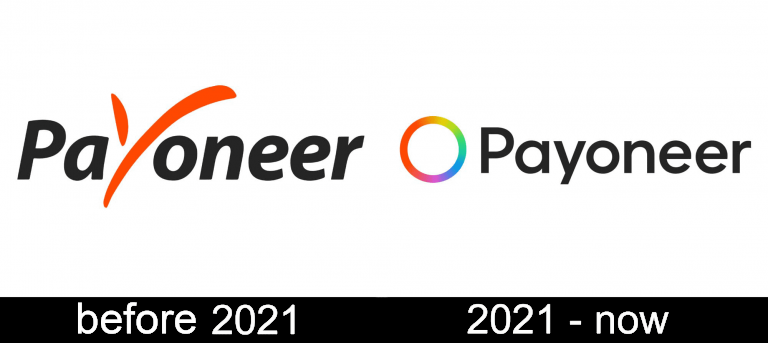
For more than fifteen years, Payoneer’s main visual signature was a bold, italicized wordmark inspired by Myriad Pro Bold Italic. The distinguishing feature was the bright orange checkmark that replaced the letter “Y.” This sweeping mark extended above the other letters, symbolizing approval, trust, and a user’s choice to rely on Payoneer’s services.
The company first introduced this identity in 2005, applied small refinements in 2014, and finalized its mature version in 2018. During these years, the logo represented reliability, honesty, and the company’s mission to simplify international commerce. Bright orange added energy and optimism, while the dark gray lettering communicated seriousness and technological confidence.
The wordmark originally appeared inside a checkered rectangular background but was eventually placed on a clean white surface for a more modern, minimal look. On mobile icons, Payoneer highlighted its identity through the orange checkmark centered on an orange square.

A New Direction — 2021 to Today
In 2021, Payoneer introduced a significant rebrand, shifting from its familiar checkmark-based wordmark to a fresh and contemporary visual identity. The transformation emphasized the company’s evolution beyond a payment solution into a full global financial platform.
The new emblem features a circular outline built from a smooth rainbow gradient. This ring suggests motion, inclusivity, and global reach. It symbolizes the continuous movement of money and ideas across borders — a visual metaphor for worldwide economic participation.
To the right of the emblem sits a clean wordmark in black or dark gray. The typography is modern, full-shaped, and confident. The contrast between the monochrome lettering and the colorful circular mark expresses the balance between reliability and innovation.
This new design direction presents Payoneer as friendly, progressive, and technologically advanced, while still grounded in trust and clarity.
Font and Color
Payoneer’s modern logotype uses a simple geometric sans-serif typeface similar to Kontora Bold, known for its balanced proportions and strong presence. Its rounded shapes and medium-weight strokes make the name approachable while maintaining a professional tone. Comparable styles include Carmen Sans Semi Bold, Kinetica Semi Bold, and Alacrity Sans Semibold.
Color has always played an essential role in Payoneer’s branding. The previous identity relied on a combination of dark gray and a bold orange checkmark that represented decision-making, energy, and reliability. The latest logo introduces a brighter, more dynamic gradient palette, blending hues across the rainbow spectrum. This shift reflects Payoneer’s expanding global community and its vision of a world where financial participation is open and universal.
The Evolution of a Global Financial Icon
Payoneer’s logo evolution mirrors the company’s growth from a startup serving freelancers to a worldwide financial ecosystem connecting millions of users. From the energetic checkmark of its early years to the colorful, inclusive circle of its modern identity, Payoneer continues to express stability, transparency, and global opportunity. The brand’s visual heritage stands as a reminder that meaningful design adapts with purpose, just as financial technology reshapes how the world works, earns, and trades.
FAQ Payoneer Logo
What does the Payoneer logo represent?
The Payoneer logo symbolizes global connectivity, open financial access, and the movement of money across borders. Its gradient circle represents inclusivity and worldwide participation.
Why did Payoneer change its logo in 2021?
The rebrand reflects Payoneer’s evolution into a broader financial ecosystem. The new design signals innovation, progress, and a more global, community-focused identity.
What font is used in the Payoneer logo?
The modern Payoneer wordmark uses a geometric sans-serif style similar to Kontora Bold, chosen for readability and contemporary appeal.
What do the colors of the Payoneer logo mean?
The rainbow gradient represents diversity, innovation, and an inclusive global network. It replaces the old orange checkmark, which previously symbolized trust and action.